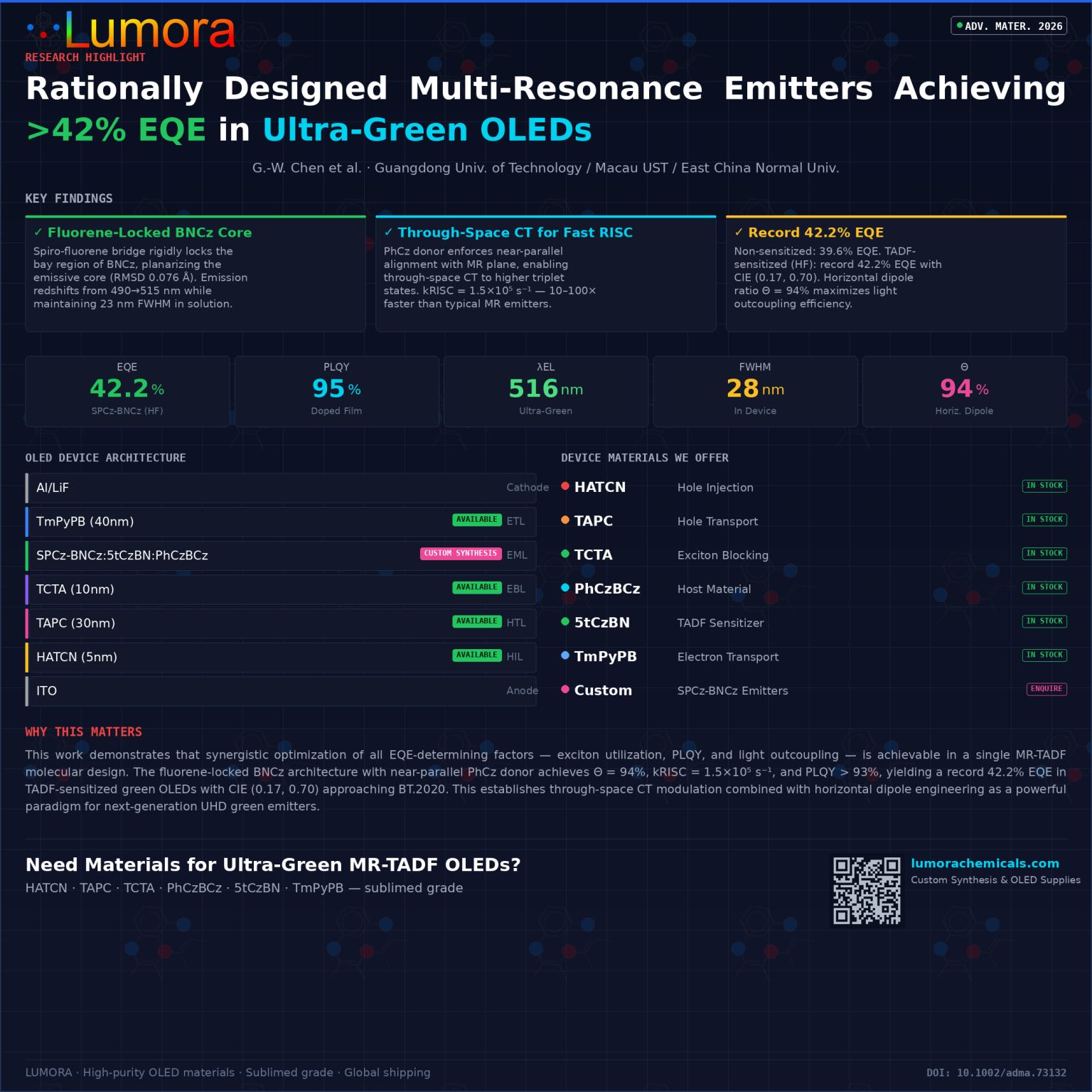
Why is it still difficult to make ultra-green MR-TADF OLEDs that are simultaneously narrowband, highly efficient, and outcoupling-optimized?
The core problem is that classic MR-TADF molecular design can narrow the emission spectrum, but it is difficult to simultaneously maximize exciton harvesting, suppress aggregation-caused quenching, and improve light outcoupling through horizontal dipole orientation in a real OLED device.
New work published in Advanced Materials by Chen, Tang, and co-workers shows that a fluorene-locked BNCz-based MR-TADF emitter can overcome this trade-off by combining rigid-core locking, through-space charge-transfer modulation, steric shielding, and near-horizontal transition dipole alignment within a single molecular architecture.
What they did
The authors designed SPCz-BNCz, a multi-resonance emitter in which a fluorene bridge rigidly locks the bay region of the BNCz core, while a planar N-phenyl-carbazol-3-yl donor is positioned nearly parallel to the emissive MR plane.
They combine:
1.Spiro-fluorene locking of the BNCz core, which planarizes and rigidifies the MR skeleton, suppresses structural relaxation and high-frequency vibration, and preserves ultranarrow green emission around 515 nm.
2.A compact face-to-face PhCz/BNCz arrangement that induces intramolecular through-space CT and high-lying CT triplet states, reducing DeltaE_ST and accelerating RISC without converting the emissive S1 state into a broad long-range CT state.
3.Steric shielding and ordered packing that suppress long-range pi-pi aggregation while keeping the transition dipole moment mainly in the molecular plane, giving a very high horizontal dipole ratio in doped films.
The emitter is then used in both non-sensitized OLEDs and sensitized hyperfluorescence-type OLEDs to exploit its narrow spectrum, high PLQY, fast triplet harvesting, and favorable outcoupling under device operating conditions.
What they achieved
- SPCz-BNCz shows ultra-green photoluminescence at 515 nm with a narrow FWHM of 23 nm in solution and 26 nm in doped film, while maintaining a high PLQY of about 92-93%.
- The non-sensitized OLED reaches 39.6% maximum EQE with EL at 516 nm, FWHM of 27 nm, and CIE coordinates of (0.17, 0.73), closely approaching the BT.2020 green region.
- With the TADF sensitizer 5tCzBN, the hyperfluorescence device reaches a record 42.2% EQE and suppresses roll-off, retaining 25.5% EQE even at 1000 cd m-2.
Altogether, the work shows that ultra-high-efficiency green MR-TADF OLEDs can be achieved when molecular rigidity, excited-state engineering, aggregation control, and dipole orientation are designed together rather than optimized separately.
What's worth taking from this
The central message is that efficient green MR-TADF OLEDs are not limited solely by emitter color purity; they are limited by whether the molecular design can globally optimize exciton lifetime and PL simultaneously.
By moving from simple peripheral shielding to a spatially locked donor-core architecture, the authors demonstrate that you can:
- Retain hallmark MR-TADF narrowband emission while using through-space CT to accelerate RISC and improve triplet harvesting.
- Suppress ACQ through steric shielding and discrete dimer packing without sacrificing horizontal dipole orientation and outcoupling efficiency.
- Push green OLEDs toward BT.2020-level color purity and >40% EQE by treating molecular packing, excited-state dynamics, and device optics as one connected design problem.
For next-generation ultra-high-definition OLED displays, this paper reinforces the importance of molecular architectures that deliver not only narrow emission, but also fast RISC, high PLQY, strong horizontal orientation, and stable high-luminance operation.
📄 DOI: 10.1002/adma.73132
🔗 Paper: https://advanced.onlinelibrary.wiley.com/doi/10.1002/adma.73132
R&D and pilot quantities
We supply the key materials from this study in high-purity sublimed grades, from grams to kilograms, shipped worldwide.
Visit LUMORA →Kilogram to production, and custom MR-TADF
For large-scale supply, new emitter synthesis, and CRDMO support, work with LAMKO directly. Scope your project in the LUMI workspace, or send a partnership request.
Open LUMI workspace →Partner with us