Why do blue OLEDs still lag behind red and green after decades of work?
The core issue hasn't changed, high-energy blue emission destroys molecules faster than we can stabilize them, and every strategy that boosts efficiency tends to make lifetime worse.
New research published in Advanced Materials from Tsinghua University takes an interesting structural approach to this tradeoff. Not a solution, but a design idea worth paying attention to.
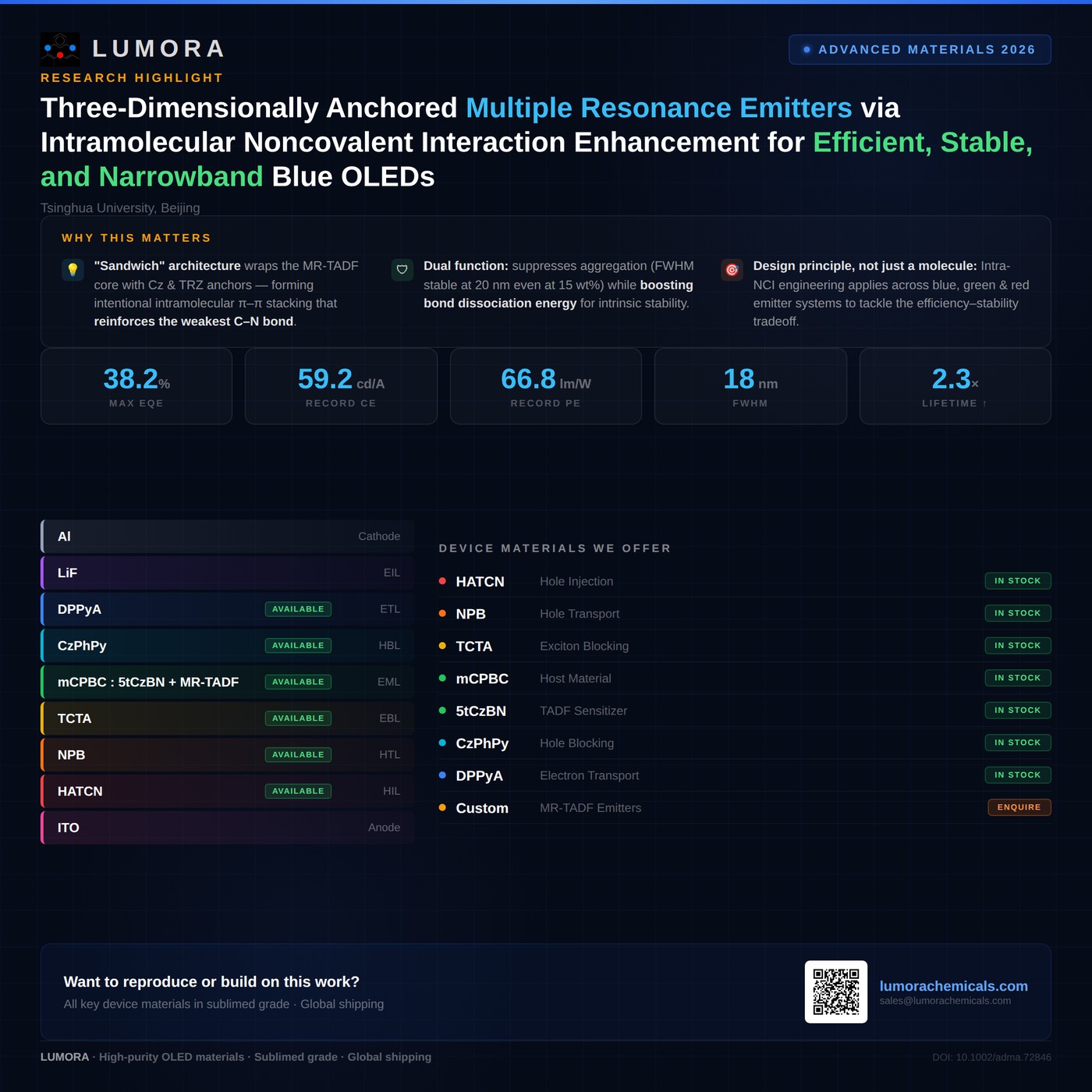
What they did: They wrapped an MR-TADF emissive core in a "sandwich" architecture using carbazole and triazine peripheral units. These aren't passive steric blockers, the triazine groups form deliberate intramolecular π-π stacking with the core, which strengthens the weakest C-N bond in the molecule while simultaneously tuning HOMO alignment with the TADF sensitizer.
One architecture addressing aggregation, energy-level mismatch, and bond fragility at the same time.
What they achieved (TRZ-BN-TRZ): > 38.2% EQE > 59.2 cd/A and 66.8 lm/W (record for blue MR-OLEDs, CIEy < 0.25) > 20 nm FWHM retained across 1-15 wt% doping > 2.3× lifetime improvement over the unwrapped reference
Promising numbers, though how this translates under prolonged electrical aging and at higher current densities remains to be seen.
What's worth taking from this: The specific molecules matter less than the principle, using intramolecular noncovalent interactions not as a byproduct of molecular geometry but as an intentional design tool to reinforce bond strength, suppress aggregation, and promote horizontal dipole orientation simultaneously. Whether you're working on blue, green, or red systems, that's a framework worth exploring.
Lots of papers tackle blue OLED stability. This one stands out for the clarity of the structure-property relationship it demonstrates.
R&D and pilot quantities
We supply the key materials from this study in high-purity sublimed grades, from grams to kilograms, shipped worldwide.
Visit LUMORA →Kilogram to production, and custom MR-TADF
For large-scale supply, new emitter synthesis, and CRDMO support, work with LAMKO directly. Scope your project in the LUMI workspace, or send a partnership request.
Open LUMI workspace →Partner with us