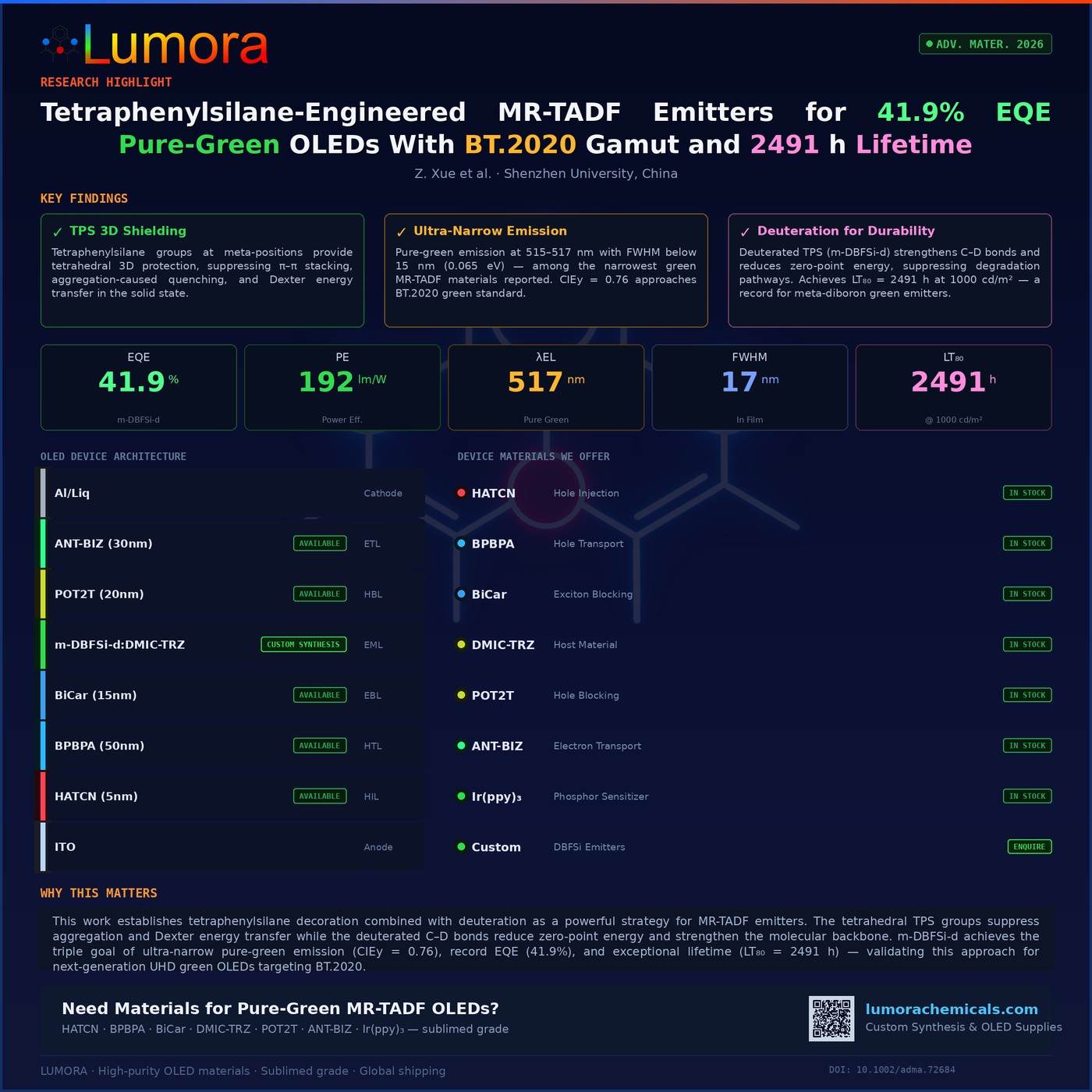
Why is it still difficult to make pure-green MR-TADF OLEDs that are simultaneously narrowband, efficient, and stable?
The central challenge is that green pixels for UHD displays must approach the BT.2020 green point while still maintaining high external quantum efficiency and long operational lifetime. Conventional green MR-TADF emitters can give narrow spectra, but many devices either fall short in CIEy, suffer from aggregation/vibronic shoulders, or lose operational stability when pushed toward ultra-pure green emission.
New work published in Advanced Materials by Xue, Hu, Yang, and co-workers shows that tetraphenylsilane (TPS) and deuterated TPS engineering can solve this trade-off by protecting a green MR-TADF core without destroying its multi-resonance emission character.
What they did
The authors designed three pure-green MR-TADF emitters, p-DBFSi, m-DBFSi, and m-DBFSi-d, by combining dibenzofuran-based π-extension with bulky TPS shielding around a meta-diboron MR skeleton.
They combine:
A dibenzofuran-embedded meta-diboron MR framework that narrows the bandgap and shifts the emission into the pure-green region while preserving the narrowband MR emission mechanism.
Tetraphenylsilane groups that form a three-dimensional steric shield around the emissive core, suppressing π-π stacking, aggregation-caused quenching, intermolecular coupling, and Dexter-type exciton losses.
Meta-linked TPS topology in m-DBFSi, which gives looser molecular packing and weaker vibronic coupling than the para-linked analogue, leading to better color purity and efficiency.
Deuterated TPS groups in m-DBFSi-d, where stronger C-D bonds and lower zero-point energy reduce vibrational degradation pathways and improve device lifetime.
Computationally, the emitters retain core-confined MR frontier orbitals, exhibit small structural relaxation between S0 and S1, have reduced Huang-Rhys factors, and exhibit weak vibronic coupling. Photophysically, they show sharp green PL at 515-517 nm, very narrow FWHM values of 14-15 nm in solution, small ΔEST values of 0.10 eV, high film PLQYs of 96-99%, and nearly horizontal transition dipole orientation in doped films.
What they achieved
- Pure-green bottom-emitting OLEDs using m-DBFSi and m-DBFSi-d reached EL peaks at 517 nm with FWHM values of only 17 nm, giving CIE coordinates of (0.15, 0.76) and (0.14, 0.76), close to the BT.2020 green target.
- The non-sensitized devices achieved outstanding efficiencies: EQEmax = 40.1% for m-DBFSi and 41.9% for m-DBFSi-d, with PEmax values of 187.5 and 191.8 lm W-1, respectively.
- The TPS structure improved concentration tolerance: compared with the TPS-free DBFBN control, m-DBFSi maintained more stable spectra and efficiency at higher doping concentrations, indicating reduced aggregation and intermolecular quenching.
- When Ir(ppy)3 was introduced as a phosphor sensitizer, the devices retained pure-green emission and showed greatly improved roll-off and durability.
- The sensitized m-DBFSi-d device achieved LT80 = 2491 h at an initial luminance of 1000 cd m-2, outperforming the non-deuterated m-DBFSi device and highlighting the benefit of deuterated TPS for operational stability.
Altogether, the work demonstrates a rare combination in green OLEDs: ultra-narrow emission, high CIEy, very high EQE, high power efficiency, and long lifetime in a single MR-TADF emitter platform.
What's worth taking from this
The key message is that TPS is not only useful as a host-material building block. When directly engineered into the MR-TADF emitter, TPS can act as a molecular protection unit that improves both photophysical quality and device durability.
By moving from simple peripheral substitution to steric-topology and isotope engineering, the authors show that pure-green MR-TADF emitters can be designed to:
Keep the MR core electronically confined, preserving narrow FWHM and high color purity.
Suppress molecular packing and aggregation without sacrificing radiative transition strength.
Reduce vibronic coupling and nonradiative decay through meta-linked TPS topology.
Extend device lifetime through deuteration, which stabilizes vulnerable C-H vibration-related degradation pathways.
Approach the BT.2020 green standard while still delivering EQE values above 40% without an additional sensitizer.
For next-generation UHD OLED displays, this paper reinforces that emitter-level steric protection and deuteration can be as important as spectral tuning itself. The practical lesson is clear: high-purity green MR-TADF OLEDs require not only a narrow emissive core, but also a molecular environment that prevents aggregation, suppresses vibronic loss, and resists operational degradation.
📄 DOI: 10.1002/adma.72684
🔗 Paper: https://advanced.onlinelibrary.wiley.com/doi/10.1002/adma.72684
Green pixels for #UHD displays must approach the #BT_2020 point while maintaining high EQE and long lifetime. MR-TADF emitters offer narrow spectra, but often miss CIEy, show aggregation/vibronic broadening, or lose stability at ultra-pure green.
New work in #Advanced_Materials by Xue, Hu, Yang, and co-workers shows that tetraphenylsilane (TPS) and deuterated TPS can resolve this trade-off by protecting the MR-TADF core without disrupting its emission.
What they did
They designed three emitters, p-DBFSi, m-DBFSi, and m-DBFSi-d, combining dibenzofuran π-extension with TPS shielding around a meta-diboron MR core.
They integrate:
Dibenzofuran-based MR framework for pure-green emission with narrow bandwidth.
TPS steric shielding to suppress π-π stacking, aggregation, and exciton loss.
Meta-linked TPS enabling looser packing and reduced vibronic coupling.
Deuterated TPS improving stability via reduced vibrational degradation.
The emitters show sharp PL (515-517 nm), FWHM 14-15 nm, ΔEST ≈ 0.10 eV, high PLQY (96-99%), and favorable dipole orientation.
What they achieved
- EL at 517 nm, FWHM ~17 nm, CIE (0.15, 0.76)/(0.14, 0.76), near BT.2020 green.
- EQEmax of 40.1-41.9% and PEmax up to 191.8 lm W⁻¹.
- Improved concentration tolerance vs TPS-free control.
- Sensitized devices retain color purity with better roll-off and durability.
- m-DBFSi-d achieves LT80 = 2491 h at 1000 cd m⁻², showing deuteration benefits.
This work demonstrates ultra-narrow emission, high CIEy, high EQE, and long lifetime in one MR-TADF system.
TPS acts as a molecular protection unit when built into the emitter.
With steric and isotope engineering, MR-TADF systems can:
· Preserve narrowband MR emission
· Suppress aggregation without losing efficiency
· Reduce vibronic loss
· Improve lifetime via deuteration
· Approach BT.2020 with EQE > 40%
For UHD OLEDs, emitter-level protection and deuteration are as important as spectral tuning.
📄 DOI: 10.1002/adma.72684
🔗 https://advanced.onlinelibrary.wiley.com/doi/10.1002/adma.72684
R&D and pilot quantities
We supply the key materials from this study in high-purity sublimed grades, from grams to kilograms, shipped worldwide.
Visit LUMORA →Kilogram to production, and custom MR-TADF
For large-scale supply, new emitter synthesis, and CRDMO support, work with LAMKO directly. Scope your project in the LUMI workspace, or send a partnership request.
Open LUMI workspace →Partner with us