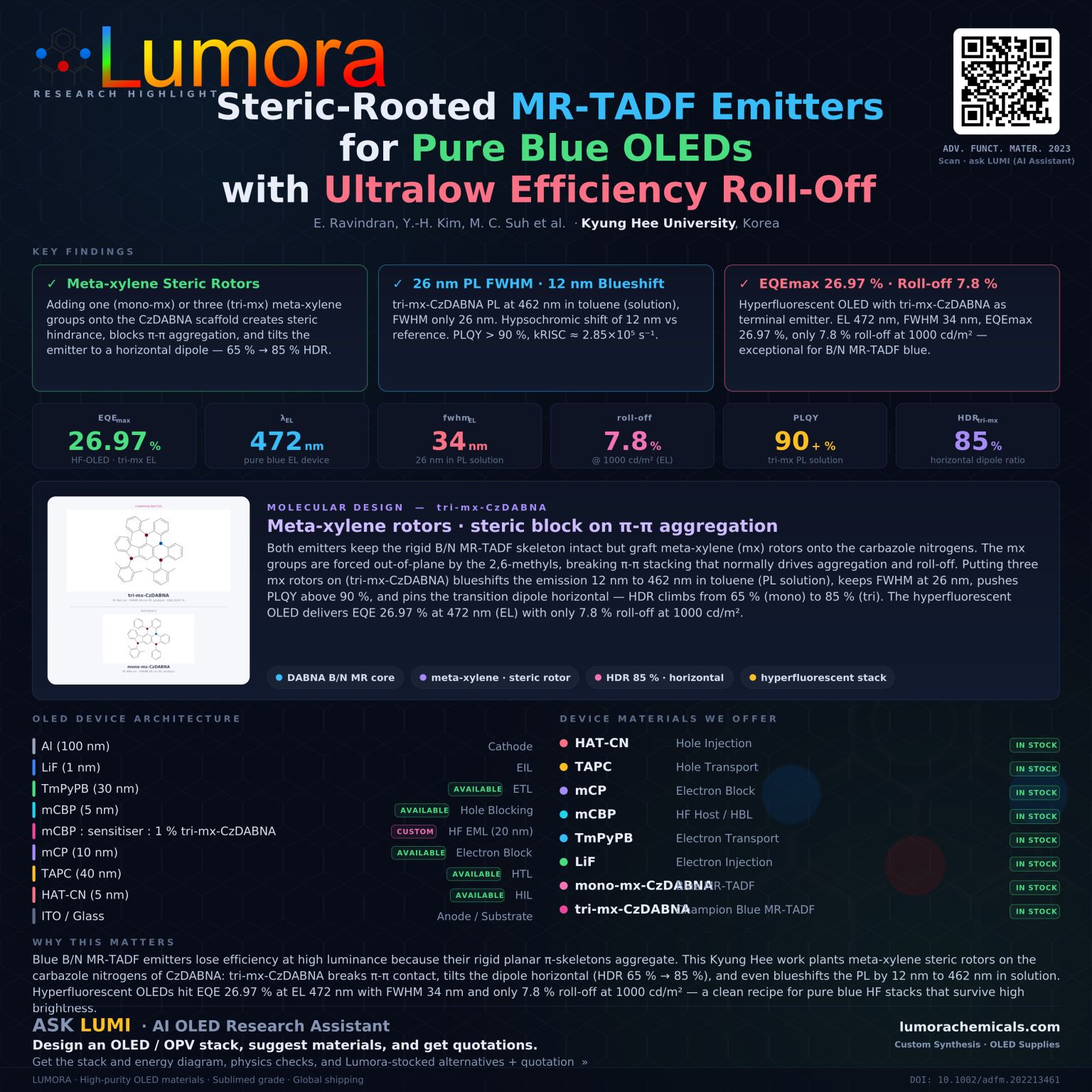
Record-level ultralow efficiency roll-off of just 7.8% at 1,000 cd/m²
Ravindran, Baek, Son, Park, Kim, and Suh, Advanced Functional Materials, 2023 "Steric Rooted Multi-Resonant Thermally Activated Delayed Fluorescent Emitters for Pure Blue Organic Light Emitting Diodes with Ultralow Efficiency Roll-Off"
At LUMORA CHEMICALS, we spotlight the scientific breakthroughs that push the boundaries of MR-TADF emitter design. This 2023 Advanced Functional Materials paper by Ezhakudiyan Ravindran, Ho Eon Baek, and colleagues from Kyung Hee University and Gyeongsang National University, also supported by Samsung Display, addresses one of the most critical unresolved challenges in MR-TADF OLEDs: the severe efficiency roll-off at high luminance caused by intermolecular pi-pi stacking interactions inherent to the rigid, planar MR-TADF molecular frameworks.
The Problem: pi-pi Stacking and Efficiency Roll-Off in MR-TADF OLEDs
MR-TADF emitters based on boron- and nitrogen-embedded PAH frameworks achieve outstanding color purity owing to their flat, rigid molecular geometry, but this planarity also drives strong intermolecular π-π stacking interactions, especially at the doping concentrations required for efficient devices. These interactions promote molecular aggregation, luminescence quenching, and long-lived triplet excitons that participate in triplet-triplet annihilation (TTA) and singlet-triplet annihilation (STA) at high luminance, causing dramatic EQE roll-off that limits real-world display performance. Achieving simultaneously high color purity, high PLQY, and low efficiency roll-off was widely considered an intrinsic trade-off in MR-TADF design prior to this work.
The Breakthrough: Ring-Fused Extended pi-Skeleton with Meta-Xylene Steric Rotors
Ravindran et al. introduced a new design strategy: grafting meta-xylene (mx) rotor units onto the DABNA-1 core while simultaneously extending the pi-skeleton by incorporating a carbazole unit into the ring-fused framework. The meta-xylene groups, with their methyl substituents, create dihedral twist angles of 76-89°, thereby sterically blocking π-π intermolecular stacking without disrupting the core MR electronic structure. Two new emitters were designed: mono-mx-CzDABNA (one meta-xylene rotor) and tri-mx-CzDABNA (three meta-xylene rotors). The three-rotor system tri-mx-CzDABNA shows a 12 nm hypsochromic (blue) shift relative to its mono-rotor counterpart, reduced reorganization energy (λ = 0.436 eV vs. 0.655 eV), dramatically suppressed nonradiative decay, and a remarkably enhanced horizontal dipole ratio (HDR) from 65% to 87%, all while maintaining the MR-TADF mechanism.
Key Photophysical & Device Results
- PL emission / FWHM: mono-mx-CzDABNA: 474 nm / 34 nm; tri-mx-CzDABNA: 462 nm / 26 nm pure blue narrowband emission in toluene
- PLQY (doped film, 3 wt% in mCBP): 83% for mono-mx-CzDABNA; 91% for tri-mx-CzDABNA higher than DABNA-1
- kRISC: Approximately 2.85 x 10⁵ s-1 for both emitters, exceeding known single-boron and double-boron MR-TADF benchmarks
- Horizontal dipole ratio (HDR): 65% for mono-mx-CzDABNA; 87% for tri-mx-CzDABNA a key driver of enhanced out-coupling efficiency
- HF-OLED EQE (tri-mx-CzDABNA): EQEmax 26.97%; 26.1% at 100 cd/m²; 24.8% at 1,000 cd/m² EL at 472 nm, FWHM 34 nm, CIE (0.13, 0.19)
- Efficiency roll-off: Only 7.8% at 1,000 cd/m² record-level among MR-TADF-based hyperfluorescent OLEDs reported at the time
- Thermal stability: Td > 370°C for both emitters; tri-mx-CzDABNA shows no Tg transition up to 300°C suitable for vacuum deposition
Why This Matters for OLED Material Supply
This work demonstrates that steric engineering using bulky meta-xylene substituents is a powerful, practical strategy for suppressing pi-pi aggregation in MR-TADF emitters without sacrificing MR electronic characteristics. The hyperfluorescent (HF) OLED architecture employed here ITO / NPB / TCTA / mCP / mCBP:PPCzTrz:MR-TADF / TSPO1 / Bphen / LiF / Al, introduces PPCzTrz as a deep-blue TADF sensitizer (ET = 2.84 eV, short triplet lifetime of 25 us) as a critical layer that enables efficient Forster energy transfer to the MR-TADF terminal emitter while suppressing triplet accumulation. LUMORA CHEMICALS supplies the mono-mx-CzDABNA and tri-mx-CzDABNA emitters, the PPCzTrz sensitizer, mCBP host, and all supporting charge transport materials, including NPB, TCTA, mCP, TSPO1, and Bphen, to support research and manufacturing teams developing next-generation pure blue hyperfluorescent OLED devices.
Reference: Ravindran, E.; Baek, H. E.; Son, H. W.; Park, J. H.; Kim, Y.-H.; Suh, M. C. Adv. Funct. Mater. 2023, 33, 2213461. DOI: 10.1002/adfm.202213461
Target Molecules: IUPAC Names & Identifiers
mono-mx-CzDABNA
11-(2,6-Dimethylphenyl)-9,16-diphenyl-11,16-dihydro-9H-9,11,16-triaza-4b-boraindeno[1,2-a]naphtho[3,2,1-de]anthracene
C₄₆H₃₃BN₃MW: ~661 g/mol
tri-mx-CzDABNA
9,11,16-Tris(2,6-dimethylphenyl)-11,16-dihydro-9H-9,11,16-triaza-4b-boraindeno[1,2-a]naphtho[3,2,1-de]anthracene
C₅₆H₄₅BN₃MW: ~793 g/mol
R&D and pilot quantities
We supply the key materials from this study in high-purity sublimed grades, from grams to kilograms, shipped worldwide.
Visit LUMORA →Kilogram to production, and custom MR-TADF
For large-scale supply, new emitter synthesis, and CRDMO support, work with LAMKO directly. Scope your project in the LUMI workspace, or send a partnership request.
Open LUMI workspace →Partner with us