Why does achieving efficient, narrowband MR-TADF emission remain difficult without shifting the emission color or increasing molecular complexity?
The core problem is that many blue MR-TADF emitters exhibit narrow emissions, but reducing the singlet-triplet energy gap, improving RISC, preserving the same color, and maintaining device efficiency simultaneously remain challenging. Strategies such as multiple-boron frameworks, heavy peripheral substitution, or extensive device optimization can work, but they often increase synthetic complexity and do not always solve spectral broadening or stability issues.
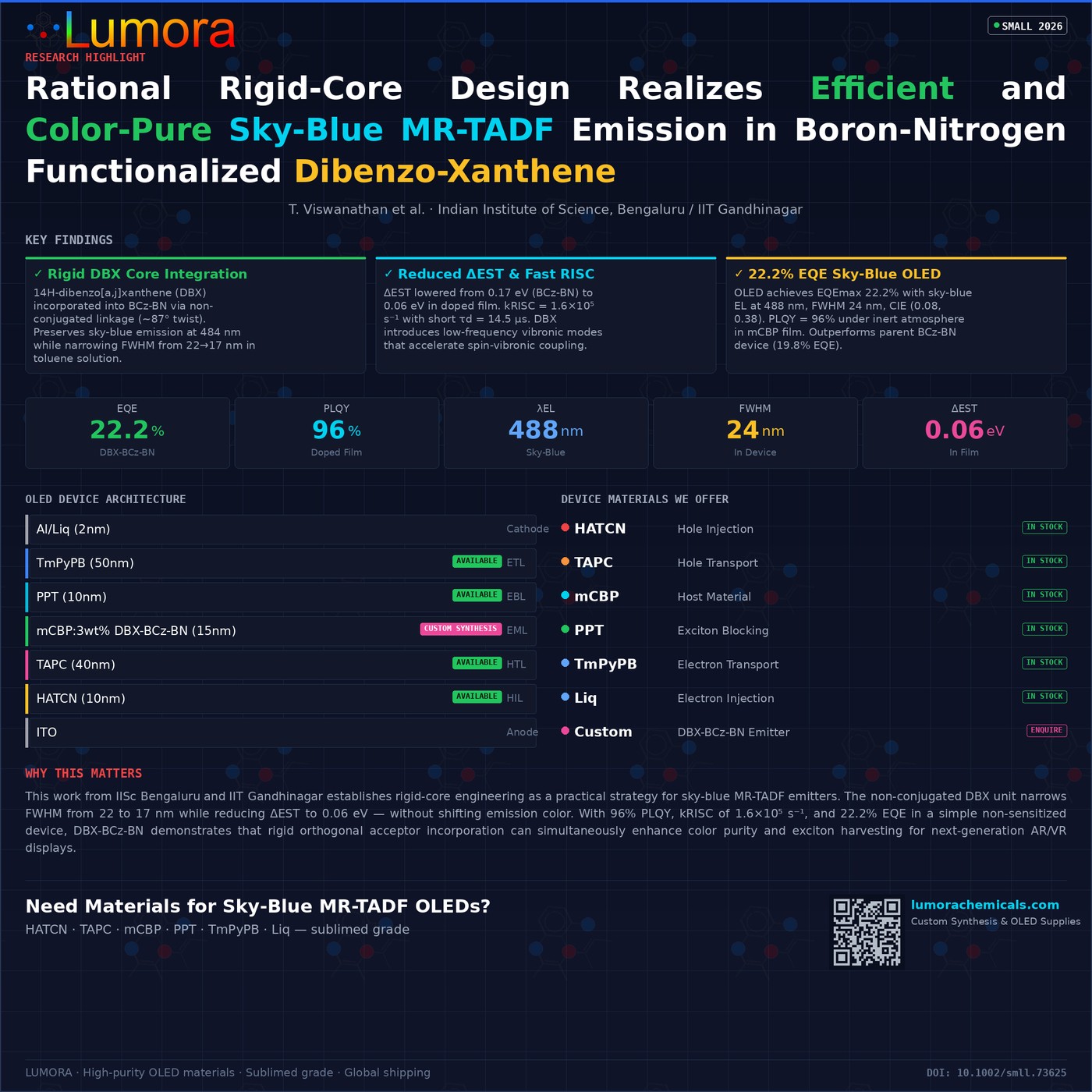
New work published in Small by Viswanathan, Rajamalli, and co-workers shows that rigid-core engineering can solve this problem through a relatively simple structural modification: inserting a rigid 14H-dibenzo[a,j]xanthene (DBX) unit into the BCz-BN multi-resonance framework to create DBX-BCz-BN.
What they did
The authors designed DBX-BCz-BN by connecting a bulky and rigid DBX core to the BCz-BN MR-TADF skeleton at the para-position through a highly twisted, non-conjugated architecture.
They combine:
1. A rigid DBX core that increases structural rigidity and steric protection while suppressing excessive geometric relaxation in the excited state.
2. A highly twisted geometry of about 87° between the DBX fragment and BCz-BN core, which prevents strong pi-conjugation and helps preserve the intrinsic MR-type narrowband emission.
3. A controlled electronic perturbation in which the LUMO subtly extends over the DBX and BCz-BN units, lowering ΔEST in the doped film and supporting faster reverse intersystem crossing.
4. Additional low-frequency vibrational modes introduced by the DBX unit, which promote spin-vibronic coupling and help accelerate RISC without destroying the narrow emission profile.
The molecule was synthesized through a three-step route, purified by high-vacuum sublimation, and evaluated by photophysics, DFT/TD-DFT calculations, electrochemistry, thermal analysis, and OLED device fabrication.
What they achieved
- In toluene solution, DBX-BCz-BN showed sky-blue emission at 484 nm with an ultra-narrow FWHM of 17 nm and a small Stokes shift of 16 nm, indicating limited excited-state relaxation.
- In a 3 wt.% mCBP film, the emitter showed emission at 491 nm, ΔEST of 0.06 eV, a high PLQY of 96% under an inert atmosphere, a prompt lifetime of 6.1 ns, and a delayed lifetime of 14.5 µs in air.
- The calculated kRISC reached 1.6 × 10⁵ s-1, while the delayed lifetime became much shorter than that of the parent BCz-BN, showing that DBX incorporation improves triplet harvesting and reduces triplet accumulation.
- The DBX-BCz-BN OLED achieved a maximum EQE of 22.2%, turn-on voltage of 3.5 V, maximum luminance of 10104 cd m-2, CE of 37.4 cd A-1, and PE of 33.6 lm W-1.
- The device maintained stable sky-blue electroluminescence at 488 nm with a narrow FWHM of 24 nm and CIE coordinates of (0.08, 0.38), outperforming the parent BCz-BN device in EQE and spectral sharpness under the same fabrication conditions.
- DBX-BCz-BN also showed strong thermal robustness, with Td = 511 °C and Tg = 165 °C, supporting its suitability for vacuum-deposited OLED fabrication.
Altogether, the work demonstrates that a rigid, orthogonal DBX unit can simultaneously improve color purity, excited-state dynamics, thermal stability, and OLED efficiency without significantly altering the sky-blue emission color.
What's worth taking from this
The central message is that the MR-TADF core does not always need to be made more complicated by adding multiple boron atoms or by extensive peripheral substituent engineering. Instead, a rigid-core modification can tune the excited-state landscape while preserving the MR emission character.
By moving from simple peripheral decoration to rigid-core control, the authors demonstrate that you can:
· Preserve narrowband MR-TADF emission while reducing ΔEST and improving RISC.
· Use a bulky orthogonal fragment to suppress structural relaxation and maintain color purity.
· Improve device efficiency and spectral sharpness with a synthetically accessible molecular design.
· Build sky-blue OLED emitters that are relevant for high-resolution, AR/VR, and next-generation display technologies.
For next-generation blue OLEDs, this paper reinforces rigid-core engineering as a practical route to efficient, color-pure, and narrowband MR-TADF emitters.
📄 DOI: 10.1002/smll.73625
🔗 Paper: https://doi.org/10.1002/smll.73625
R&D and pilot quantities
We supply the key materials from this study in high-purity sublimed grades, from grams to kilograms, shipped worldwide.
Visit LUMORA →Kilogram to production, and custom MR-TADF
For large-scale supply, new emitter synthesis, and CRDMO support, work with LAMKO directly. Scope your project in the LUMI workspace, or send a partnership request.
Open LUMI workspace →Partner with us