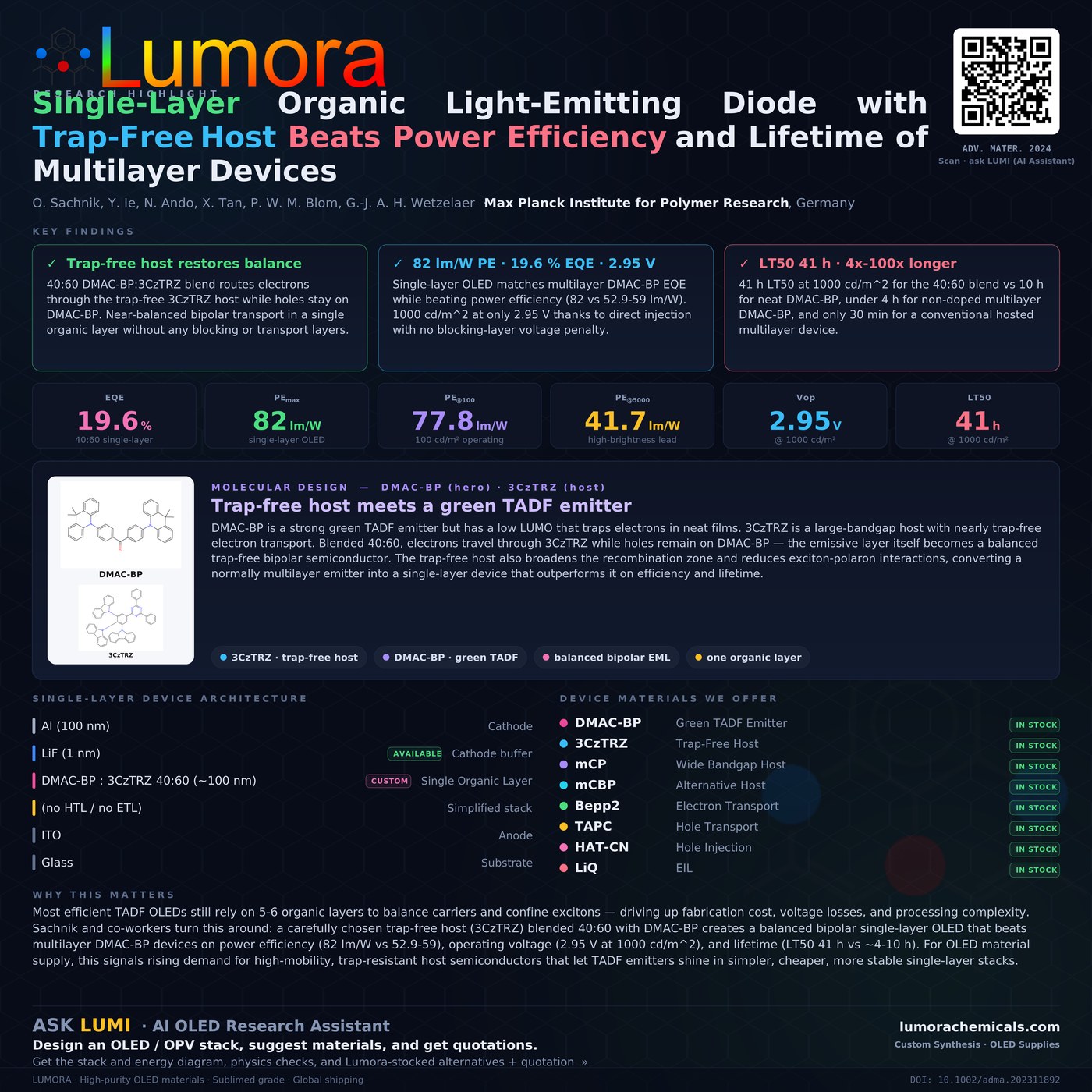
Outperforming comparable multilayer DMAC-BP devices in both energy efficiency and stability
Sachnik, Ie, Ando, Tan, Blom, and Wetzelaer, Advanced Materials, 2024 "Single-Layer Organic Light-Emitting Diode with Trap-Free Host Beats Power Efficiency and Lifetime of Multilayer Devices"
At LUMORA CHEMICALS, we pay close attention not only to new emitters, but also to host and transport concepts that simplify device architecture while improving practical performance. This 2024 Advanced Materials paper from Oskar Sachnik, Yutaka Ie, and co-workers shows that a carefully chosen trap-free host can turn a normally multilayer TADF emitter system into a highly efficient single-layer OLED. The central idea is powerful: instead of adding more blocking and transport layers to compensate for charge imbalance, the authors solved the underlying transport problem directly inside the emissive layer.
The Problem: Efficient TADF OLEDs Usually Depend on Complex Multilayer Stacks
Most high-performance OLEDs rely on 5-6 organic layers and several different materials to manage charge injection, carrier balance, exciton confinement, and outcoupling. That complexity increases fabrication cost and deposition time, and heterojunctions also contribute to voltage losses. Single-layer OLEDs could be simpler, cheaper, and potentially more stable, but they usually fail because balanced bipolar transport is extremely difficult to achieve in one layer. The green TADF emitter DMAC-BP is a good example: it gives strong efficiency in multilayer devices, but its low LUMO leads to severe electron trapping, making neat single-layer devices inefficient.
The Breakthrough: A Trap-Free Host That Restores Balanced Transport
The authors addressed this limitation by blending DMAC-BP with 3CzTRZ, a recently developed large-bandgap organic semiconductor with nearly trap-free electron transport. In the optimized 40:60 DMAC-BP:3CzTRZ blend, electron transport occurs through 3CzTRZ while hole transport remains governed by DMAC-BP, creating nearly balanced and trap-free bipolar transport in the emissive layer. This balanced transport allowed the team to build a true single-layer OLED that matched multilayer DMAC-BP devices in EQE while beating them in operating voltage, power efficiency, and lifetime. The result is an important proof that device simplification does not have to mean performance sacrifice when transport physics is engineered correctly.
Key Device Results
- Neat DMAC-BP single-layer OLED: Only 8% EQE and 32 lm W−1 maximum power efficiency, confirming that electron trapping severely limits performance.
Optimized 40:60 DMAC-BP:3CzTRZ single-layer OLED: Reached 19.6% EQE, comparable to reported multilayer DMAC-BP OLEDs at 18.9-21% EQE.
- Record power efficiency: The same single-layer device achieved 82 lmW−1 maximum power efficiency and 77.8 lmW−1 at 100 cdm−2, exceeding reported multilayer DMAC-BP values of 52.9-59 lmW−1.
- Low operating voltage: The device reached 1,000 cdm−2 at only 2.95 V, enabled by direct injection and the absence of blocking-layer voltage penalties.
- High-brightness advantage: Even at 5,000 cd cdm−2, the power efficiency remained 41.7 lmW−1, well above the best reported multilayer comparison at the same brightness.
- Lifetime improvement: LT50 reached 41 h at 1,000 cdm−2 for the 40:60 blend OLED, versus 10 h for neat DMAC-BP, under 4 h for nondoped multilayer DMAC-BP, and only about 30 min for a conventional hosted multilayer device.
- Why it works: The trap-free host broadens the recombination zone, reduces exciton-polaron interactions, and enables balanced transport without relying on complex multilayer confinement structures.
Why This Matters for OLED Material Supply
This paper matters because it shifts the conversation from "more layers for better performance" to "better transport design for simpler performance." For commercial OLED manufacturing, a single-layer architecture can reduce material count, simplify vacuum deposition or future printing strategies, lower operating voltage, and improve device stability all at once. It also highlights an important materials opportunity: trap-free host platforms may become just as strategically valuable as emitters themselves, especially for TADF systems that underperform when transport is not tightly controlled. For materials suppliers, this signals rising demand for high-mobility, trap-resistant host semiconductors that can enable simpler, more energy-efficient OLED stacks.
Reference: Sachnik, O.; Ie, Y.; Ando, N.; Tan, X.; Blom, P. W. M.; Wetzelaer, G.-J. A. H. Adv. Mater. 2024, 2311892. DOI: 10.1002/adma.202311892
Target Materials: Host-Emitter System/ IUPAC names
DMAC-BP
bis(4-(9,9-dimethylacridin-10(9H)-yl)phenyl)methanone; green TADF emitter
3CzTRZ
9,9′,9″-(5-(4,6-diphenyl-1,3,5-triazin-2-yl)benzene-1,2,3-triyl)tris(9H-carbazole); trap-free host
R&D and pilot quantities
We supply the key materials from this study in high-purity sublimed grades, from grams to kilograms, shipped worldwide.
Visit LUMORA →Kilogram to production, and custom MR-TADF
For large-scale supply, new emitter synthesis, and CRDMO support, work with LAMKO directly. Scope your project in the LUMI workspace, or send a partnership request.
Open LUMI workspace →Partner with us