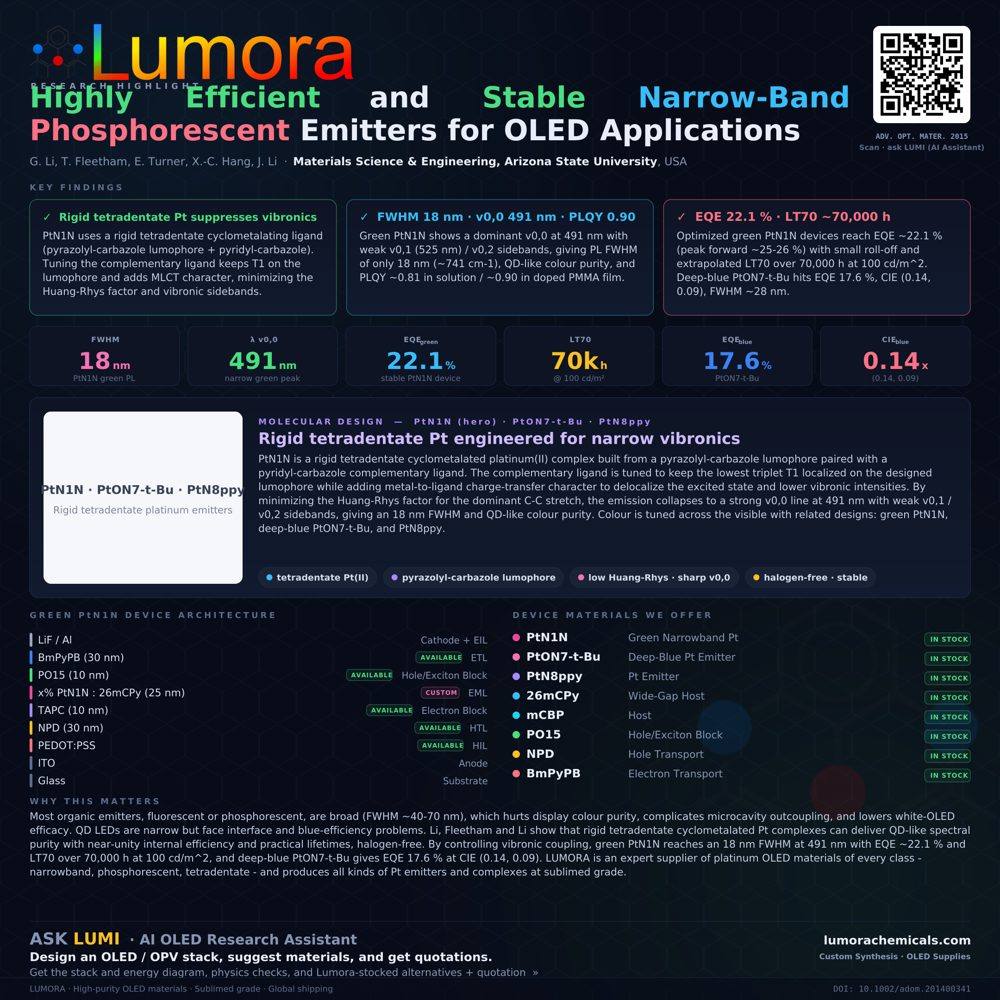
Li, Fleetham, Turner, Hang, and Li, Advanced Optical Materials, 2015 — "Highly Efficient and Stable Narrow-Band Phosphorescent Emitters for OLED Applications"
At LUMORA CHEMICALS, narrowband phosphorescent platforms that combine high efficiency, precise color points, and commercial lifetimes are strategically important for both displays and lighting. Li et al. provide one of the earliest and most rigorous demonstrations that rigid tetradentate Pt complexes can deliver QD-like spectral purity together with nearly unity internal quantum efficiency and long device lifetimes, without relying on lanthanides or fragile deep-blue hosts. Their PtN1N and PtON7-t-Bu designs are therefore key reference points for any future halogen-free Pt-based emitter program.
The Problem: Broad Emission Limits OLED Color Purity and System Efficiency
Most organic emitters—fluorescent or phosphorescent exhibit relatively broad photoluminescence (FWHM ~40–70 nm), which degrades display color purity, complicates resonant microcavity outcoupling, and reduces white OLED efficacy because red bands often extend into the deep red and near-IR. Quantum-dot LEDs can provide narrow spectra, but suffer from interface and blue-efficiency issues. The authors argue that a better path is to design purely organic or organometallic emitters with intrinsically narrow-band phosphorescence, using cyclometalated Pt complexes engineered to suppress vibronic progressions.
The Breakthrough: Rigid Tetradentate Pt Design with Controlled Vibronic Structure
The key design idea is to use a rigid tetradentate cyclometalating ligand built from a pyrazolyl-carbazole lumophore and a carefully chosen pyridyl-carbazole complementary ligand. The complementary ligand is tuned to keep the lowest triplet state (T₁) primarily localized on the designed lumophore, while adding enough metal-to-ligand charge-transfer character to delocalize the excited state and reduce vibronic intensities. By minimizing the Huang–Rhys factor for the dominant C–C stretch, the PtN1N complexes exhibit a leading v₀,₀ emission at 491 nm with much weaker v₀,₁ and v₀,₂ sidebands, yielding a PL FWHM of only 18 nm and high color purity comparable to, or better than, many QDs.
Key Results (Short)
- Narrowband green PtN1N emission: PtN1N displays a PL FWHM of 18 nm (≈741 cm⁻¹) with v₀,₀ at 491 nm and weak v₀,₁/v₀,₂ bands, yielding high color purity comparable to QDs and PLQY ≈ 0.81 in solution and ≈0.90 in doped PMMA film.
- High-efficiency green OLEDs: In charge- and exciton-confining structures with 2–14% PtN1N doping in 26mCPy host, forward-viewing EQE peaks around 25–26%, with FWHM ≈ 18–22 nm, implying nearly 100% internal quantum efficiency at typical outcoupling factors.
- Long-lifetime optimized devices: In electrochemically stable architectures using HATCN/NPD, mCBP host, BPyTP electron-transport layers, and TrisPCz/mCBT blocking layers, PtN1N devices reach EQE ≈ 22.1% with small roll-off and extrapolated LT₇₀ ≈ 60–70 000 h at 100 cd m⁻².
- Deep-blue PtON7-t-Bu performance: Blue devices using PtON7-t-Bu in 26mCPy host achieve EQE ≈ 17.6%, CIE ≈ (0.14, 0.09), and FWHM ≈ 28 nm. The emission energy remains in the mid-blue rather than UV, avoiding quenching and enabling the use of more conventional host and blocking materials.
Why This Matters for OLED Material Supply
For LUMORA CHEMICALS, this paper demonstrates that halogen-free tetradentate Pt complexes can deliver QD-like spectral purity, nearly unity internal efficiency, and practical lifetimes across green and deep-blue devices. The PtN1N platform in particular shows how careful control of vibronic coupling and device architecture can produce emitters that are both narrowband and robust, paving the way for high-color-purity display primaries and efficient white stacks built from stable Pt-based triplet centers.
Emitter Platform: IUPAC names
PtN1N
[9-(pyridin-2-yl-κN)-2-(1H-pyrazol-1-yl-κN2)-2,9-bi-9Hcarbazole-1,1-diyl-κC1,κC1]
PtON7-t-Bu
[6-(1,3-dihydro-3-methyl-2H-imidazol-2-ylidene-κC2)-1,2-phenylene-κC1]oxy[9-(4-tert-butyltpyridin-2-yl-κN)-9H-carbazole-1,2-diyl-κC1]
PtN8ppy
[2-(1-methyl-1H-benzo[d]imidazol-2-yl-κN3)-9-(6-(pyridin-2-yl-κN)-1,2-phenylene-κC1)-9H-carbazole-yl-κC1]
R&D and pilot quantities
We supply the key materials from this study in high-purity sublimed grades, from grams to kilograms, shipped worldwide.
Visit LUMORA →Kilogram to production, and custom synthesis
For large-scale supply, new emitter synthesis, and CRDMO support, work with LAMKO directly. Scope your project in the LUMI workspace, or send a partnership request.
Open LUMI workspace →Partner with us