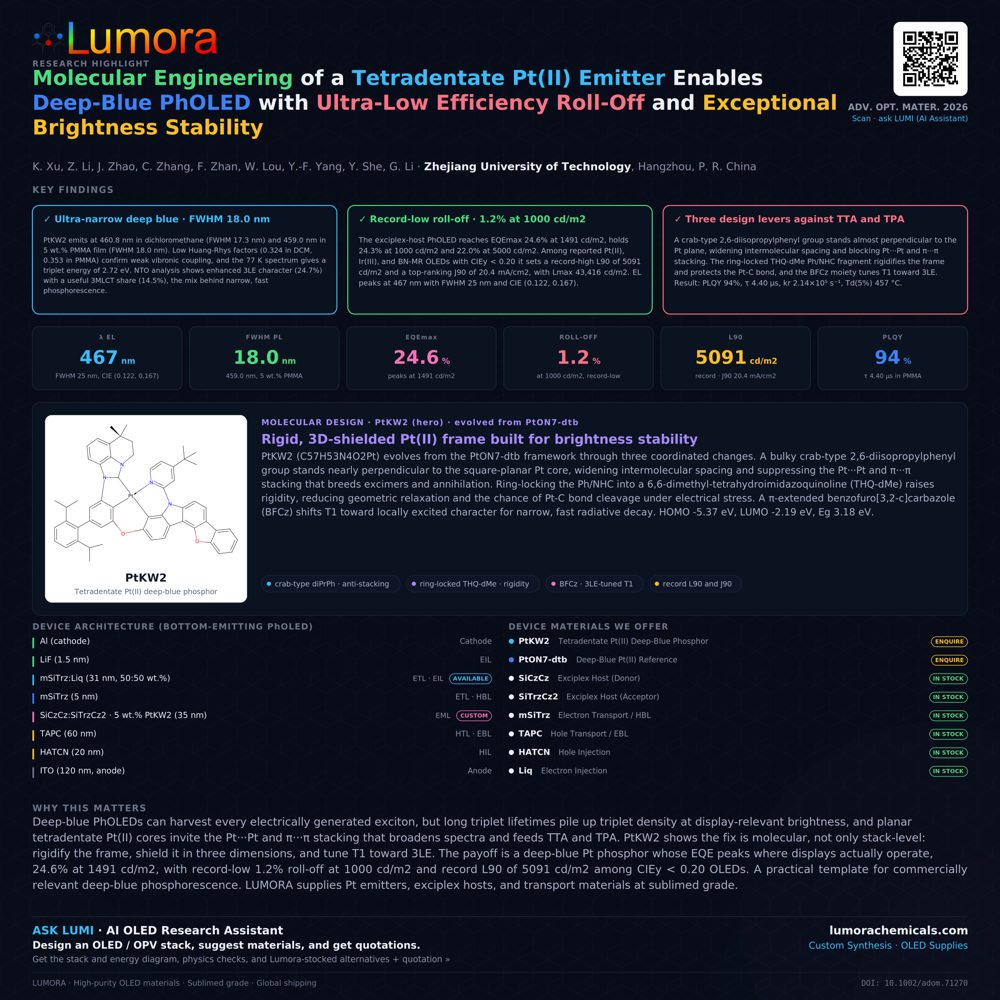
Xu et al., Advanced Optical Materials, 2026 — “Molecular Engineering of a Tetradentate Pt(II) Emitter Enables Deep-Blue PhOLEDs with Record-Low Efficiency Roll-Off”
At LUMORA CHEMICALS, deep-blue phosphors are most compelling when high color purity does not come at the expense of brightness and roll-off. Xu et al. provide a strong Pt(II)-emitter blueprint: use a three-dimensional, rigid ligand architecture to block aggregation and triplet annihilation, while retaining the locally excited-state character needed for narrow-band blue emission. The result is a Pt phosphor that combines display-grade CIEy below 0.20 with unusually stable EQE at practical high luminance.
The Problem: Deep-Blue PhOLEDs Struggle with Roll-Off and Aggregation
Deep-blue phosphorescent OLEDs can theoretically harvest all electrically generated excitons, but their long triplet lifetimes cause high triplet density under strong drive. This increases triplet–triplet annihilation (TTA), triplet–polaron annihilation (TPA), and other loss channels, creating severe EQE roll-off. For planar tetradentate Pt(II) complexes, Pt···Pt, π···π, and host–guest interactions can additionally form excimers or exciplexes, broadening the spectrum and sacrificing color purity. The challenge is to achieve narrow deep-blue emission, high radiative efficiency, and low roll-off at the same time.
The Breakthrough: PtKW2 Uses Rigidity, Steric Shielding, and 3LE Control
PtKW2 evolves from the PtON7-dtb framework using three coordinated molecular changes. A bulky “crab-type” 2,6-diisopropylphenyl group increases intermolecular spacing and suppresses molecular stacking; a ring-locked THQ-dMe Ph/NHC fragment raises rigidity and reduces the chance of Pt–C bond cleavage; and a BFCz unit tunes the triplet state toward a stronger 3LE contribution while maintaining a useful 3MLCT component. Calculations show PtKW2 has greater 3LE character (24.7%) and slightly lower 3MLCT character (14.5%) than PtON7-dtb, supporting narrow emission, fast radiative decay, and reduced aggregation-induced quenching.
Emitter Platform: IUPAC names
Key Results
- Narrow deep-blue Pt phosphorescence: PtKW2 emits at 460.8 nm in solution with FWHM 17.3 nm and at 459.0 nm in PMMA with FWHM 18.0 nm. Its low Huang–Rhys factors (0.324 in DCM and 0.353 in PMMA) indicate weak vibronic coupling and support high color purity.
- High PLQY with a shorter triplet lifetime: At 5 wt% in PMMA, PtKW2 achieves PLQY 94% and τ 4.40 μs, improving on PtON7-dtb (91% and 4.70 μs). The radiative rate, 2.14×10^5 s−1, is more than an order of magnitude larger than the nonradiative rate.
- High-efficiency, low-roll-off deep-blue PhOLED: A 5 wt% PtKW2 exciplex-host device reaches EQEmax 24.6% at 1491 cd m−2, maintains 24.3% at 1000 cd m−2 and 22.0% at 5000 cd m−2, and gives EL at 467 nm with FWHM 25 nm and CIE (0.122, 0.167).
- Record-level practical brightness metrics: The device shows only 1.2% EQE roll-off at 1000 cd m−2, J90 = 20.4 mA cm−2, L90 = 5091 cd m−2, Lmax = 43 416 cd m−2, and LT50 = 27 h from an initial 1000 cd m−2. The authors attribute roll-off mainly to TTA, with molecular design limiting its impact.
Why This Matters for OLED Material Supply
For LUMORA CHEMICALS, PtKW2 illustrates how emitter design and stack design must work together for commercially relevant deep-blue phosphorescence. The molecular package—ring locking, 3D steric shielding, and controlled 3LE/3MLCT balance—offers an actionable template for suppressing aggregation, preserving a narrow spectrum, and moving the EQE peak into useful luminance ranges. It also highlights the value of supplying complementary high-triplet-energy exciplex hosts, transport/blocking materials, and high-purity Pt emitter intermediates for low-roll-off blue PhOLED development.
PtKW2
Platinum(II) [6-(6,6-dimethyl-1,2,5,6-tetrahydro-4H-imidazo[4,5,1-ij]quinolin-2-ylidene-κC²)-4-(2,6-diisopropylphenyl)-1,2-phenylene-κC¹]oxy[9-(4-tert-butylpyridin-2-yl-κN)-9H-benzofuro[2,3-d]carbazole-1,2-diyl-κC¹]
R&D and pilot quantities
We supply the key materials from this study in high-purity sublimed grades, from grams to kilograms, shipped worldwide.
Visit LUMORA →Kilogram to production, and custom synthesis
For large-scale supply, new emitter synthesis, and CRDMO support, work with LAMKO directly. Scope your project in the LUMI workspace, or send a partnership request.
Open LUMI workspace →Partner with us