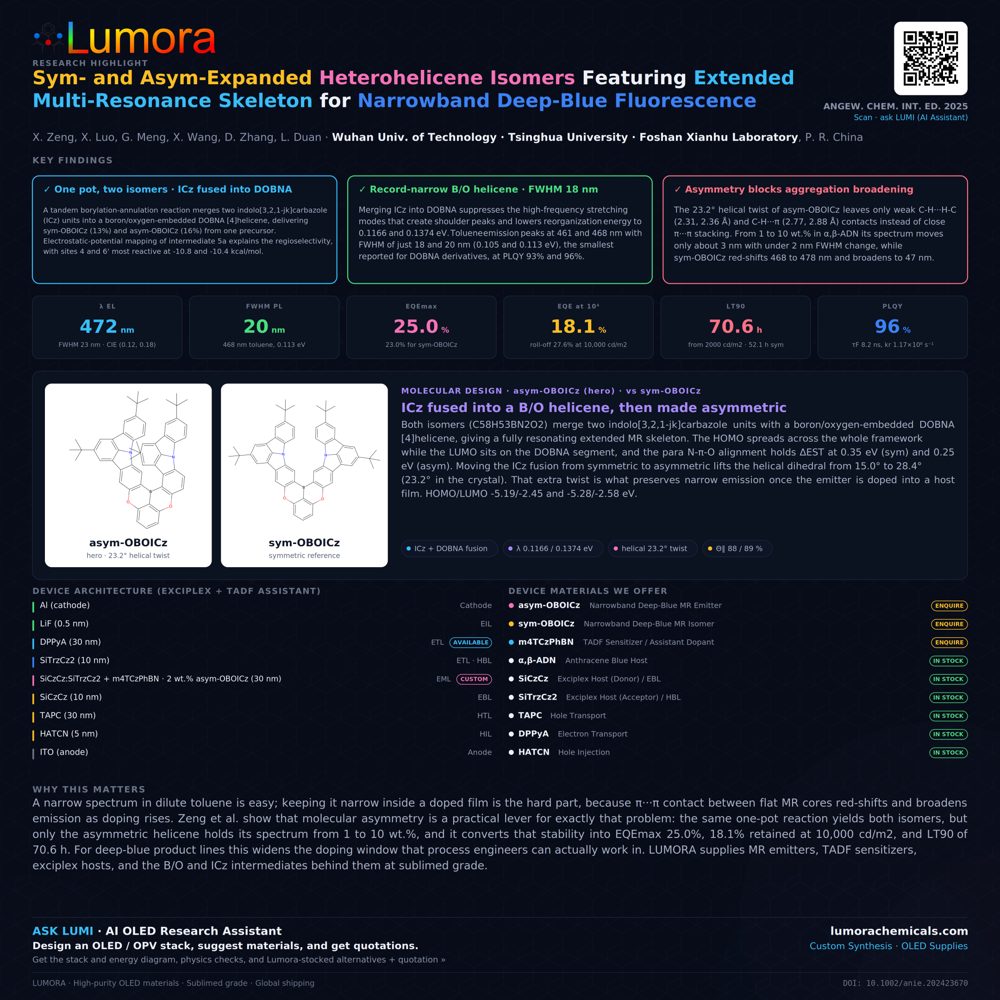
Zeng et al., Angewandte Chemie International Edition, 2025 — “One-Shot Synthesis of Sym- and Asym-Expanded Heterohelicene Isomers Exhibiting Narrowband Deep-Blue Fluorescence”
At LUMORA CHEMICALS, narrowband blue materials need more than an excellent dilute-solution spectrum: they must resist spectral broadening, efficiency loss, and degradation in a doped device film. Zeng et al. show that asymmetry can offer a practical solid-state advantage. By merging ICz and B/O-embedded DOBNA segments into a helical MR framework, they achieve low vibronic coupling; by making the fusion asymmetric, they further disrupt intermolecular π stacking and preserve narrow emission across a broad doping range.
The Problem: Narrow MR Emission Can Broaden in Solid Films
B/O-based multiple-resonance emitters are valued for high color purity, but vibration-driven sidebands and intermolecular π–π interactions can broaden their spectra after film formation. This issue becomes more severe at higher dopant concentration, where aggregation can red-shift emission and reduce efficiency. Designing a rigid fused skeleton reduces structural relaxation, yet a fully symmetric architecture may still pack too efficiently. The authors therefore compare symmetric and asymmetric expanded heterohelicene isomers to separate intrinsic spectral narrowing from solid-state aggregation control.
The Breakthrough: ICz–DOBNA Fusion plus Asymmetric Helicity
The target molecules, sym-OBOICz and asym-OBOICz, are produced simultaneously from a common precursor through a one-pot tandem borylation–annulation reaction. Fusing ICz units into the DOBNA skeleton increases rigidity and shifts vibrational activity toward lower frequencies, reducing high-frequency stretching modes that normally generate spectral shoulders. The asymmetric isomer has a helical structure with a 23.2° dihedral angle between its asymmetrically fused ICz units; its nonplanar shape weakens π–π contacts, leaving only weak C–H···H–C and C–H···π interactions in the crystal. This delivers greater resistance to aggregation-caused broadening in host films.
Emitter Platform: Sym-OBOICz vs Asym-OBOICz
Key Results
- Record-level narrow B/O-helicene emission: The two fused heterohelicenes emit deep blue at 461 and 468 nm with FWHM values of 18 and 20 nm, respectively, and PLQYs above 90%. Reduced reorganization energies (calculated 0.1166 and 0.1374 eV) and suppression of high-frequency stretching modes explain the narrow spectral profiles.
- Asymmetry prevents aggregation broadening: In α,β-ADN films, asym-OBOICz keeps essentially the same spectrum from 1 to 10 wt% doping, with only ~3 nm peak movement and <2 nm FWHM change. Sym-OBOICz red-shifts from 468 to 478 nm and broadens to 47 nm at 10 wt%, revealing the solid-state advantage of the helical asymmetric structure.
- High-efficiency narrowband blue OLEDs: At 2 wt% terminal-emitter doping in an exciplex/TADF-assistant architecture, asym-OBOICz produces EL at 472 nm with FWHM 23 nm and CIE (0.12, 0.18). It reaches EQEmax 25.0%, current efficiency 32.4 cd A−1, maximum luminance 76 500 cd m−2, and retains EQE of 21.4% and 18.1% at 1000 and 10 000 cd m−2.
- Strong operational stability for narrowband blue: The asymmetric device shows EQE roll-off of 14.4% at 1000 cd m−2 and 27.6% at 10 000 cd m−2, lower than the symmetric analogue. It also reaches LT90 70.6 h from an initial 2000 cd m−2, compared with 52.1 h for sym-OBOICz under the same test condition.
Why This Matters for OLED Material Supply
For LUMORA CHEMICALS, this paper links molecular asymmetry directly to production-relevant device robustness. The one-pot access to both isomers provides an efficient synthetic route, while the asymmetric product demonstrates that a helical MR skeleton can protect color purity at higher film concentration—a valuable window for manufacturing-tolerant doping control. The platform also highlights demand for high-purity B/O-heteroaromatic intermediates, ICz building blocks, exciplex host pairs, and TADF sensitizers that can unlock high exciton utilization without compromising narrowband blue output.
Key Compounds & IUPAC Names
sym-OBOICz
tetra-tert-butyl-bis(indolocarbazole)-fused 5,9-dioxa-13b-boranaphtho[3,2,1-de]anthracene
asym-OBOICz
tri-tert-butyl asymmetric indolo[3,2,1-jk]carbazole-fused 5,9-dioxa-13b-boranaphtho[3,2,1-de]anthracene
R&D and pilot quantities
We supply the key materials from this study in high-purity sublimed grades, from grams to kilograms, shipped worldwide.
Visit LUMORA →Kilogram to production, and custom synthesis
For large-scale supply, new emitter synthesis, and CRDMO support, work with LAMKO directly. Scope your project in the LUMI workspace, or send a partnership request.
Open LUMI workspace →Partner with us