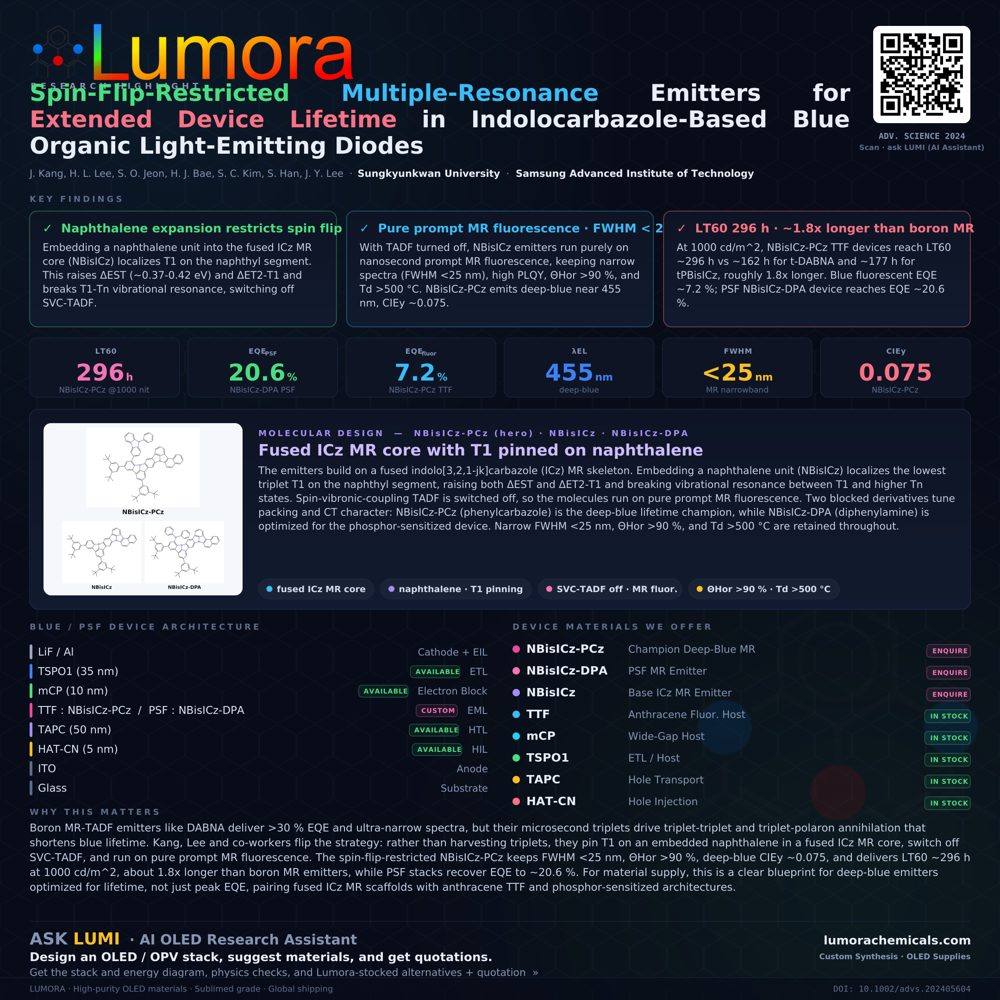
Kang et al., Advanced Science, 2024 — "Spin-Flip-Restricted Multiple-Resonance Emitters for Extended Device Lifetime in Indolocarbazole-Based Blue Organic Light-Emitting Diodes"
At LUMORA CHEMICALS, we are interested in deep-blue platforms that trade some peak efficiency for much better stability and controllable roll-off. Kang et al. show that designing spin-flip-restricted multiple-resonance emitters on a fused ICz backbone—rather than relying on long-lived MR-TADF—can keep MR advantages (narrow spectra, high PLQY, high horizontal dipole ratio) while significantly extending device lifetime. This is exactly the kind of emitter design strategy display makers need for robust deep-blue pixels at high luminance.
The Problem: Long-Lived MR-TADF Triplets Undermine Blue Lifetime
Boronic MR-TADF emitters such as DABNA derivatives deliver outstanding EQE and ultranarrow spectra, but their slow reverse intersystem crossing from microsecond triplets makes devices vulnerable to triplet–triplet and triplet–polaron annihilation and hot-exciton damage under long-term operation. For practical deep-blue OLEDs, the key challenge is how to maintain MR-type color purity without relying on triplet harvesting mechanisms that degrade lifetime.
The Breakthrough: Naphthalene-Expanded NBisICz to Restrict Spin Flip
The authors start from BisICz fused ICz MR-TADF emitters and embed a naphthalene unit to create NBisICz, which localizes the lowest triplet state on the naphthyl segment. This stabilizes T₁, increases both ΔEST and ΔET2–T1, and breaks vibrational resonance between T₁ and higher Tn states. As a result, SVC-TADF is energetically switched off and NBisICz and its derivatives operate purely through prompt MR fluorescence. Two blocked derivatives, NBisICz–PCz and NBisICz–DPA, then tune intermolecular packing and CT character for improved solid-state spectra and device performance.
Key Results
- Spin-flip-restricted MR emission: NBisICz and derivatives show increased ΔEST (≈0.37–0.42 eV) and ΔET2–T1, low SOC, and only nanosecond-range prompt fluorescence in mCP:TSPO1 and TTF hosts, confirming suppression of SVC-TADF while retaining narrow MR spectra.
- Narrowband deep-blue color: In solution and TTF host, NBisICz–PCz delivers deep-blue emission near 455 nm with FWHM ≈ 25 nm and CIEy ≈ 0.075, preserving MR-level color purity with ΘHor > 90% and Td > 500 °C.
- Efficient blue fluorescent and PSF devices: TTF-based fluorescent NBisICz–PCz devices reach EQE ≈ 7.2% and blue index ≈ 68.6 cd A⁻¹; PtON7-dtb-sensitized NBisICz–DPA PSF devices achieve EQE up to ≈20.6% with CIEy ≈ 0.076 and FWHM ≈ 22–28 nm.
- Extended lifetime vs boron MR-TADF: At 1000 cd m⁻², NBisICz–PCz TTF devices show LT60 ≈ 296 h, versus ≈162 h for t-DABNA and ≈177 h for tPBisICz, indicating roughly 1.8× longer lifetime for spin-flip-restricted ICz MR emitters.
Why This Matters for OLED Material Supply
For LUMORA CHEMICALS, this paper provides a clear blueprint for deep-blue MR emitters optimized for lifetime rather than just peak EQE: stabilize T₁ to turn off MR-TADF, use fused ICz MR scaffolds to keep narrow spectra and high Horizontal emitting dipole orientation ratio , and pair them with anthracene TTF and PSF stacks to recover high device efficiency. NBisICz–PCz in particular demonstrates a commercially attractive balance of color purity, efficiency, and extended lifetime for deep-blue pixels in advanced displays.
Emitter Platform: IUPAC names
NBisICz
10,13-Bis(3,5-di-tert-butylphenyl)-indolo[3,2,1-jk]benzo[4',5']indolo[3',2',1':7,1]indolo[3,2-b]carbazole
NBisICz–PCz
10,13-Bis(3,5-di-tert-butylphenyl)-15-(9-phenyl-carbazol-3yl)-indolo[3,2,1-jk]benzo[4',5']indolo[3',2',1':7,1]indolo[3,2-b]carbazole
NBisICz–DPA
10,13-Bis(3,5-di-tert-butylphenyl)-N15,N15-diphenyl-indolo[3,2,1-jk]benzo[4',5']indolo[3',2',1':7,1]indolo[3,2-b]carbazol-15-amine
R&D and pilot quantities
We supply the key materials from this study in high-purity sublimed grades, from grams to kilograms, shipped worldwide.
Visit LUMORA →Kilogram to production, and custom synthesis
For large-scale supply, new emitter synthesis, and CRDMO support, work with LAMKO directly. Scope your project in the LUMI workspace, or send a partnership request.
Open LUMI workspace →Partner with us