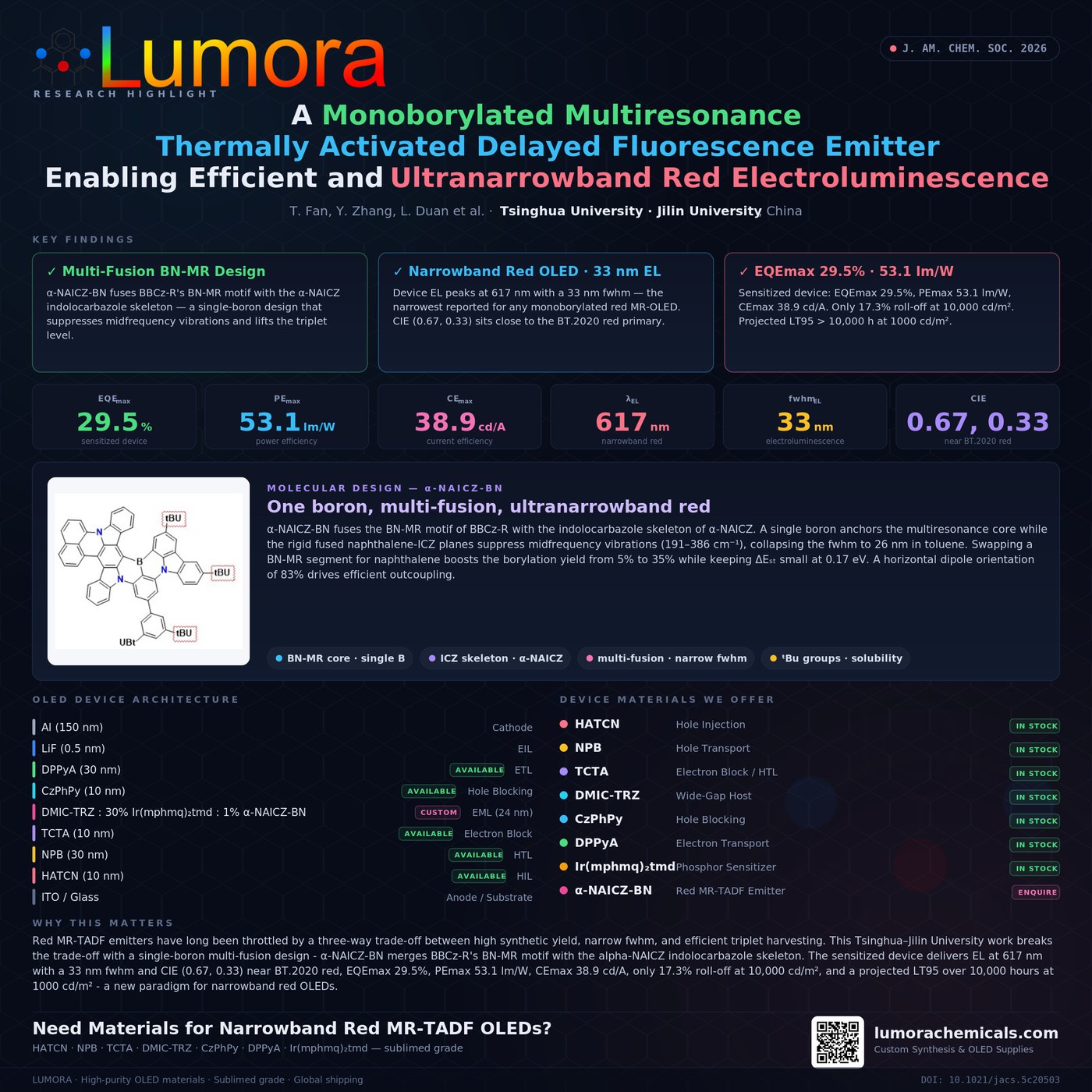
Why is high-performance narrowband red MR-TADF still difficult to realize?
The core problem is that red organic light-emitting diode (OLED) emitters must simultaneously deliver deep-red color purity, high exciton utilization, high efficiency, and practical synthetic accessibility. However, most strategies used to redshift multiple-resonance thermally activated delayed fluorescence (MR-TADF) emitters, such as extending π-conjugation or increasing long-range charge-transfer character, tend to increase excited-state structural relaxation and vibrational broadening, thereby widening the emission spectrum.
New work published in the Journal of the American Chemical Society by Fan, Liu, Cao, Li, Yuewei Zhang, Hongyu Zhang, Duan, and co-workers shows that this trade-off can be broken by using a high-yield monoborylated MR-TADF scaffold that merges the key structural advantages of two ultranarrowband red emitter motifs, rather than relying only on large multi-boron frameworks or simple π-extension.
What they did
The authors designed a new red MR-TADF emitter, α-NAICZ-BN, by combining structural features from BBCz-R and α-NAICZ through a multiple-fusion strategy. This design keeps the local nonbonding orbital character required for narrowband MR emission while introducing a BN-MR rigid skeleton that helps suppress vibrational broadening.
They combine:
1.A monoborylated BN-MR skeleton, which suppresses high-frequency bending and midfrequency stretching vibrations between the naphthalene unit and the ICz plane, reducing structural displacement and narrowing the emission band.
2.A naphthalene-integrated ICz framework, which lowers molecular weight and improves the key borylation-step yield from 5% to 35%, while still preserving red emission and strong MR character.
3.Balanced orbital coupling, where reduced π-bond character raises the triplet energy, decreases ΔEST, and supports TADF without sacrificing the oscillator strength needed for efficient radiative decay.
The molecule was validated using DFT/TD-DFT calculations, natural transition orbital analysis, and Franck-Condon simulations, which confirmed MR-dominated frontier orbital distributions and the suppression of low- to mid-frequency vibrational modes. The emitter was then used as the terminal red emitter in a phosphorescence-sensitized OLED with DMIC-TRZ as the host and Ir(mphmq)2tmd as the sensitizer, enabling efficient FRET to α-NAICZ-BN.
What they achieved
- α-NAICZ-BN shows red solution emission at 605 nm with an ultranarrow FWHM of 26 nm, CIE coordinates of (0.65, 0.34), a high PLQY of 95.0% under nitrogen, and a delayed fluorescence lifetime of 40.0 μs.
- The emitter has S1/T1 energies of 2.15/1.98 eV, giving a small experimental ΔEST of 0.17 eV, with calculated photophysical rates of kr = 1.6 × 10⁸ s⁻¹ and kRISC = 2.9 × 10⁴ s⁻¹.
- In a 1 wt% DMIC-TRZ doped film, α-NAICZ-BN maintains high solid-state performance, showing PL at 609 nm, FWHM of 32 nm, PLQY of 93.0%, τPF of 6.8 ns, and τDF of 55.0 μs.
- The sensitized red OLED reaches EL at 617 nm with a 33 nm FWHM and CIE coordinates of (0.67, 0.33), representing the narrowest emission band reported for a monoborylated red MR-OLED in the paper.
- The device achieves EQEmax = 29.5%, PEmax = 53.1 lm W⁻¹, CEmax = 38.9 cd A⁻¹, a low turn-on voltage of 2.2 V, maximum luminance of 9.5 × 10⁴ cd m⁻², and very low roll-off, maintaining EQE values of 28.3% at 1000 cd m⁻² and 24.4% at 10,000 cd m⁻².
- The emitter also shows strongly preferred horizontal molecular orientation with Θ// = 83.0%, and the device demonstrates LT95 = 635.7 h at 5000 cd m⁻², corresponding to an extrapolated LT95 of 10,628 h at 1000 cd m⁻².
Altogether, the work demonstrates that a single-boron MR-TADF framework can simultaneously achieve high synthetic yield, ultranarrow red emission, high OLED efficiency, low power consumption, and promising device stability.
What's worth taking from this
The central message is that the red MR-TADF design need not rely solely on heavy π-extension or large multi-boron frameworks. By selectively merging rigid MR motifs and suppressing the specific vibrational modes that broaden red emission, a monoborylated emitter can retain color purity while still supporting efficient TADF and high device efficiency.
By moving from conventional red-shift strategies to vibration-controlled multiple-fusion molecular design, the authors demonstrate that you can:
- Use a single-boron MR framework to obtain ultranarrow red emission while improving synthetic accessibility.
- Suppress midfrequency stretching vibrations to reduce reorganization energy and prevent unwanted spectral broadening.
- Balance nonbonding MR character and moderate orbital coupling to keep both narrow FWHM and efficient exciton utilization.
- Use a sensitized device architecture to overcome concentration quenching and roll-off problems common in planar red MR-TADF emitters.
For next-generation wide-color-gamut OLED displays, this paper reinforces the shift from simple color tuning to integrated molecular and device engineering, in which emission wavelength, vibrational coupling, ΔEST, molecular orientation, sensitized energy transfer, and device stability are optimized together.
📄 DOI: 10.1021/jacs.5c20503
🔗 Paper: https://doi.org/10.1021/jacs.5c20503
Why is high-performance narrowband red MR-TADF still difficult to realise?
The core problem is that red #OLED emitters must simultaneously deliver deep-red color purity, high exciton utilisation, high efficiency, and practical synthetic accessibility. However, most redshift strategies for MR-TADF emitters, such as extending π-conjugation or increasing charge-transfer character, increase structural relaxation and vibrational broadening, widening emission.
New work in JACS by Prof. Duan and co-workers shows this trade-off can be overcome using a high-yield monoborylated MR-TADF scaffold that merges the advantages of two ultranarrowband red emitter motifs, instead of relying on multi-boron systems or simple π-extension.
The authors designed a red MR-TADF emitter, α-NAICZ-BN, by combining BBCz-R and α-NAICZ via a multiple-fusion strategy. This preserves nonbonding orbital character for narrow emission while introducing a rigid BN-MR skeleton to suppress vibrational broadening.
They combine:
- A monoborylated BN-MR skeleton that suppresses bending and stretching vibrations between the naphthalene unit and ICz plane.
- A naphthalene-integrated ICz framework that improves borylation yield from 5% to 35% while maintaining MR character.
- Balanced orbital coupling that reduces ΔEST and enables efficient TADF without sacrificing oscillator strength.
- 605 nm emission, 26 nm FWHM, CIE (0.65, 0.34), PLQY 95%
- ΔEST 0.17 eV with strong radiative and RISC rates
- Solid-state 609 nm emission, 32 nm FWHM, PLQY 93%
- OLED EL at 617 nm, 33 nm FWHM (among the narrowest for monoborylated red MR emitters)
- EQEmax 29.5%, low roll-off, luminance 9.5 × 10⁴ cd m⁻²
- Horizontal orientation 83% and long device lifetime
Red MR-TADF design does not need heavy π-extension or multi-boron frameworks. By merging rigid MR motifs and suppressing key vibrational modes, a monoborylated emitter can maintain color purity with efficient #TADF.
Achieve ultranarrow red emission with a single-boron MR framework
Suppress midfrequency vibrations to reduce reorganization energy
Balance MR character and orbital coupling for narrow FWHM and high efficiency
Use sensitized architectures to reduce quenching and roll-off
For next-generation wide-color-gamut OLEDs, this highlights the shift toward integrated molecular and device engineering.
R&D and pilot quantities
We supply the key materials from this study in high-purity sublimed grades, from grams to kilograms, shipped worldwide.
Visit LUMORA →Kilogram to production, and custom MR-TADF
For large-scale supply, new emitter synthesis, and CRDMO support, work with LAMKO directly. Scope your project in the LUMI workspace, or send a partnership request.
Open LUMI workspace →Partner with us