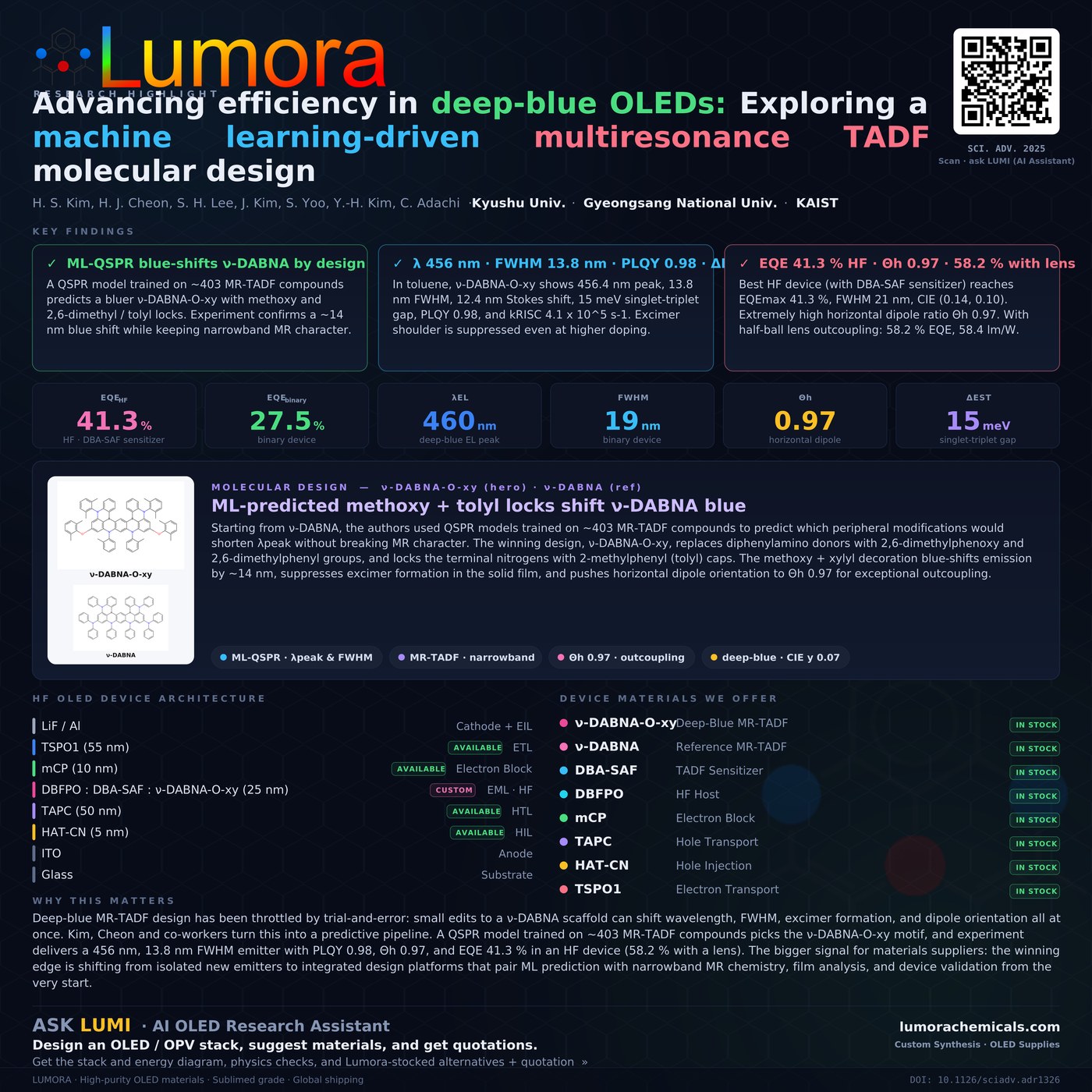
🔬 ML-Driven Design of Deep-Blue MR-TADF: ν-DABNA-O-xy
Kim, Cheon, Lee, Kim, Yoo, Kim & Adachi · Kyung Hee Univ. + Kyushu Univ. · Sci. Adv. 2025
At LUMORA we track not only new emitters but how discovery methods themselves are changing OLED materials development. This 2025 Science Advances paper combines machine learning with molecular photophysics to design a new deep-blue MR-TADF emitter, ν-DABNA-O-xy. Rather than slow trial-and-error, the authors built QSPR models to predict emission peak and FWHM, then used those predictions to guide synthesis toward a high-performance deep-blue target.
🚧 The Problem
Boron-based MR-TADF emitters are among the strongest candidates for wide-gamut blue OLEDs, combining narrow emission, small ΔEST, and color purity. But designing new molecules in this family is hard: small structural edits can affect wavelength, vibronic broadening, excimer formation, dipole orientation, and roll-off all at once. Traditional development means repeated synthesis with uncertain outcomes.
💡 The Breakthrough
Using ~403 MR-TADF compounds from the literature, the team trained QSPR models to predict λpeak and FWHM from molecular descriptors and fingerprints. The models pointed to ν-DABNA-O-xy: 2,6-dimethylphenoxy plus 2,6-dimethylphenyl peripheral groups with tolyl locks on the terminal nitrogens. This design blue-shifts emission and preserves the ν-DABNA platform. In toluene: 456.4 nm peak, 13.8 nm FWHM, ΔEST 15 meV, PLQY 0.98, kRISC 4.1 × 10⁵ s⁻¹.
📊 Key Device Results
🔵 ML prediction confirmed: ~14 nm blue shift vs ν-DABNA in solution and film
🔵 Suppressed excimer: DBFPO host film keeps deep-blue emission at higher doping
🔵 Extreme orientation: horizontal dipole ratio Θh = 0.97
🔵 Binary OLED: EQE 27.5 %, EL 460 nm, FWHM 19 nm, CIE (0.14, 0.07)
🔵 HF OLED (with DBA-SAF): EQE 41.3 %, FWHM 21 nm, CIE (0.14, 0.10)
🔵 With half-ball lens outcoupling: EQE 58.2 %, PE 58.4 lm/W, CE 92.5 cd/A
🧭 Why This Matters
This paper shows a new way to accelerate MR-TADF discovery without giving up physical rigor. ML prediction, spectral simulation, film analysis, and device validation unified into one workflow. For material suppliers, the competitive edge shifts toward integrated design platforms that connect molecular structure, film behavior, and device architecture from the start. Molecules like ν-DABNA-O-xy show that discovery speed, color purity, and device efficiency can move together when predictive design is done well.
Reference: Kim, H. S.; Cheon, H. J.; Lee, S. H.; Kim, J.; Yoo, S.; Kim, Y.-H.; Adachi, C. Sci. Adv. 2025, 11, eadr1326. DOI: 10.1126/sciadv.adr1326
R&D and pilot quantities
We supply the key materials from this study in high-purity sublimed grades, from grams to kilograms, shipped worldwide.
Visit LUMORA →Kilogram to production, and custom MR-TADF
For large-scale supply, new emitter synthesis, and CRDMO support, work with LAMKO directly. Scope your project in the LUMI workspace, or send a partnership request.
Open LUMI workspace →Partner with us