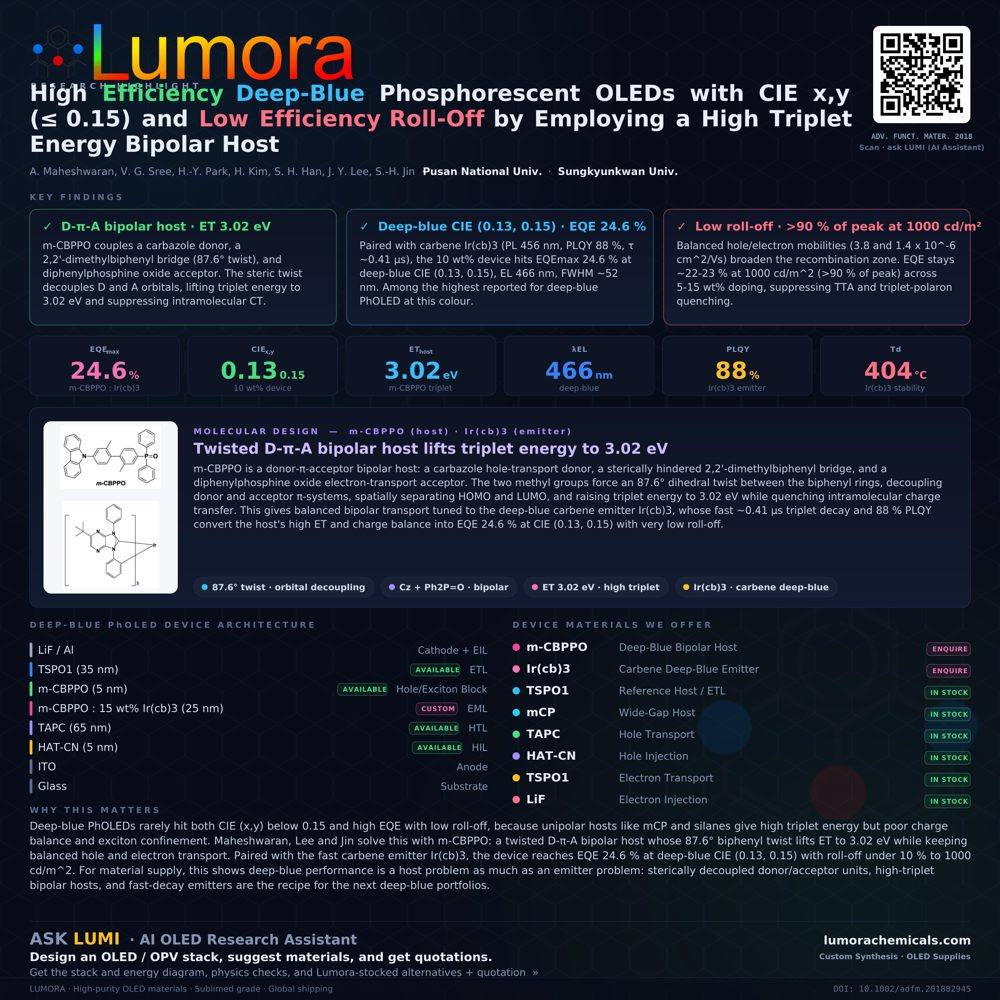
Maheshwaran, Sree, Park, Kim, Han, Lee, and Jin, Advanced Functional Materials, 2018 — "High Efficiency Deep-Blue Phosphorescent Organic Light-Emitting Diodes with CIE x, y (≤ 0.15) and Low Efficiency Roll-Off by Employing a High Triplet Energy Bipolar Host Material"
At LUMORA CHEMICALS, we view host design as just as critical as emitter design, especially for deep-blue phosphorescent devices where high triplet energy and charge balance must be engineered together. This 2018 Advanced Functional Materials paper from Maheshwaran, Lee, Jin and co-workers is a textbook case of that philosophy. By combining a carbazole donor, a twisted 2,2′-dimethylbiphenyl bridge, and diphenylphosphine oxide acceptors into a D–π–A bipolar host, they simultaneously achieve ET above 3.0 eV, robust thermal stability, and near-balanced hole/electron transport all tuned for a carbene-based deep-blue Ir(cb)3 emitter.
The Problem: Deep-Blue PhOLEDs Rarely Achieve Both CIE (x, y) ≤ 0.15 and High EQE with Low Roll-Off
Previous deep-blue PHOLEDs either compromised on color purity (CIEy > 0.15) or accepted lower EQE to stay within NTSC-like blue coordinates. Unipolar hosts such as mCP and silane-based materials provide high ET but suffer from poor charge balance and exciton confinement, which hurts efficiency and stability. The authors set out to design a host that meets deep-blue color coordinates (x, y ≤ 0.15), maintains ET above ~2.9 eV, and supports balanced bipolar transport to suppress triplet–triplet and triplet–polaron quenching even at higher dopant loadings.
The Breakthrough: D–π–A Bipolar Host m-CBPPO Tuned for Ir(cb)3
The new host, m-CBPPO, integrates carbazole (hole-transport donor), a sterically hindered 2,2′-dimethylbiphenyl bridge, and diphenylphosphine oxide (electron-transport acceptor). The methyl-substituted biphenyl core forces an 87.6° twist between rings, decoupling donor and acceptor orbitals and raising ET to 3.02 eV while suppressing intramolecular charge transfer. The Cz and Ph2P=O fragments spatially separate HOMO and LUMO, giving bipolar transport with hole and electron mobilities on the order of 3.8 × 10⁻⁶ and 1.4 × 10⁻⁶ cm2 V−1 s−1, respectively. Paired with the deep-blue Ir(cb)3 emitter (PL at 456 nm, PLQY 88%, short triplet lifetime ~0.41 μs), this host–dopant system is optimized for high EQE and minimal roll-off.
Host and Emitter: Key Photophysical and Materials Data
Key Results
- Deep-blue color and spectra: Devices with m-CBPPO host and Ir(cb)3 dopant show EL peaks at 462–466 nm with narrow FWHM (~52 nm) and CIE coordinates as low as (0.136, 0.138), meeting the target of CIE (x, y) ≤ 0.15 for deep-blue PHOLEDs.
- High EQE and minimal roll-off: Across 5–15 wt% Ir(cb)3, maximum EQE stays around 24.6–24.8%, with EQE still ~22–23% at 1000 cd m−2 more than 90% of peak EQE indicating extremely low efficiency roll-off.
- Balanced bipolar transport: Single-carrier devices confirm similar hole and electron mobilities in m-CBPPO, enabling a broad recombination zone, reduced exciton crowding, and improved suppression of triplet–triplet and triplet–polaron annihilation.
- Thermal robustness of host and emitter: m-CBPPO exhibits Tg above 100 °C and Td around 315 °C, while Ir(cb)3 has Td ≈ 404 °C, supporting vacuum deposition and stable device operation at high brightness.
- Comparison to TSPO1: Under identical device architecture, a TSPO1 host yields EQEmax ≈ 17.1% with less favorable CIE (0.14, 0.19), clearly demonstrating the performance advantage of m-CBPPO for deep-blue Ir(cb)3 devices.
- Doping concentration window: The system maintains similar EQE from 5 to 15 wt% Ir(cb)3, with 15 wt% providing the highest luminance (>10 000 cd m−2) while retaining excellent color purity and low roll-off.
Why This Matters for OLED Material Supply
This work shows that deep-blue performance depends as much on host architecture as on emitter chemistry. The m-CBPPO design illustrates how a twisted D–π–A scaffold can deliver high ET, bipolar transport, and thermal stability, all tuned to a specific carbene-based Ir complex to achieve deep-blue CIE, high EQE, and low roll-off simultaneously. For LUMORA CHEMICALS, these design principles—sterically decoupled donor/acceptor units, high-triplet bipolar hosts, and emitters with fast triplet decay—provide a clear blueprint for future deep-blue PhOLED portfolios and for pairing hosts with newer Ir, Pt, or MR-sensitized systems.
Key Compounds & IUPAC Names
m-CBPPO
(4′-(9H-carbazol-9-yl)-2,2′-dimethyl-[1,1′-biphenyl]-4-yl)diphenylphosphine oxide
Ir(cb)3
tris[(6-tert-butyl-3-phenyl-2H-imidazo[4,5-b]pyrazin-1-yl-κC²)phenyl-κC]iridium(III)
R&D and pilot quantities
We supply the key materials from this study in high-purity sublimed grades, from grams to kilograms, shipped worldwide.
Visit LUMORA →Kilogram to production, and custom synthesis
For large-scale supply, new emitter synthesis, and CRDMO support, work with LAMKO directly. Scope your project in the LUMI workspace, or send a partnership request.
Open LUMI workspace →Partner with us