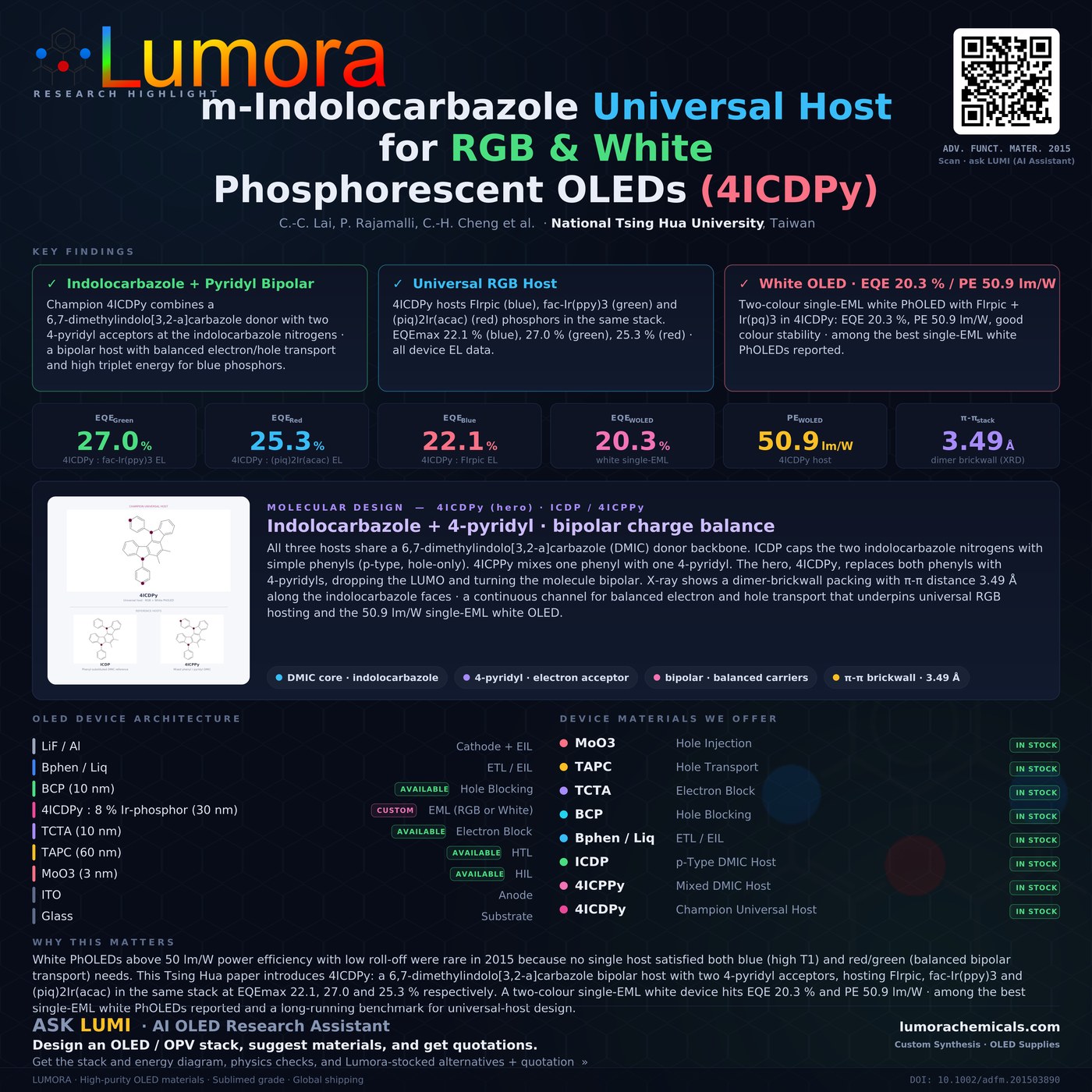
A universal bipolar host for blue, green, red, and white PhOLEDs
Lai, Huang, Chou, Liao, Rajamalli, and Cheng, Advanced Functional Materials, 2015, "m-Indolocarbazole Derivative as a Universal Host Material for RGB and White Phosphorescent OLEDs"
At LUMORA CHEMICALS, we closely follow host-material innovations that simplify OLED stack design while improving efficiency across multiple colors. This 2015 Advanced Functional Materials paper from Cheng-Chang Lai, Min-Jie Huang, and co-workers reports a new indolocarbazole-based host platform for phosphorescent OLEDs, showing that a properly engineered bipolar host can support not only blue, green, and red phosphors, but also highly efficient single-emitting-layer white devices. The standout molecule in this study, 4ICDPy, combines a 6,7-dimethylindolo[3,2-a]carbazole core with 4-pyridyl groups, giving the material the triplet energy, carrier balance, and thermal robustness required for universal-host behavior.
The Problem: A True Universal Host for RGB and White PhOLEDs Is Hard to Achieve
Universal hosts are highly attractive because they can simplify OLED fabrication, reduce stack complexity, and improve the practicality of single-emitting-layer white devices. However, this is difficult in practice because a host must satisfy several competing requirements at once: it needs sufficiently high triplet energy for blue phosphors, balanced hole and electron transport for broad recombination, and high thermal/morphological stability for reliable device operation. Many bipolar hosts lose too much triplet energy when donor and acceptor units are combined, which limits their usefulness in blue and white phosphorescent OLEDs.
The Breakthrough: 4-Pyridyl-Modified Indolocarbazole as a Bipolar Universal Host
The authors designed three new host materials, ICDP, 4ICPPy, and 4ICDPy, by integrating 6,7-dimethylindolo[3,2-a]carbazole with phenyl and/or 4-pyridyl groups. The indolocarbazole core was chosen because its bridged meta-structure helps preserve high triplet energy, while the 4-pyridyl substituents improve electron transport and thermal stability. Among the three, 4ICDPy emerged as the best-performing host because it combined a high triplet energy of 2.81 eV, the highest Tg of 114 °C, smoother film morphology, and the most balanced carrier mobility. This bipolar transport behavior enabled efficient charge recombination and low efficiency roll-off across blue, green, red, and white devices.
Key Device Results
- Blue PhOLED (FIrpic, 4ICDPy host): EQEmax 22.1%, CE 45.4 cd A−1, PE 34.5 lm W−1; EQE remained 18.4% at 1,000 nits.
- Green PhOLED (Ir(ppy)3, 4ICDPy host): EQEmax 27.0%, CE 102.4 cd A−1, PE 101.3 lm W−1; EQE at 1,000 cd m−2 was 26.4%, corresponding to only 2.2% roll-off.
- Red PhOLED ((piq)2Ir(acac), 4ICDPy host): EQEmax 25.3%, CE 31.5 cd A−1, PE 30.0 lm W−1; EQE at 1,000 cd m−2 remained 23.4%.
- Single-emitting-layer WOLED: Using 4ICDPy with FIrpic and Ir(pq)3, the device achieved EQE 20.3%, CE 48.7 cd A−1, and PE 50.9 lm W−1.
- Color stability in white OLED: CIE coordinates shifted only slightly from (0.39, 0.42) to (0.37, 0.42) as brightness increased from 300 to 10,000 cd m−2.
- Thermal and morphological advantage: 4ICDPy showed the highest thermal robustness and the smoothest annealed film among the three hosts, supporting stable device operation.
- Why 4ICDPy won: Its bis-pyridyl design increased electron mobility and balanced carrier transport without sacrificing triplet energy, which is essential for universal-host performance.
Why This Matters for OLED Material Supply
This paper is important because it shows how a universal host can reduce OLED stack complexity while still delivering top-tier phosphorescent performance across multiple colors. For display and lighting developers, a single host that works for RGB and white devices can simplify formulation, inventory, and process optimization. The work also highlights a broader materials lesson: careful tuning of host polarity and bipolarity can dramatically improve efficiency roll-off, voltage, and color stability without sacrificing triplet confinement. For materials suppliers, that means strong demand not only for emitters, but also for advanced host systems like 4ICDPy that unlock performance at the device-architecture level.
Reference: Lai, C.-C.; Huang, M.-J.; Chou, H.-H.; Liao, C.-Y.; Rajamalli, P.; Cheng, C.-H. Adv. Funct. Mater. 2015, 25, 5548-5556. DOI: 10.1002/adfm.201502079
Target Host Molecules: IUPAC names & Identifiers
ICDP
6,7-dimethyl-5,12-diphenyl-5,12-dihydroindolo[3,2-a]carbazole
4ICPPy
6,7-dimethyl-5-phenyl-12-(pyridin-4-yl)-5,12-dihydroindolo[3,2-a]carbazole
4ICDPy
6,7-dimethyl-5,12-di(pyridin-4-yl)-5,12-dihydroindolo[3,2-a]carbazole
R&D and pilot quantities
We supply the key materials from this study in high-purity sublimed grades, from grams to kilograms, shipped worldwide.
Visit LUMORA →Kilogram to production, and custom MR-TADF
For large-scale supply, new emitter synthesis, and CRDMO support, work with LAMKO directly. Scope your project in the LUMI workspace, or send a partnership request.
Open LUMI workspace →Partner with us