K-Display 2026, Seoul | Filmed and photographed on site by LUMORA | August 2026
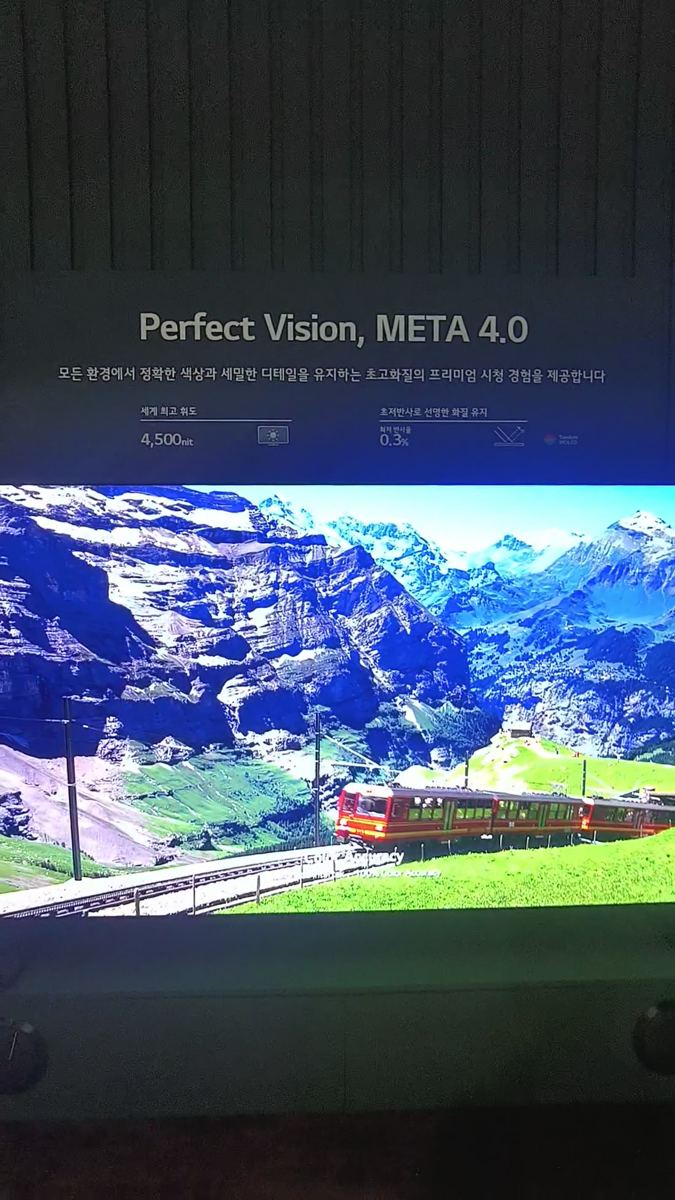
Introduction: a booth organized around where OLED lives
LG Display built its K-Display 2026 booth around a simple frame: where OLED lives. Display at Home covered televisions and gaming. Display at Work covered monitors, laptops, tablets and watches. Display at Mobility covered the automobile, including a cabin concept visitors could sit inside. We filmed the entire floor, and across all three zones the deeper story was remarkably consistent. Every headline number, 4,500 nits, 540 Hz, 40 percent lower power, under 0.3 percent reflectance, is the visible result of decisions taken at the level of emitting molecules and stack architecture. This highlight walks through the exhibits zone by zone and connects each specification to the materials science underneath, finishing with the four generations of OLED emitters that explain both what was shown and what comes next.
The headline: fourth generation Primary RGB Tandem
Some materials context makes the headline meaningful. When electrons and holes recombine in an organic emitter, spin statistics produce 25 percent singlet and 75 percent triplet excitons. Commercial panels harvest red and green with second generation phosphorescent emitters, iridium complexes that emit from the triplet state with internal quantum efficiency, IQE, near 100 percent. Blue, however, still relies mostly on fluorescent emitters governed by first generation physics, which caps blue IQE at 25 percent. Blue is therefore the weak link of every OLED product, in efficiency, in brightness headroom, and in lifetime.
LG Display’s fourth generation TV panel answers with architecture: the Primary RGB Tandem stack. Instead of one emitting unit, the panel stacks four, two blue emission layers plus independently driven red and green layers, connected in series by charge generation layers. Because the stacked units share the drive current, each emitting layer operates far below its stress limit while the panel as a whole emits more photons. The results stated on the floor: roughly three times the brightness and double the lifespan of a single stack design, a peak luminance of 4,500 nits, and reflectance under 0.3 percent from the anti glare film stack, which keeps blacks black even under exhibition lighting.
The materials logic deserves emphasis. Doubling the blue layers is a direct, honest response to blue’s 25 percent IQE ceiling. Until a commercial phosphorescent, TADF or hyperfluorescent blue matures, the pragmatic route to brightness and lifetime runs through tandem architecture. And tandem architecture runs through materials: charge generation layers that inject both carrier types cleanly, transparent internal electrodes, and host systems that tolerate the higher voltages of a series stack. Each interface added to the stack is a new chemistry problem solved before it is a device feature.
Three times the brightness and twice the lifespan is not a marketing sentence. It is what happens when four emitting units share the work that one used to do.
Gaming OLED: 540 Hz is a response time argument
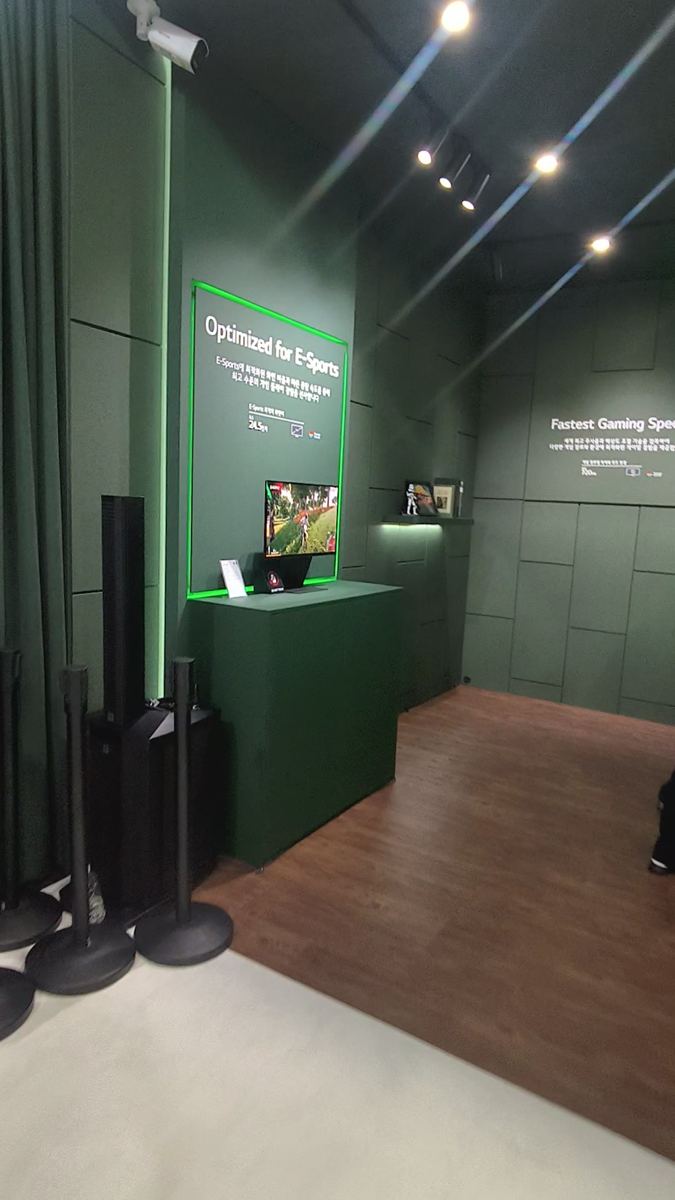
The gaming zone made refresh rate physical: 540 Hz panels, a 27 inch dual frequency design reaching 720 Hz, and a 39 inch 5K ultrawide. At 540 Hz a new frame arrives every 1.85 milliseconds. A liquid crystal cell needs milliseconds simply to reorient its molecules mechanically, so LCD motion performance collapses at these rates. An OLED pixel switches in microseconds because nothing mechanical moves at all: emission follows the drive current through the organic layers almost instantaneously. At these speeds the panel stops being the bottleneck in the chain. The graphics card is.
High refresh also multiplies materials stress in a way spec sheets rarely mention. More frames per second at competitive brightness means more charge pushed through the hole and electron transport layers per unit time, and faster accumulation of the charge induced degradation that ages emitters. Gaming panels therefore lean on the same tandem architectures, robust host materials and high purity transport layers as the flagship televisions. The e-sports market buys motion clarity; what it is really buying is charge transport chemistry that survives abuse.
Display at Work: efficiency is the product
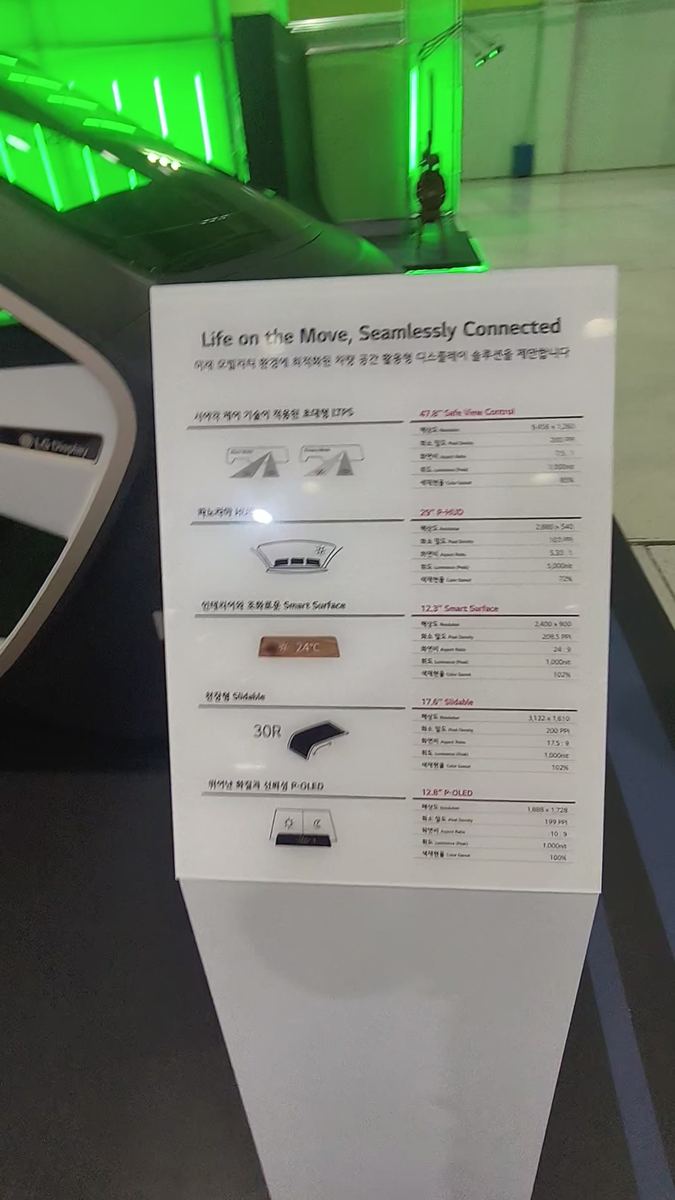
A specification board in the Display at Work zone: 3200 x 2000 resolution, 20 to 120 Hz variable refresh, 1,000,000:1 contrast, 100 percent DCI-P3 color.
The work zone treated efficiency as the product itself. A 27 inch 5K monitor at 220 pixels per inch uses a true RGB stripe subpixel layout, which matters for text rendering because no subpixel borrowing or fringing correction is needed; professionals reading code and documents all day notice. Tandem OLED laptop panels cut power consumption by roughly 40 percent, which is battery life created by stack architecture rather than by a heavier battery. And LTPO backplanes, which combine low temperature polycrystalline silicon drive transistors with oxide switching transistors, let the refresh rate idle from 120 Hz down to 20 Hz or below on static content. LG showed the approach across a 13 inch tablet, a smartphone and a 1.96 inch watch panel.
It helps to see the efficiency chain as one system. The emitter sets how many photons each injected electron produces. The tandem stack sets how gently each layer is driven for a given luminance. The backplane sets how often the panel is asked to do any work at all. Materials sit at the start of that chain, which is why a more efficient emitter, for example a TADF or hyperfluorescent system that harvests every exciton without iridium, propagates savings through the entire device, from panel power to battery mass to charger size.
Mobility: where tandem OLED was born
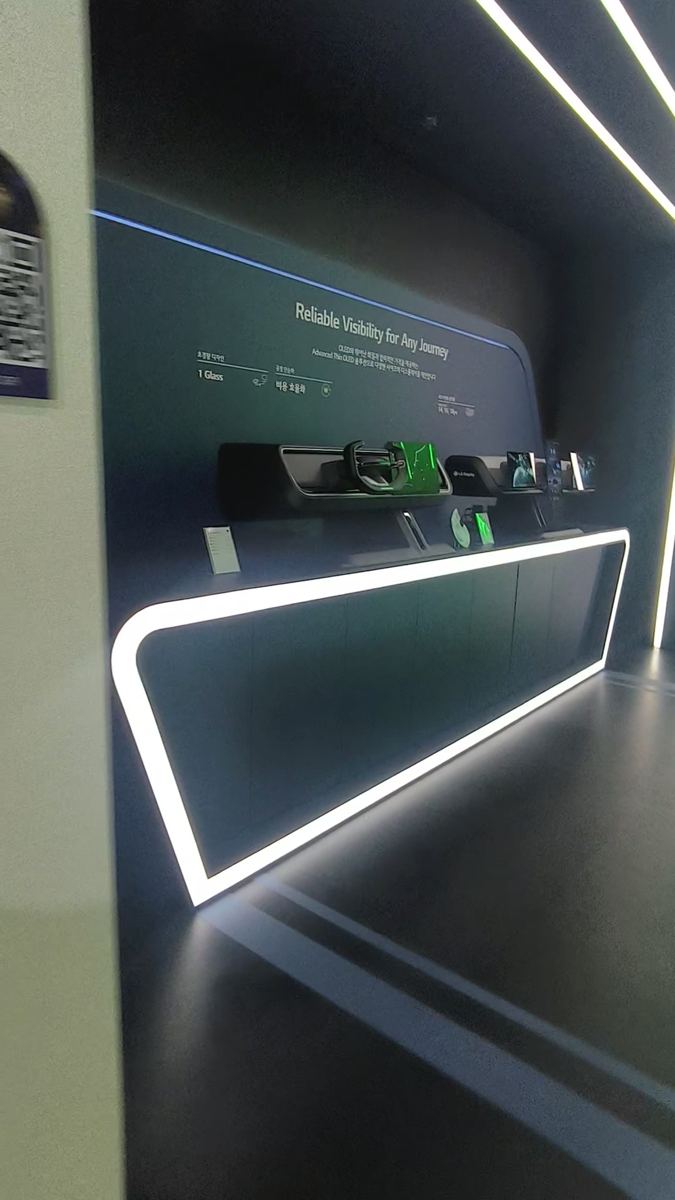
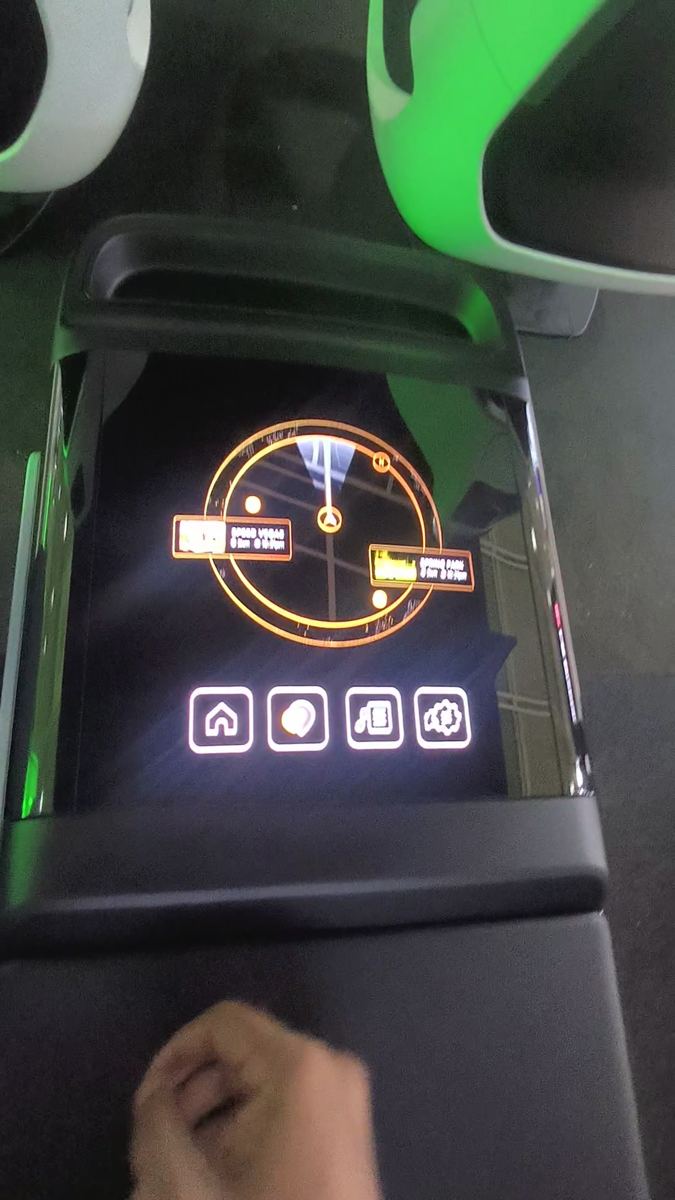
Inside the mobility cabin concept: consoles and armrests wake as displays.
It is easy to forget that tandem OLED was commercialized first in automobiles, years before it reached tablets and televisions, precisely because vehicles demand lifetime above all. The mobility zone showed a 48 inch pillar to pillar dashboard spanning the full width of the car, an 18 inch slidable OLED that unrolls from the ceiling for rear seat passengers, and a cabin concept visitors could sit inside, where consoles and armrests wake up as touch displays. The message: the cabin is becoming an interface, and its surfaces are becoming chemistry.
Automotive panels must survive wide thermal swings and direct sunlight, which is why reflectance and emitter lifetime dominate the specification sheet. Heat accelerates every degradation pathway in the emissive layer, so bond strength, host guest energy alignment, and the impurity level of the deposited films decide whether a panel survives qualification. Purification earns its keep here: trace metals at parts per billion levels measurably shorten device lifetime, which is why sublimation grade materials are the automotive standard, and why suppliers who control purity control the market.
Four generations of OLED emitters: the chemistry behind the specs
The specifications across all three zones are best understood through the four generations of emitter chemistry, the through line of modern display science.
First generation, fluorescence (1987). The modern OLED began with Ching W. Tang and Steven VanSlyke at Kodak, who built the first efficient bilayer organic light emitting diode using the aluminium complex Alq3. When electrons and holes recombine in an organic semiconductor, quantum spin statistics dictate that only 25 percent of the excitons form as singlets while 75 percent form as triplets. A fluorescent emitter can use only the singlets, so its internal quantum efficiency, IQE, is capped at 25 percent. Remarkably, almost four decades later, the deep blue pixel in most commercial OLED panels still runs on this first generation physics. That single fact explains a large share of the display industry roadmap, because blue is the color that limits panel brightness, lifetime and power consumption.
Second generation, phosphorescence (1998). Marc Baldo, Mark Thompson and Stephen Forrest showed that organometallic complexes of heavy metals, first platinum porphyrins and soon after iridium complexes, exploit strong spin orbit coupling to emit light directly from the triplet state. Suddenly all 100 percent of excitons could be harvested. Phosphorescent red and green emitters became the commercial standard and have held it for two decades. The missing piece is blue: a phosphorescent blue with deep color and competitive lifetime has been one of the most valuable unsolved problems in materials chemistry, and the industry watches every announcement in this space closely.
Third generation, thermally activated delayed fluorescence, TADF (2012). Chihaya Adachi and coworkers demonstrated that purely organic molecules, designed with a very small energy gap between their singlet and triplet states, can recycle triplets back into emissive singlets through reverse intersystem crossing driven by ambient thermal energy. TADF offers up to 100 percent IQE without iridium or platinum, which matters for cost, for supply chains, and for molecular design freedom.
Fourth generation, MR-TADF and hyperfluorescence (2016 onward). Takuji Hatakeyama introduced the DABNA family, rigid frameworks of boron and nitrogen atoms in fused aromatic systems, creating what is now called multi resonance TADF, MR-TADF. Their rigidity suppresses the structural relaxation that broadens emission, so they emit with a full width at half maximum, FWHM, near 20 to 30 nm, as narrow as a quantum dot. In a hyperfluorescence device a TADF sensitizer harvests all the excitons and transfers the energy to an MR-TADF terminal emitter, combining complete exciton harvesting with exceptional color purity. This architecture is the emitter community’s road to the BT.2020 color standard, and it is the chemistry LUMORA works with every day.
LG’s four stack tandem is what world class engineering does while blue chemistry catches up. The first panels that pair tandem architecture with fourth generation emitters, narrowband MR-TADF and hyperfluorescent systems, will define the next leap in brightness, lifetime and color gamut simultaneously. That intersection of stack engineering and emitter chemistry is exactly where materials suppliers matter most.
The takeaway
The display roadmap is written in materials. Brightness came from stacking emitting units. Efficiency came from harvesting excitons and from backplanes that know when to rest. Color purity is coming from narrowband emission. Automotive durability is being won by molecular stability and purity. LG Display’s K-Display 2026 booth showed all four levers pulled at once, and each lever, followed to its source, ends at a molecule.
Watch the companion videos: youtu.be/P1IZjmPz5BE (English), youtu.be/7IjI5B4ONOM (Korean).
Glossary for the general reader
OLED. Organic light emitting diode. A display pixel made of thin organic semiconductor films that emit light directly when current flows, with no backlight.
IQE and EQE. Internal and external quantum efficiency. IQE counts photons generated per injected electron inside the device; EQE counts photons that actually escape into the air, typically 20 to 30 percent of IQE without special outcoupling.
Singlet and triplet excitons. The two spin states formed when electrons and holes meet, in a fixed 25 to 75 ratio. Which of them a molecule can use for light defines its emitter generation.
FWHM. Full width at half maximum, the width of an emission peak. Narrower emission means purer color; 20 to 30 nm is the current gold standard for both quantum dots and MR-TADF emitters.
CIE 1931 and BT.2020. The standard map of human color perception, and the widest broadcast color gamut defined on it. Covering more of BT.2020 requires primaries with narrow FWHM.
Tandem stack and charge generation layer. An architecture that stacks two or more emitting units in series, joined by charge generation layers that supply electrons and holes to each unit, trading a little voltage for large gains in brightness and lifetime.
LTPO. A backplane combining polysilicon drive transistors with oxide switching transistors, letting a panel drop its refresh rate on static content to save power.
Nit. One candela per square metre, the standard unit of display brightness. A phone peaks near 1,000 to 2,000 nits; the panels in this report reach 4,500.
MR-TADF and hyperfluorescence. Multi resonance TADF emitters are rigid boron nitrogen molecules with very narrow emission; hyperfluorescence pairs them with a TADF sensitizer that harvests all excitons for them.
Sublimation purification. Purifying a material by evaporating and recondensing it under vacuum, the standard route to the parts per billion purity levels that long lived OLED devices require.
Sourcing the materials behind this story
LUMORA, research to pilot quantities. LUMORA, a brand of LUMORA · a brand of LAMKO Co., Ltd., supplies high purity sublimed OLED, OPV and semiconductor materials, including emitters, hosts and charge transport materials, for research and development use. Every lot ships with a certificate of analysis. Browse the catalogue at lumorachemicals.com or write to sales@lumorachemicals.com.
LAMKO, scale up and CRDMO. For kilogram to production scale supply, custom synthesis of new emitters, and full CRDMO support from first gram to production volume, work with LAMKO. Projects proceed NDA first and your intellectual property stays yours. Start by describing your project to LUMI, our AI project workspace, at lamko.co.kr/lumi, or visit lamko.co.kr.
References and sources
C. W. Tang, S. A. VanSlyke, Applied Physics Letters 51, 913 (1987). M. A. Baldo, M. E. Thompson, S. R. Forrest et al., Nature 395, 151 (1998). H. Uoyama, C. Adachi et al., Nature 492, 234 (2012). T. Hatakeyama et al., Advanced Materials 28, 2777 (2016). Product and exhibit information: LG Display newsroom, LEDinside and OLED-Info coverage of K-Display 2026 and the fourth generation tandem panel. All photographs and footage in this document were taken by LUMORA at K-Display 2026.
Disclaimer: this document is educational commentary based on our own visit to K-Display 2026 and on publicly available information. All product names, brands and trademarks belong to their respective owners. No affiliation or endorsement is implied. Specifications quoted are as presented by the exhibitors and may change.
Emitters, hosts and transport layers
We supply high-purity OLED materials in sublimed grades, from grams to kilograms, shipped worldwide.
Visit LUMORA →Kilogram to production, and custom synthesis
For large-scale supply, new material development and CRDMO support, work with LAMKO directly.
Open LUMI workspace →Partner with us