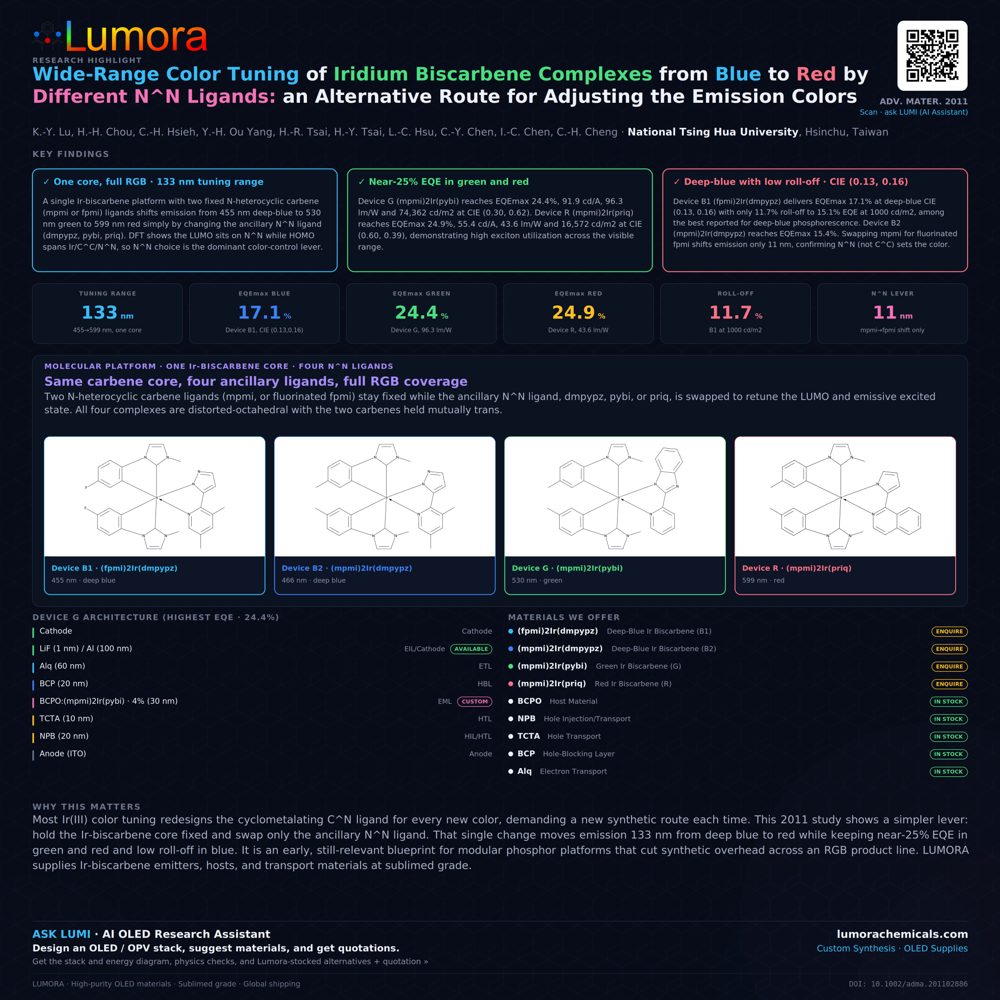
Lu et al., Advanced Materials, 2011 “Wide-Range Color Tuning of Iridium Biscarbene Complexes from Blue to Red by Different N^N Ligands: an Alternative Route for Adjusting the Emission Colors”
At LUMORA CHEMICALS, we value emitter platforms that provide a modular route to multiple display colors without rebuilding the entire molecular framework. This 2011 Advanced Materials study is a foundational example: it shows that a common Ir-biscarbene core can be maintained while the heteroleptic N^N ligand controls the LUMO and triplet emissive state. That design lever produces a continuous shift from deep-blue to green and red emission, together with strong phosphorescent OLED efficiencies in all three primary colors.
The Problem: Conventional Iridium Color Tuning Often Relies on C^N Ligand Redesign
Cyclometalated Ir(III) phosphors are highly efficient because phosphorescence can utilize both singlet and triplet excitons, but shifting their emission across the RGB range traditionally requires redesigning C^N ligands, changing conjugation length, adding electron-withdrawing/donating substituents, or replacing the third ligand. These approaches can demand new synthetic routes for each color. The authors instead ask whether emission can be tuned broadly by preserving the two N-heterocyclic carbene ligands and varying only an N^N ancillary ligand.
The Breakthrough: N^N Ligands Control LUMO and Emissive-State Energy
The authors synthesize four distorted-octahedral heteroleptic Ir-biscarbene complexes: (fpmi)2Ir(dmpypz), (mpmi)2Ir(dmpypz), (mpmi)2Ir(pybi), and (mpmi)2Ir(priq). The carbene ligands are largely held constant while dmpypz, pybi, and priq provide progressively different N^N electronic structures. Calculations show that the LUMO is located primarily on the N^N ligand, whereas the HOMO is distributed across Ir, C^C, and N^N components. Replacing the N^N ligand therefore shifts the excited-state energy substantially: the emission maximum moves by 133 nm, from blue through green to red, while changing mpmi to fpmi alone shifts the blue emission only 11 nm.
Emitter Platform: IUPAC names
Key Results
- One ligand family, RGB coverage: Changing the N^N ligand shifts emission from 455 nm (deep blue) to 530 nm (green) and 599 nm (red), a 133 nm tuning range. In contrast, replacing mpmi with fluorinated fpmi while keeping dmpypz changes emission by only 11 nm, confirming that N^N ligand choice is the dominant color-control lever.
- High-quality deep-blue OLEDs: The dmpypz complexes yield deep-blue devices with CIE (0.13, 0.16) and (0.13, 0.18), EQEmax values of 17.1% and 15.4%, and retained EQEs of 15.1% and 13.6% at 1000 cd m−2. Device B1 shows low efficiency roll-off of about 11.7% and CIE x+y < 0.30.
- Near-25% EQE green and red phosphorescence: The pybi-based green device reaches EQEmax 24.4%, 91.9 cd A−1, 96.3 lm W−1, and 74 362 cd m−2. The priq-based red device reaches EQEmax 24.9%, 55.4 cd A−1, and CIE (0.60, 0.39), demonstrating high exciton utilization across RGB.
- MLCT-containing triplet states: All complexes exhibit 13–23 nm blue shifts at 77 K and short phosphorescence lifetimes, consistent with significant MLCT contribution to the room-temperature excited state and favorable radiative performance.
Why This Matters for OLED Material Supply
For LUMORA CHEMICALS, this paper establishes a valuable modular synthesis principle for phosphorescent emitters: a stable Ir-biscarbene platform can be used across RGB colors by tailoring the ancillary N^N ligand that defines the accepting orbital and emissive state. This reduces the need to re-engineer the entire cyclometalating framework for every target color. The combination of deep-blue color purity, low roll-off, and near-25% EQE in green and red makes this ligand-centric approach a useful reference for next-generation Ir phosphor development and supply portfolios.
(fpmi)2Ir(dmpypz)
Iridium(III) bis1-(4-fluorophenyl)-3-methylimidazolin-2-ylidene-C,C²′
(mpmi)2Ir(dmpypz)
Iridium(III) bis1-(4-methylphenyl)-3-methylimidazolin-2-ylidene-C,C²′
(mpmi)2Ir(pybi)
Iridium(III) bis[1-(4-methylphenyl)-3-methylimidazolin-2-ylidene-C,C²′][2-(pyridin-2-yl)-1H-benzo[d]imidazole]
(mpmi)2Ir(priq)
Iridium(III) bis[1-(4-methylphenyl)-3-methylimidazolin-2-ylidene-C,C²′][1-(1H-pyrrol-2-yl)isoquinolinato]
R&D and pilot quantities
We supply the key materials from this study in high-purity sublimed grades, from grams to kilograms, shipped worldwide.
Visit LUMORA →Kilogram to production, and custom synthesis
For large-scale supply, new emitter synthesis, and CRDMO support, work with LAMKO directly. Scope your project in the LUMI workspace, or send a partnership request.
Open LUMI workspace →Partner with us