Why do deep-blue OLEDs still fall short of their theoretical efficiency limits?
The core problem is that achieving high efficiency, narrow emission, and long operational lifetime simultaneously in blue OLEDs requires perfect coordination between interfacial energetics, charge balance, and exciton management, and most device architectures optimise these independently rather than as a unified system.
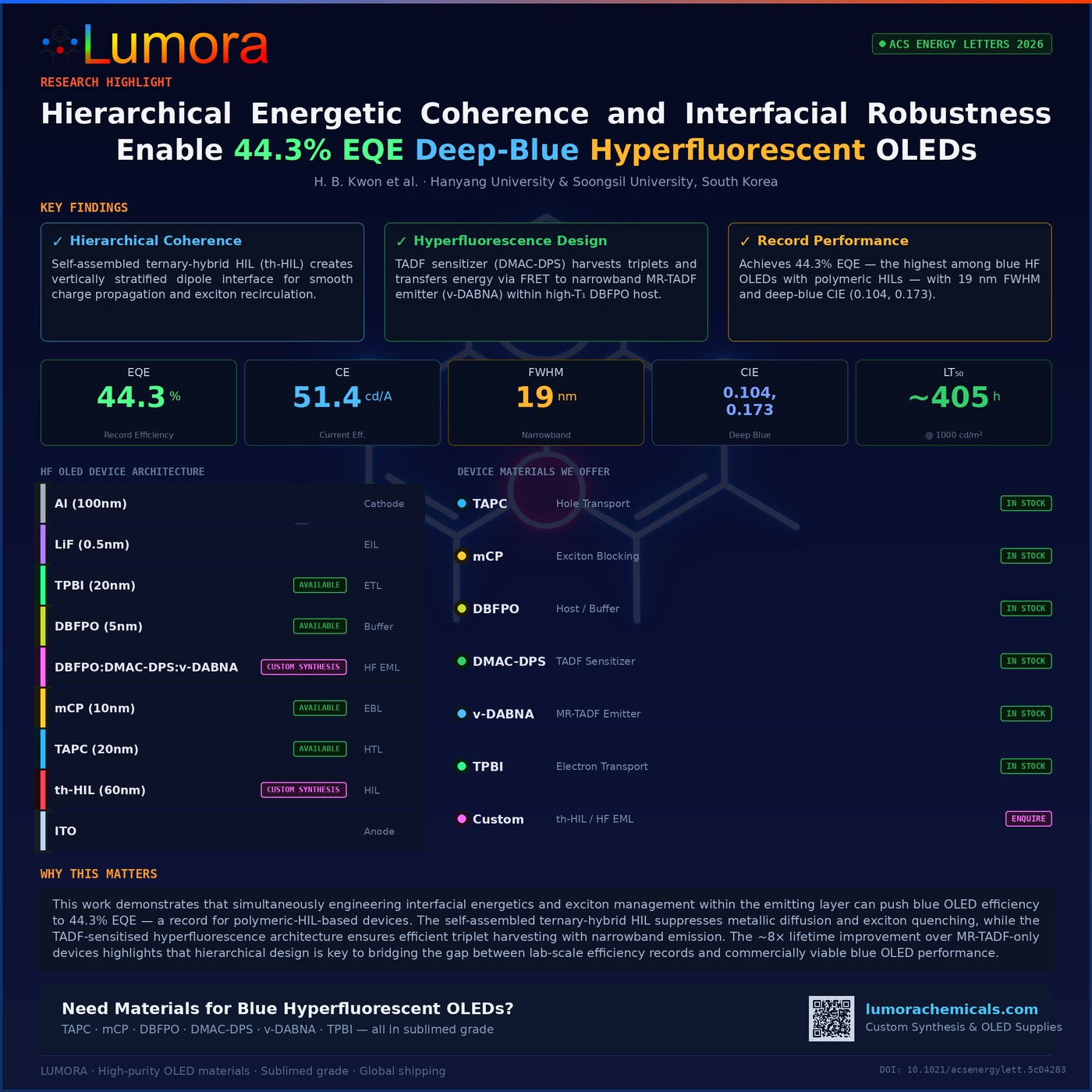
New work published in ACS Energy Letters by researchers at Hanyang University and Soongsil University demonstrates that integrating hierarchical energy-level coherence with robust interfacial photophysics can push blue hyperfluorescent OLEDs to a record 44.3% EQE, the highest reported among blue HF OLEDs using polymeric hole-injection layers.
What they did
The authors engineered two critical innovations simultaneously:
1. A self-assembled ternary-hybrid hole-injection layer (th-HIL) composed of PEDOT:PSS, PFSA, and NiOₓ. During film drying, PFSA spontaneously segregates to the surface, creating a vertically stratified architecture with a depth-graded work function. This suppresses metallic species diffusion from the ITO anode, blocks exciton quenching at the HIL/HTL interface, and preserves the exciton recirculation pathway, even across a 30 nm HTL buffer.
2. A hyperfluorescence (HF) emitting layer combining a fast triplet-upconverting TADF sensitizer (DMAC-DPS), a high-triplet-energy host (DBFPO), and a narrowband MR-TADF terminal emitter (v-DABNA). The sensitizer harvests both singlet and triplet excitons and funnels them via efficient Förster resonance energy transfer (FRET) to v-DABNA, achieving narrowband deep-blue emission while suppressing triplet accumulation.
---
What they achieved
- External quantum efficiency of 44.3% (record for polymeric-HIL blue HF OLEDs)
- Current efficiency of 51.4 cd/A
- Narrowband emission at 473 nm with 19 nm FWHM
- Deep-blue CIE coordinates of (0.104, 0.173)
- Operational half-lifetime LT₅₀ ≈ 405 h at 1000 cd/m², an ~8× improvement over the MR-TADF reference
- Stepwise HIL improvement: LT₅₀ from ~16.8 h (PEDOT:PSS) > ~61.7 h (f-PEDOT:PSS) > ~404.8 h (th-HIL)
---
What's worth taking from this
The central message is that interfacial design and emitting-layer engineering are not independent optimisation problems, they must be solved together. The th-HIL doesn't just improve hole injection; it preserves exciton recirculation across the entire multilayer stack. The HF architecture doesn't just boost efficiency; it redistributes exciton density away from the fragile terminal emitter, directly extending device lifetime.
This hierarchical approach, where every layer from the anode to the cathode participates in a coherent energetic continuum, represents a shift from component-level to system-level OLED design.
A practical consideration: while the EQE of 44.3% is exceptional, the device uses a solution-processed HIL in combination with vacuum-deposited organic layers, which may present integration challenges for fully solution-processed manufacturing workflows.
---
R&D and pilot quantities
We supply the key materials from this study in high-purity sublimed grades, from grams to kilograms, shipped worldwide.
Visit LUMORA →Kilogram to production, and custom MR-TADF
For large-scale supply, new emitter synthesis, and CRDMO support, work with LAMKO directly. Scope your project in the LUMI workspace, or send a partnership request.
Open LUMI workspace →Partner with us