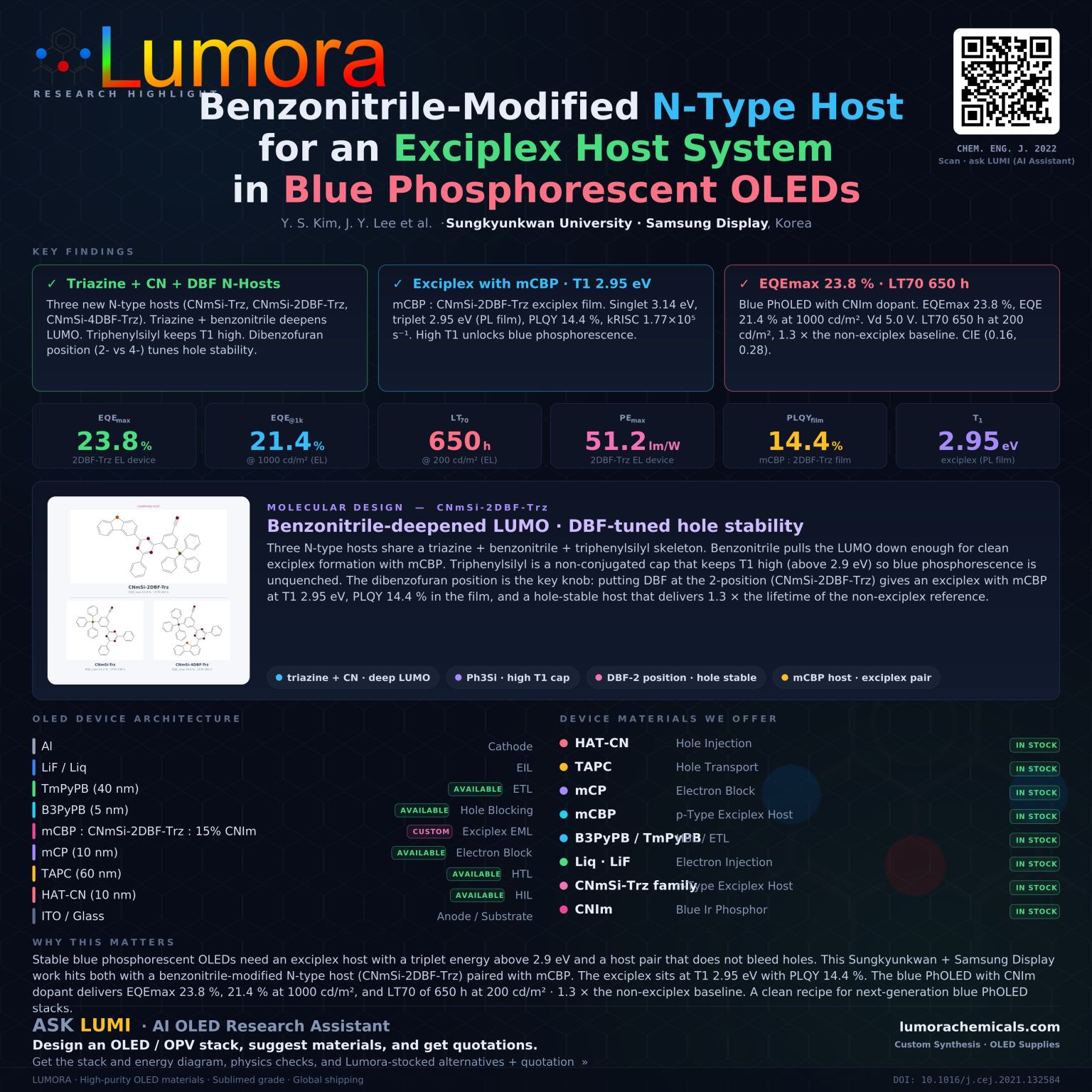
Outperforming the non-exciplex reference in both efficiency and operational stability
Kim, Lim, Lee et al., Chemical Engineering Journal, 2022 "Benzonitrile modified N-type host for exciplex host to enhance efficiency and lifetime in blue phosphorescent organic light-emitting diodes"
At LUMORA CHEMICALS, we spotlight the scientific developments that improve real OLED device performance at the materials-stack level. This 2022 Chemical Engineering Journal paper by Yoon Sung Kim, Junseop Lim, and Prof. Jun Yeob Lee, in collaboration with Samsung Display, demonstrates how molecular engineering of N-type host materials can simultaneously improve charge balance, triplet management, driving voltage, efficiency, and operational lifetime in blue phosphorescent OLEDs by using an exciplex host strategy.
The Problem: Blue PhOLEDs Need Both High Triplet Energy and Long-Term Stability
Blue phosphorescent OLEDs can theoretically reach 100% internal quantum efficiency, but practical commercialization remains difficult because the host materials must combine high triplet energy, stable charge transport, and resistance to degradation under operation. Mixed-host systems are already known to improve charge balance and reduce polaron stress, but blue exciplex hosts remain especially challenging because they require a sufficiently deep LUMO, a suitable HOMO-LUMO offset with the P-type host, and sufficient triplet energy to avoid back-energy transfer from the dopant to the host.
The Breakthrough: Benzonitrile-Modified N-Type Exciplex Hosts
The authors designed three new N-type hosts by combining triazine and benzonitrile acceptor units with a triphenylsilyl blocking group: CNmSi-Trz, CNmSi-2DBF-Trz, and CNmSi-4DBF-Trz. Dibenzofuran was additionally introduced in two of the hosts to tune charge transport and hole stability. All three materials were paired with the P-type host mCBP to form mixed hosts, and both CNmSi-Trz and CNmSi-2DBF-Trz successfully formed high-triplet-energy exciplexes, while CNmSi-2DBF-Trz emerged as the best overall host due to its balanced electron transport, high triplet energy, and improved hole stability.
Key Device & Host Results
- Best EQE: 23.8% maximum EQE for the mCBP: CNmSi-2DBF-Trz device; 21.4% at 1,000 cd/m².
- Best lifetime: 650.5 h LT70 at 200 cd/m² for mCBP:CNmSi-2DBF-Trz, 1.3× longer than the non-exciplex mSiTrz reference.
- Driving voltage: Only 5.0 V at 1,000 cd/m² for CNmSi-2DBF-Trz, lower than the 6.0 V reference device.
- Power efficiency: 51.2 lm/W maximum and 25.0 lm/W at 1,000 cd/m² for the best device.
- Triplet energy of exciplex host: 2.95 eV for mCBP: CNmSi-2DBF-Trz, high enough for blue phosphor confinement.
- Thermal stability: Td/Tg of 404°C / 114°C for CNmSi-2DBF-Trz, showing good process stability.
- Why 4DBF underperformed: Its exciplex triplet energy dropped to 2.81 eV, causing back energy transfer and exciton quenching.
Why This Matters for OLED Material Supply
This work shows that the performance of blue PhOLEDs can be significantly improved not only by emitter design, but by precise engineering of the supporting host system. The optimized exciplex stack, mCBP as the P-type host paired with CNmSi-2DBF-Trz as the N-type host and CNIm as the phosphorescent dopant, delivered better voltage, efficiency, and lifetime than the non-exciplex benchmark. For OLED material suppliers, this highlights growing demand for high-triplet N-type hosts, mixed-host exciplex systems, and stable transport materials that can support commercial blue PhOLED architectures.
Reference: Kim, Y. S.; Lim, J.; Lee, J. Y.; Lee, Y.; Choo, C. Chem. Eng. J. 2022, 429, 132584. DOI: 10.1016/j.cej.2021.132584
Compound
IUPAC Systematic Name
Formula
CNmSi-Trz
3-(4,6-Diphenyl-1,3,5-triazin-2-yl)-5-(triphenylsilyl)benzonitrile
C33H22N4Si
CNmSi-2DBF-Trz
3-(4-(Dibenzo[b,d]furan-2-yl)-6-phenyl-1,3,5-triazin-2-yl)-5-(triphenylsilyl)benzonitrile
C39H24N4OSi
CNmSi-4DBF-Trz
3-(4-(Dibenzo[b,d]furan-4-yl)-6-phenyl-1,3,5-triazin-2-yl)-5-(triphenylsilyl)benzonitrile
C39H24N4OSi
R&D and pilot quantities
We supply the key materials from this study in high-purity sublimed grades, from grams to kilograms, shipped worldwide.
Visit LUMORA →Kilogram to production, and custom MR-TADF
For large-scale supply, new emitter synthesis, and CRDMO support, work with LAMKO directly. Scope your project in the LUMI workspace, or send a partnership request.
Open LUMI workspace →Partner with us