Why do deep‑blue MR‑TADF OLEDs so often lose their narrow spectra and efficiency once you go from solution to actual devices?
The core problem is that planar, rigid polycyclic frameworks that give MR‑TADF emitters their narrowband emission also promote strong intermolecular interactions in the solid state. This drives aggregate and excimer formation, broadens and red‑shifts the spectrum, and opens nonradiative decay pathways. Many MR‑TADF cores also fall short of strict BT.2020 blue requirements in devices.
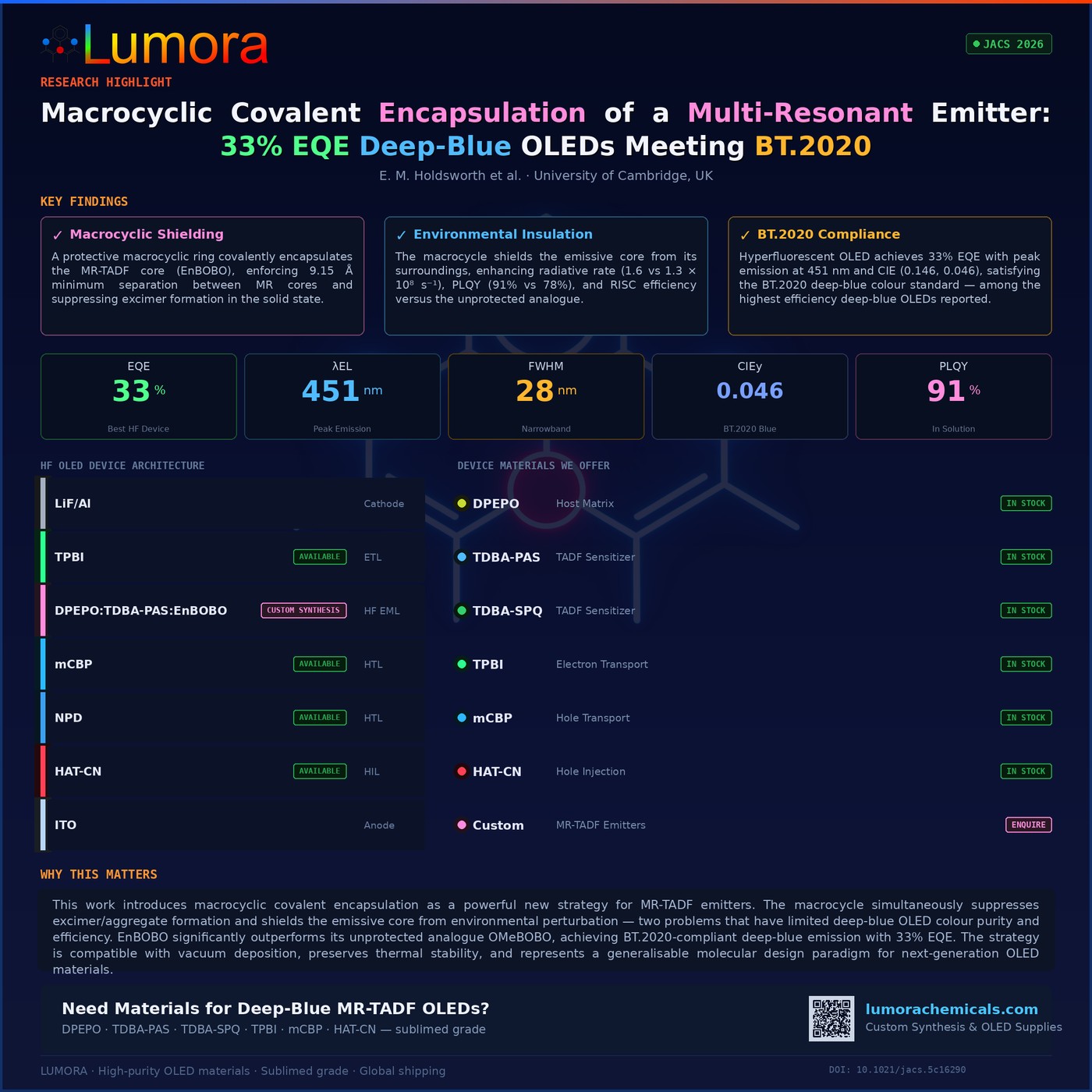
New work in J. Am. Chem. Soc. from a Technion-Cambridge collaboration shows that covalent macrocyclic encapsulation of a blue‑shifted MR‑TADF core can suppress aggregation, shield the emitter, and push deep‑blue hyperfluorescent OLEDs to 33% EQE while meeting BT.2020 blue.
What they did
The authors implemented two tightly coupled design elements:
Macrocyclic covalent encapsulation of an MR‑TADF core. A ν‑DABNA‑type deep‑blue emitter was modified with a macrocyclic ring to produce an encapsulated emitter (EnBOBO), compared with a non‑encapsulated analogue. Single‑crystal X‑ray diffraction confirms encapsulation and shows increased 3D character and larger intermolecular spacing, blocking π-π contacts that promote aggregation and excimers.
Hyperfluorescent device architecture. The encapsulated emitter serves as the terminal deep‑blue emitter in a hyperfluorescent OLED with a TADF sensitizer and host. Triplets are harvested on the sensitizer and transferred radiatively to the core. Spectrally resolved transient PL reveals weak aggregate/excimer species in the reference and shows strong suppression in the encapsulated system, preserving narrow emission.
What they achieved
- EQE up to 33% using EnBOBO.
- EL peak at 451 nm with CIE (0.146, 0.046), meeting BT.2020 blue.
- Narrowband emission retained with reduced red‑shift and broadening.
- Increased radiative rate, PLQY, and RISC via environmental shielding.
- Thermal robustness (~436 °C, 5% loss).
What's worth taking from this
"Add bulky groups" is not sufficient. Macrocyclic encapsulation blocks MR-MR interactions while shielding the emissive core, enabling improved radiative and RISC rates. Key loss channels are only visible in transient PL, not steady‑state spectra.
A practical consideration
Macrocyclic encapsulation offers a general design route for next‑generation MR‑TADF emitters. Building a protective macrocycle can enable device‑level deep‑blue performance aligned with BT.2020.
R&D and pilot quantities
We supply the key materials from this study in high-purity sublimed grades, from grams to kilograms, shipped worldwide.
Visit LUMORA →Kilogram to production, and custom MR-TADF
For large-scale supply, new emitter synthesis, and CRDMO support, work with LAMKO directly. Scope your project in the LUMI workspace, or send a partnership request.
Open LUMI workspace →Partner with us