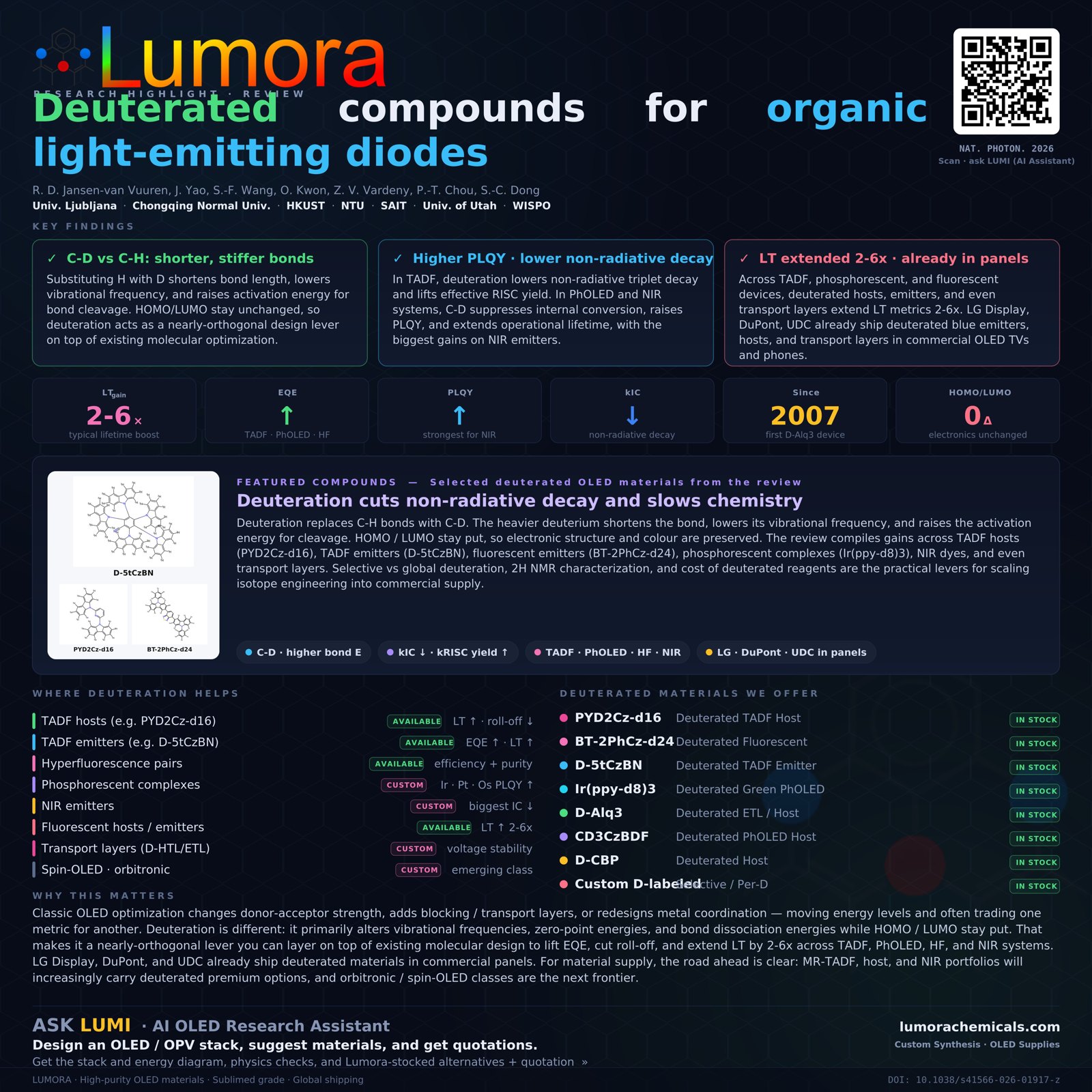
Jansen-van Vuuren, Yao, Wang, Kwon, Vardeny, Chou, and Dong, Nature Photonics, 2026 — "Deuterated compounds for organic light-emitting diodes"
At LUMORA CHEMICALS, we see deuteration as a cross-cutting design lever that can be applied to many OLED material families including MR-TADF, phosphorescent complexes, and NIR dyes without changing frontier orbital energies. This 2026 Nature Photonics review authored by Ross D. Jansen-van Vuuren and colleagues summarizes how the deuterium isotope effect has evolved from a niche tool to a mainstream strategy used in commercial panels. It organizes the field around three main benefits: suppressing nonradiative decay, slowing chemical degradation, and sometimes improving charge transport through subtle changes in packing.
The Problem: Improving Lifetime and Efficiency Without Re-Engineering Electronic Structure
Classic OLED optimization relies on changing donor–acceptor strength, adding transport and blocking layers, or redesigning metal-coordination environments. These changes inevitably modify energy levels, bandgaps, and spectra, and they often trade improvements in one metric against losses in another. The review highlights deuteration as fundamentally different: by substituting hydrogen with deuterium, one primarily alters vibrational frequencies, zero-point energies, and bond dissociation energies, while keeping HOMO/LUMO positions effectively unchanged. The key challenge is to understand where deuteration provides the largest benefit and how to implement it cost-effectively in real device stacks.
The Breakthrough: Deuterium Isotope Effect as a General OLED Design Tool
The article explains that C–D bonds have slightly higher bond energies and lower vibrational frequencies than C–H bonds, which reduces nonradiative decay from excited states and increases activation barriers for bond-breaking degradation processes. In TADF emitters, this means lower nonradiative triplet decay and a higher effective RISC yield, translating into higher delayed-fluorescence efficiency and EQE. In phosphorescent and NIR systems, deuteration suppresses internal conversion, raises PLQY, and lengthens device lifetimes. The authors compile many examples where targeted deuteration at fragile sites or perdeuteration across whole molecules yields cumulative gains in stability and efficiency.
Key Results and Trends Highlighted in the Review
- Fundamental mechanism: Deuteration lowers vibrational frequencies and zero-point energies, which reduces nonradiative decay and raises activation energies for degradation pathways involving C–H/C–D bond cleavage.
- Quantum efficiency in TADF and PhOLEDs: Deuterated TADF emitters show clear EQE gains across blue, green, and yellow devices, while deuterated Ir, Pt, and Os complexes deliver higher PLQYs and device efficiencies, especially for NIR emission where internal conversion is strong.
- Operational lifetime: Across TADF, phosphorescent, and fluorescent systems, deuterated hosts, emitters, and even transport layers consistently extend LT metrics, often by factors of 2–6, by slowing chemical degradation and exciton–polaron annihilation.
- Charge transport and packing: Some deuterated hosts exhibit more compact film packing and higher carrier mobilities, although the review notes that the impact on transport is system-dependent and still under debate.
- Industrial adoption: LG Display, DuPont, UDC and others already deploy deuterated blue emitters, hosts, and transport layers in commercial OLED TVs and smartphone panels, demonstrating that isotope engineering has moved beyond laboratory curiosity.
- Design considerations: The authors emphasize selective versus global deuteration strategies, cost and sustainability of deuterated reagents, and the need for rigorous characterization (including 2H NMR) to maintain isotopic integrity.
Why This Matters for OLED Material Supply
For materials suppliers, this review is a roadmap showing how isotope engineering can be layered on top of existing molecular design strategies to extend lifetime and unlock new performance regimes. It suggests that future MR-TADF, host, and NIR portfolios will increasingly offer deuterated analogues as premium options, particularly for blue and NIR applications where stability and nonradiative losses are most acute. The article also points toward emerging opportunities in orbitronics and spintronic OLEDs, where deuteration may help clarify and control spin–phonon and orbital interactions in organic semiconductors, opening new device classes beyond displays alone.
Reference: Jansen-van Vuuren, R. D.; Yao, J.; Wang, S.-F.; Kwon, O.; Vardeny, Z. V.; Chou, P.-T.; Dong, S.-C. Nat. Photon. 2026, Deuterated compounds for organic light-emitting diodes. DOI: 10.1038/s41566-026-01917-z
Key Compounds & IUPAC Names
PYD2Cz-d16
2,6-bis(1,2,3,4,5,6,7,8-octadeuteriocarbazol-9-yl)pyridine
BT-2PhCz-d24
4,7-bis[1,2,4,5,6,7,8-heptadeuterio-9-(2,3,4,5,6-pentadeuteriophenyl)-9H-carbazol-3-yl]-2,1,3-benzothiadiazole
D-5tCzBN
2,3,4,5,6-pentakis[1,2,3,4,5,6,7,8-octadeuterio-9H-carbazol-9-yl]benzonitrile
Ir(ppy-d8)3
fac-tris[2-(3,4,5,6-tetradeuteriopyridin-2-yl-κN)-3,4,5,6-tetradeuteriophenyl-κC¹]iridium(III)
R&D and pilot quantities
We supply deuterated emitters, hosts, and transport materials in high-purity sublimed grades, from grams to kilograms, shipped worldwide.
Visit LUMORA →Kilogram to production, and custom deuteration
For large-scale supply, selective or global deuteration of your own materials, and CRDMO support, work with LAMKO directly. Scope your project in the LUMI workspace, or send a partnership request.
Open LUMI workspace →Partner with us