Why are deep-blue CP-OLEDs still so difficult to realise, even after major progress in OLED materials?
The central challenge is that a deep-blue emitter must simultaneously maintain a wide bandgap, strong chiroptical activity, and high electroluminescence performance. In practice, improving one of these properties often weakens another, so deep-blue circularly polarised devices remain rare.
New work published in Angewandte Chemie proposes a compact molecular-design solution built around C₂-symmetric axial chirality. Rather than relying on external chiral environments or sacrificing colour purity, the authors designed chirality directly into a small organic emitter that can still preserve deep-blue emission.
What they did
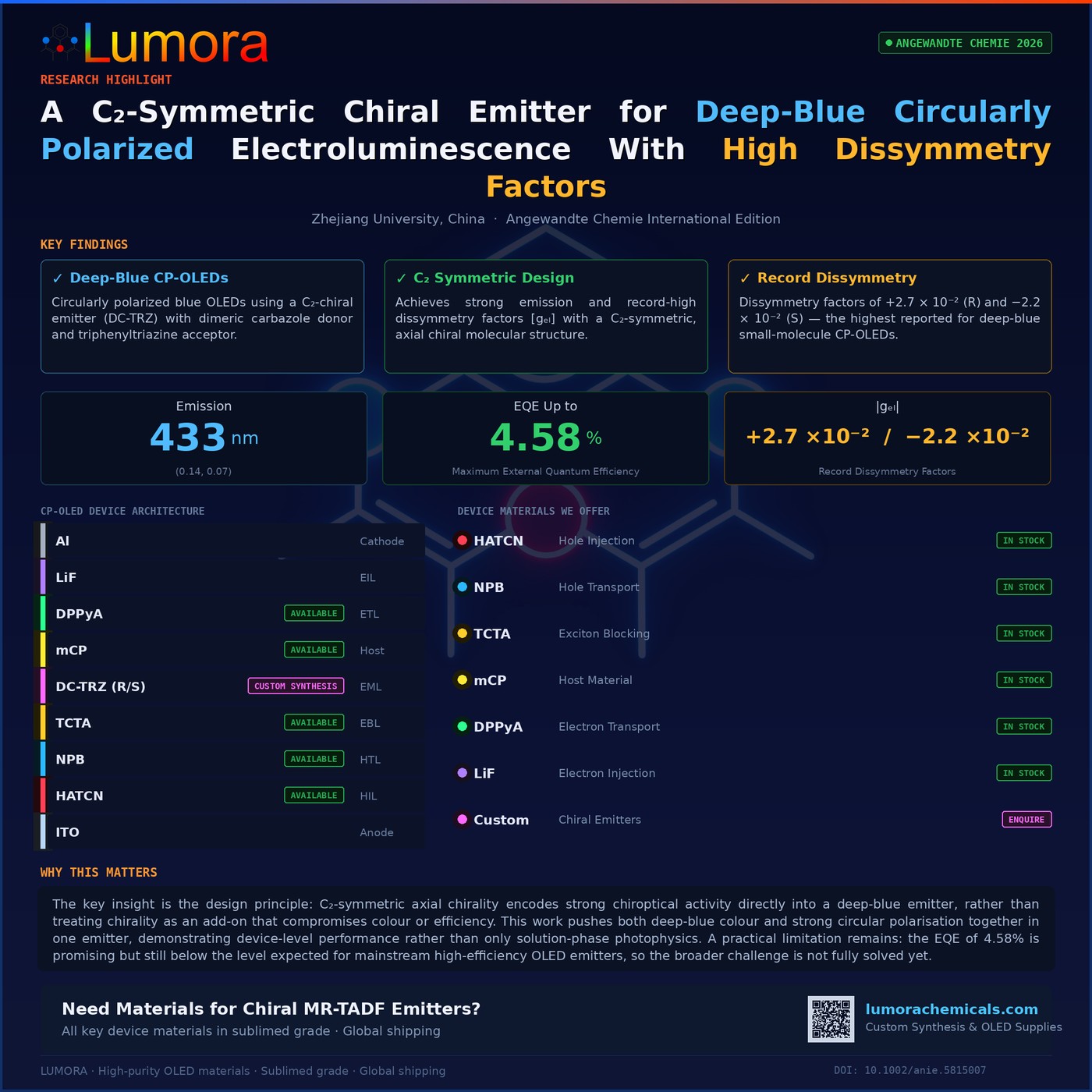
They developed DC-TRZ, a C₂-symmetric chiral emitter composed of a dimeric carbazole donor and a triphenyltriazine acceptor. The optically pure (R)- and (S) enantiomers were prepared and evaluated for their photophysics, circular dichroism, CPL, and CP-OLED device performance.
One molecule was therefore asked to solve several problems at once: maintain a sufficiently wide bandgap for deep-blue emission, generate measurable chiroptical activity, and function as an efficient electroluminescent emitter in a device.
What they achieved (DC-TRZ)
- Deep-blue emission centred at 433 nm
- Emission efficiency up to 79%
- Clear Cotton effects and distinct CPL from the enantiopure isomers
- CP-OLEDs with CIE coordinates of (0.14, 0.07)
- Maximum EQE of 4.58%
- Record-high electroluminescence dissymmetry factors of +2.7 × 10⁻² and −2.2 × 10⁻² for the two enantiomers
These are among the highest dissymmetry factors reported for blue CP-OLEDs from small organic molecules, with truly deep-blue emission.
What's worth taking from this
The key idea is not only the specific molecule, but the design principle. C₂-symmetric axial chirality can be used as a molecular strategy to encode strong chiroptical activity directly into a deep-blue small-molecule emitter, instead of treating chirality as an add-on that compromises colour or efficiency. Many studies report either better blue colour or stronger circular polarisation. This work stands out because it pushes both together in one emitter and demonstrates device-level performance rather than only solution-phase photophysics.
A practical limitation remains: the EQE is promising but still below the level expected for mainstream high-efficiency OLED emitters, so the broader challenge of combining very high efficiency, long operational lifetime, and large dissymmetry in deep-blue CP-OLEDs is not fully solved yet.
R&D and pilot quantities
We supply the key materials from this study in high-purity sublimed grades, from grams to kilograms, shipped worldwide.
Visit LUMORA →Kilogram to production, and custom MR-TADF
For large-scale supply, new emitter synthesis, and CRDMO support, work with LAMKO directly. Scope your project in the LUMI workspace, or send a partnership request.
Open LUMI workspace →Partner with us