Why do BT.2020-level pure-green MR-TADF OLEDs with both ultra-narrow emission and concentration-tolerant device performance remain so hard to realize?
The core problem is that pure-green OLED emitters cannot be optimized solely by emission wavelength. To approach the BT.2020 green point, the material must simultaneously deliver the correct green peak, an ultra-narrow FWHM, suppressed vibronic shoulder peaks, high PLQY, and stable spectra even at practical doping concentrations where aggregation-caused quenching and spectral broadening are common.
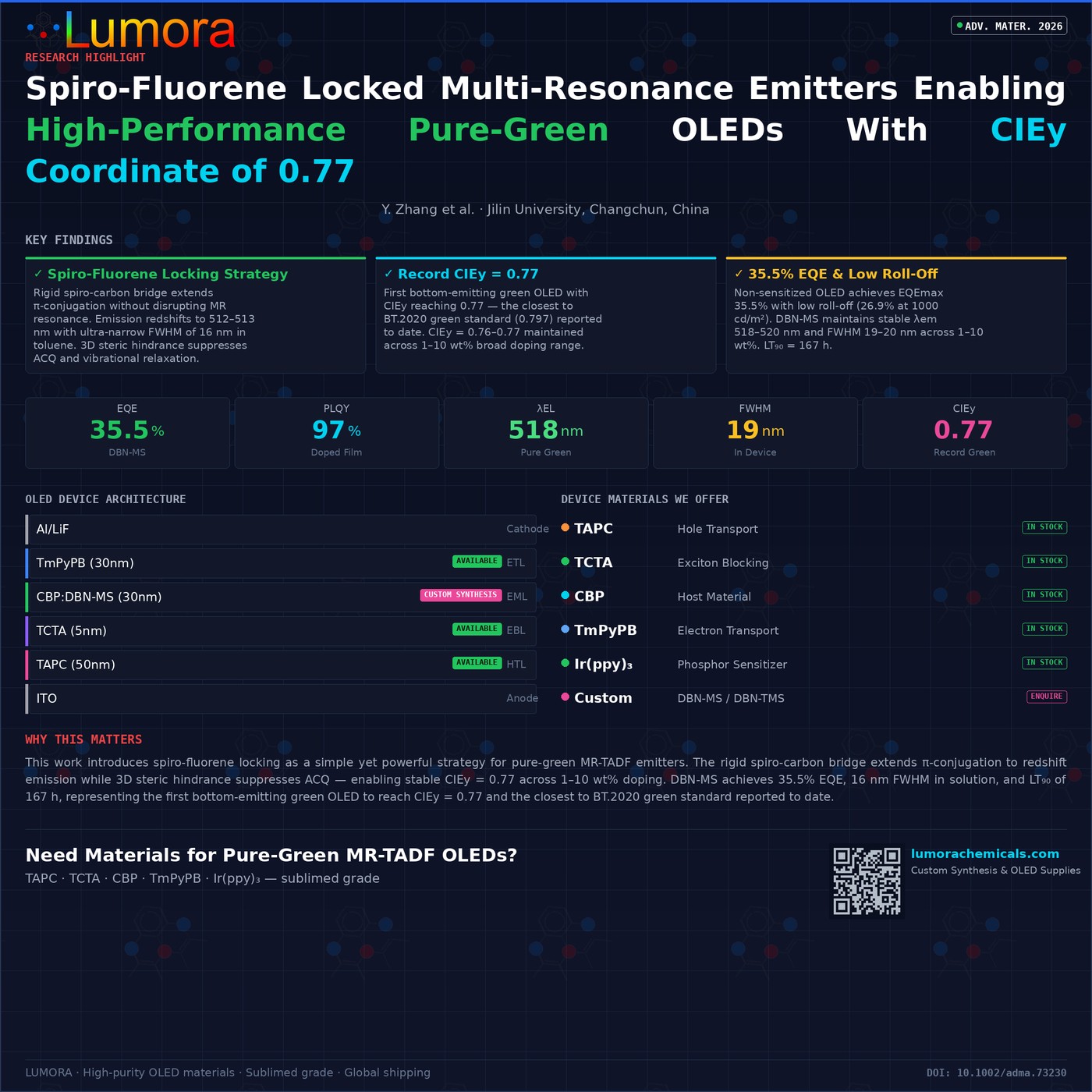
New work published in Advanced Materials by Zhang, Ling, Li, Liu, and co-workers shows that spiro-fluorene locking is a simple but powerful molecular design strategy for pure-green MR-TADF emitters, enabling bottom-emitting OLEDs with CIEy values up to 0.77 while preserving high efficiency, low roll-off, and broad doping tolerance.
What they did
The authors designed two spiro-fluorene locked MR-TADF emitters, DBN-MS and DBN-TMS, using DBN as the parent reference structure. The idea was not only to extend pi-conjugation for a controlled redshift into pure green, but also to physically lock and shield the MR core so that the emission remains narrow in solid films and devices.
They combine:
1. A rigid spiro-carbon bridge that links fluorene units to the MR skeleton, extending pi-conjugation without destroying the short-range charge-transfer character of the B/N multi-resonance core.
2. A 3D steric shield from nearly perpendicular spiro-fluorene and phenyl groups, which suppresses molecular rotation, excited-state structural relaxation, and intermolecular pi-pi stacking.
3. Detailed molecular and device validation using single-crystal analysis, DFT/TD-DFT calculations, Huang-Rhys/reorganization-energy analysis, doped-film photophysics, horizontal dipole measurements, and non-sensitized OLED devices over 1-10 wt% doping concentrations.
These emitters are then incorporated into conventional bottom-emitting OLEDs with CBP as the host material for the emitting layer to test whether the molecular locking concept can withstand real device conditions rather than only dilute-solution measurements.
What they achieved
- Ultra-narrow pure-green emission in solution: DBN-MS and DBN-TMS emit at 512-513 nm with FWHM = 16 nm, showing that spiro-fluorene extension can redshift the DBN parent while preserving MR-type spectral sharpness.
- Strong concentration tolerance, especially for DBN-MS: in CBP films from 1 to 10 wt%, DBN-MS keeps nearly unchanged emission at 518-520 nm with FWHM = 19-20 nm and high PLQY of 93-97%, effectively suppressing aggregation-caused quenching and spectral broadening.
- High-performance non-sensitized OLEDs: the best DBN-MS device reaches EQEmax = 35.5%, CEmax = 126.9 cd A-1, PEmax = 110.8 lm W-1, and still maintains EQE = 26.9% at 1000 cd m-2.
- Record-level pure-green color for bottom-emitting OLEDs: DBN-MS devices show CIEy = 0.76-0.77 across 1-10 wt% doping, including CIE = (0.13, 0.77) at 1 wt%, reported as the first bottom-emitting green OLEDs reaching CIEy = 0.77 and the closest result to the BT.2020 green standard to date.
- Device stability is also meaningful: in a stable non-sensitized structure, the DBN-MS device shows LT90 = 167 h at an initial luminance of 1000 cd m-2, much longer than the DBN-TMS analogue.
Altogether, the work shows that spiro-fluorene locking can deliver green MR-TADF OLEDs that are spectrally sharp, efficient, concentration-tolerant, and much closer to BT.2020 green than previous bottom-emitting OLEDs.
What's worth taking from this
The central message is that spiro-fluorene is not just a bulky substituent. In this design, it acts as a molecular lock and steric shield, simultaneously controlling the emission wavelength, spectral linewidth, excited-state relaxation, intermolecular packing, and concentration quenching.
By moving from simple peripheral substitution to spiro-fluorene locking of the MR skeleton, the authors demonstrate that you can:
· Redshift a sky-blue MR core into the pure-green region while keeping the hallmark MR-TADF narrow FWHM.
· Suppress vibronic relaxation and shoulder formation through increased molecular rigidity and reduced geometry change between S0 and S1.
· Maintain high color purity at higher doping concentrations, which is important for scalable vacuum deposition because extremely low 1 wt% doping is difficult to control in mass production.
· Improve device-level practicality by combining high EQE, low efficiency roll-off, high CIEy, and measurable operational lifetime in a non-sensitized OLED architecture.
For next-generation UHD OLED displays, this paper reinforces the idea that pure-green BT.2020 performance requires molecular designs that address both color purity and manufacturing tolerances. DBN-MS is especially important because its zigzag packing suppresses intermolecular contacts more effectively than DBN-TMS, thereby preserving a narrower, more stable green emission profile in films and devices.
📄 DOI: 10.1002/adma.73230
🔗 Paper: https://advanced.onlinelibrary.wiley.com/doi/10.1002/adma.73230
R&D and pilot quantities
We supply the key materials from this study in high-purity sublimed grades, from grams to kilograms, shipped worldwide.
Visit LUMORA →Kilogram to production, and custom MR-TADF
For large-scale supply, new emitter synthesis, and CRDMO support, work with LAMKO directly. Scope your project in the LUMI workspace, or send a partnership request.
Open LUMI workspace →Partner with us