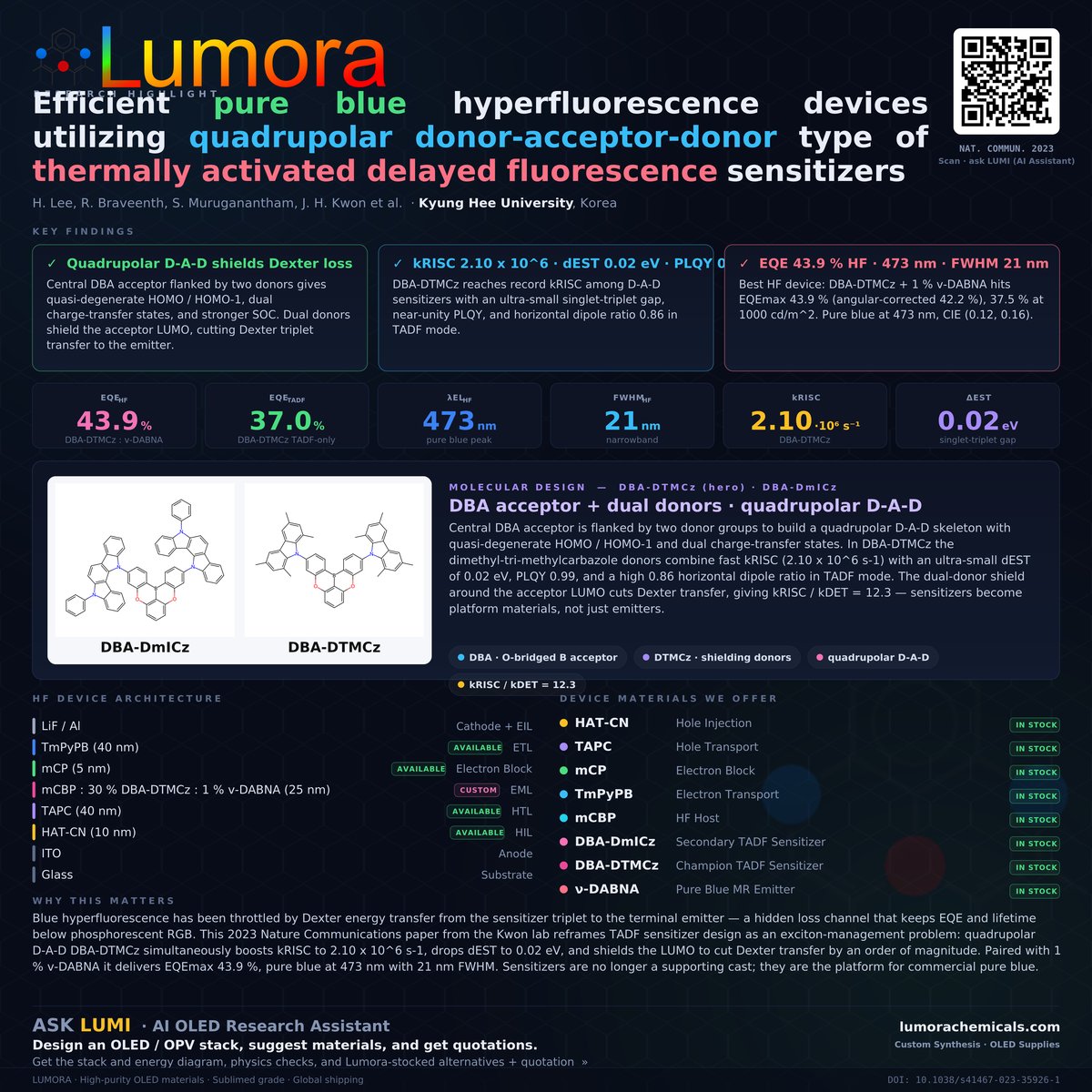
🔬 Quadrupolar D-A-D TADF Sensitizer for Pure Blue Hyperfluorescence OLEDs
Lee, Braveenth, Muruganantham, Jeon, Lee & Kwon · Kyung Hee University · Nat. Commun. 2023
At LUMORA we track hyperfluorescence architectures closely because the sensitizer design is often the hidden lever behind OLED efficiency, color purity, and roll-off. This 2023 Nature Communications paper from the Kwon lab introduces a new TADF sensitizer strategy based on quadrupolar donor-acceptor-donor (D-A-D) skeletons. Rather than chasing spectral overlap alone, the study tackles the deeper bottleneck in blue HF: minimizing Dexter energy transfer and triplet loss while preserving fast reverse intersystem crossing and strong horizontal dipole orientation.
🚧 The Problem
Blue hyperfluorescence can in principle combine 100% exciton utilization of TADF with the narrowband color purity of a terminal emitter like ν-DABNA. In practice, efficiency is capped by unwanted Dexter transfer from the sensitizer triplet to the emitter, a non-radiative leak. Conventional dipolar D-A sensitizers also suffer from slower kRISC and weaker orbital shielding.
💡 The Breakthrough
The authors design two oxygen-bridged boron-acceptor TADF sensitizers, DBA-DmICz and DBA-DTMCz, both quadrupolar D-A-D. Dual donors generate quasi-degenerate HOMO / HOMO-1, dual charge-transfer states, and stronger SOC, while shielding the LUMO from intermolecular overlap to cut Dexter loss. DBA-DTMCz wins with ΔEST 0.02 eV, kRISC 2.10 × 10⁶ s⁻¹, PLQY 0.99, and horizontal dipole ratio 0.86.
📊 Key Device Results
🔵 TADF-only DBA-DTMCz: EQEmax 37.0 %, 35.5 % at 1000 cd/m², EL 479 nm, CIE (0.14, 0.27)
🔵 HF device DBA-DTMCz + 1 % ν-DABNA: EQEmax 43.9 % (angular-corrected 42.2 %), 37.5 % at 1000 cd/m²
🔵 Pure blue output: 473 nm, FWHM 21 nm, CIE (0.12, 0.16)
🔵 Energy transfer: kFRET 4.26 × 10⁷ s⁻¹, kDET 1.70 × 10⁵ s⁻¹ > kRISC / kDET = 12.3
🔵 Reference D-A DBA-mICz: EQEmax only 18.6 %, quadrupolar D-A-D is decisive
🧭 Why This Matters
The study reframes TADF sensitizer design from a spectral overlap problem into a full exciton-management problem. For high-performance blue HF, a great terminal emitter is not enough; the sensitizer must deliver fast kRISC, reduced Dexter transfer, and favorable molecular orientation in the host matrix. DBA-DTMCz becomes a strategic platform molecule for future commercial pure blue displays, pointing to growing demand for integrated sensitizer-emitter-host sets, co-optimized rather than treated as separate components.
Reference: Lee, H.; Braveenth, R.; Muruganantham, S.; Jeon, C. Y.; Lee, H. S.; Kwon, J. H. Nat. Commun. 2023, 14, 419. DOI: 10.1038/s41467-023-35926-1
R&D and pilot quantities
We supply the key materials from this study in high-purity sublimed grades, from grams to kilograms, shipped worldwide.
Visit LUMORA →Kilogram to production, and custom MR-TADF
For large-scale supply, new emitter synthesis, and CRDMO support, work with LAMKO directly. Scope your project in the LUMI workspace, or send a partnership request.
Open LUMI workspace →Partner with us