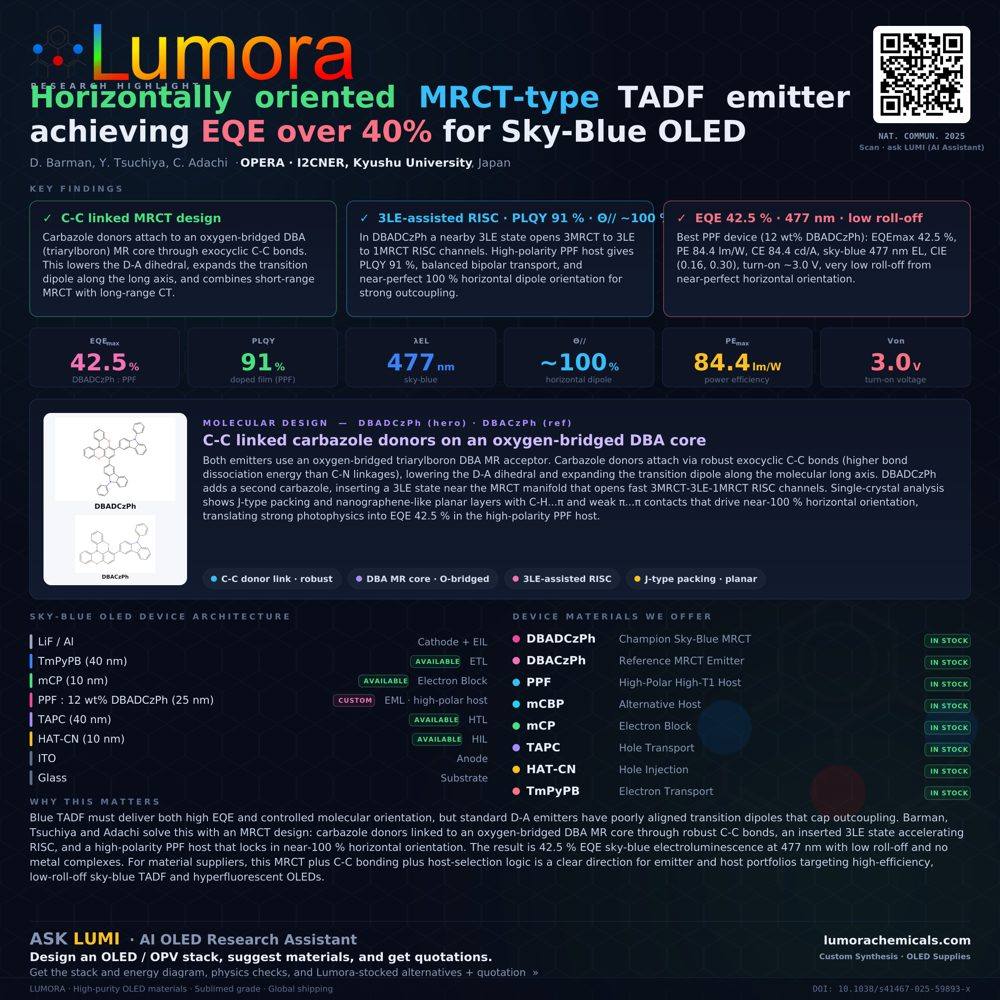
Barman, Tsuchiya, and Adachi, Nature Communications, 2025 — "Horizontally oriented MRCT-type TADF emitter achieving EQE over 40% for sky-blue OLED"
At LUMORA CHEMICALS, we focus on emitter design strategies that not only push EQE but also engineer molecular orientation and charge balance in real device stacks. This 2025 Nature Communications paper from Adachi’s group is a benchmark example of that approach. By moving from conventional C–N linked donor–acceptor TADF scaffolds to C–C linked, MRCT-type DBA–carbazole frameworks, they show how to synchronize short-range and long-range CT, achieve strong sky-blue delayed fluorescence, and tune host polarity to obtain almost perfect horizontal orientation and very high outcoupling efficiency.
The Problem: Blue TADF Needs Both High EQE and Controlled Orientation
Standard D–A TADF emitters can harvest triplets efficiently, but they often struggle with degradation, broad spectra, and limited outcoupling because their transition dipoles are not strongly aligned parallel to the substrate. Multi-resonance TADF cores help with PLQY and FWHM, but achieving >40% EQE in pure organic sky-blue devices demands precise management of spin–vibronic coupling and molecular orientation in the host. This work tackles that by using a DBA-based MR core as an acceptor, attaching carbazole donors via robust C–C bonds, and explicitly engineering the host polarity and triplet alignment.
The Breakthrough: C–C Linked MRCT Design on an Oxygen-Bridged Triarylboron Core
The authors design two emitters, DBACzPh (DBA + one carbazole donor) and DBADCzPh (DBA + two carbazole donors), in which the donors are attached to the DBA core through exocyclic C–C bonds. This lowers the D–A dihedral angle, expands the transition dipole along the molecular long axis, and preserves MR-character on the boron-based core. In DBADCzPh, the additional carbazole introduces a nearby 3LE state that interacts with the MRCT manifold, creating efficient 3MRCT → 3LE → 1MRCT RISC channels. Combined with the high-polar PPF host, this yields strong TADF, balanced bipolar transport, and a horizontal dipole ratio close to 100%.
Key Results
- MRCT concept and charge-transfer mixing: The emitters combine short-range MRCT from the DBA core with long-range CT from carbazole donors, inserting 3LE states close in energy to MRCT levels to accelerate RISC via 3MRCT → 3LE → 1MRCT pathways.
- Solution photophysics: Both molecules show strong CT-type emission in toluene with PL peaks around 445–460 nm, moderate ΔEST (~0.15–0.17 eV), and clear TADF behavior, with DBADCzPh exhibiting stronger delayed components and higher PLQY than DBACzPh.
- Doped-film behavior in mCBP vs PPF: In doped films, PLQY increases significantly, reaching 83% and then 91% for DBADCzPh in mCBP and PPF, respectively. PPF’s higher triplet energy and polarity improve triplet confinement, Förster energy transfer, and RISC, yielding shorter delayed lifetimes and stronger TADF.
- Host polarity and triplet alignment: The study shows that choosing a high-polar, high-triplet host such as PPF maximizes dipole–dipole interactions, stabilizes singlet excitons, reduces ΔEST, and suppresses back transfer, all critical for efficient sky-blue TADF.
- C–C bonding and stability: Exocyclic C–C bonds between donor and acceptor segments provide higher bond dissociation energies than analogous C–N linkages, promising improved device stability and reduced degradation under high triplet energies.
- Molecular packing and orientation: Single-crystal analysis reveals J-type packing and nanographene-like planar layers for DBADCzPh, with multiple C–H···π and weak π···π interactions that promote horizontal growth and suppress triplet diffusion-based quenching.
- Sky-blue OLED performance with mCBP: Devices based on DBADCzPh:mCBP (12 wt%) already reach EQEmax ≈21%, with sky-blue EL at 476 nm and reasonable roll-off, but limited by more random orientation and hole-dominated transport.
- Best sky-blue OLED with PPF: In a PPF host (12 wt% DBADCzPh), the optimized device delivers 477 nm EL, EQEmax 42.5%, PEmax 84.4 lm W−1, CEmax 84.4 cd A−1, CIEx,y ≈(0.16, 0.30), low turn-on voltage (~3.0 V), and very low roll-off thanks to almost perfect horizontal orientation and balanced hole/electron mobilities.
Why This Matters for OLED Material Supply
This work demonstrates that next-generation sky-blue emitters will come from design strategies that integrate MR cores, robust C–C donor connections, and host engineering to control dipole orientation and triplet dynamics in tandem. DBADCzPh in PPF represents a practical recipe: high PLQY, tuned ΔEST, engineered 3LE involvement, and nearly 100% horizontal dipoles that directly translate into >40% EQE without metal complexes. For LUMORA CHEMICALS, this MRCT–C–C bonding concept and host-selection logic point to clear directions in emitter and host portfolio development for high-efficiency, low-roll-off, sky-blue TADF and hyperfluorescent OLEDs.
Emitters and IUPAC names
DBACzPh
3-(5,9-dioxa-13b-boranaphtho[3,2,1-de]anthracen-6-yl)-9-phenyl-9H-carbazole
DBADCzPh
6,8-bis(9-phenyl-9H-carbazol-3-yl)-5,9-dioxa-13b-boranaphtho[3,2,1-de]anthracene
R&D and pilot quantities
We supply the key materials from this study in high-purity sublimed grades, from grams to kilograms, shipped worldwide.
Visit LUMORA →Kilogram to production, and custom synthesis
For large-scale supply, new emitter synthesis, and CRDMO support, work with LAMKO directly. Scope your project in the LUMI workspace, or send a partnership request.
Open LUMI workspace →Partner with us