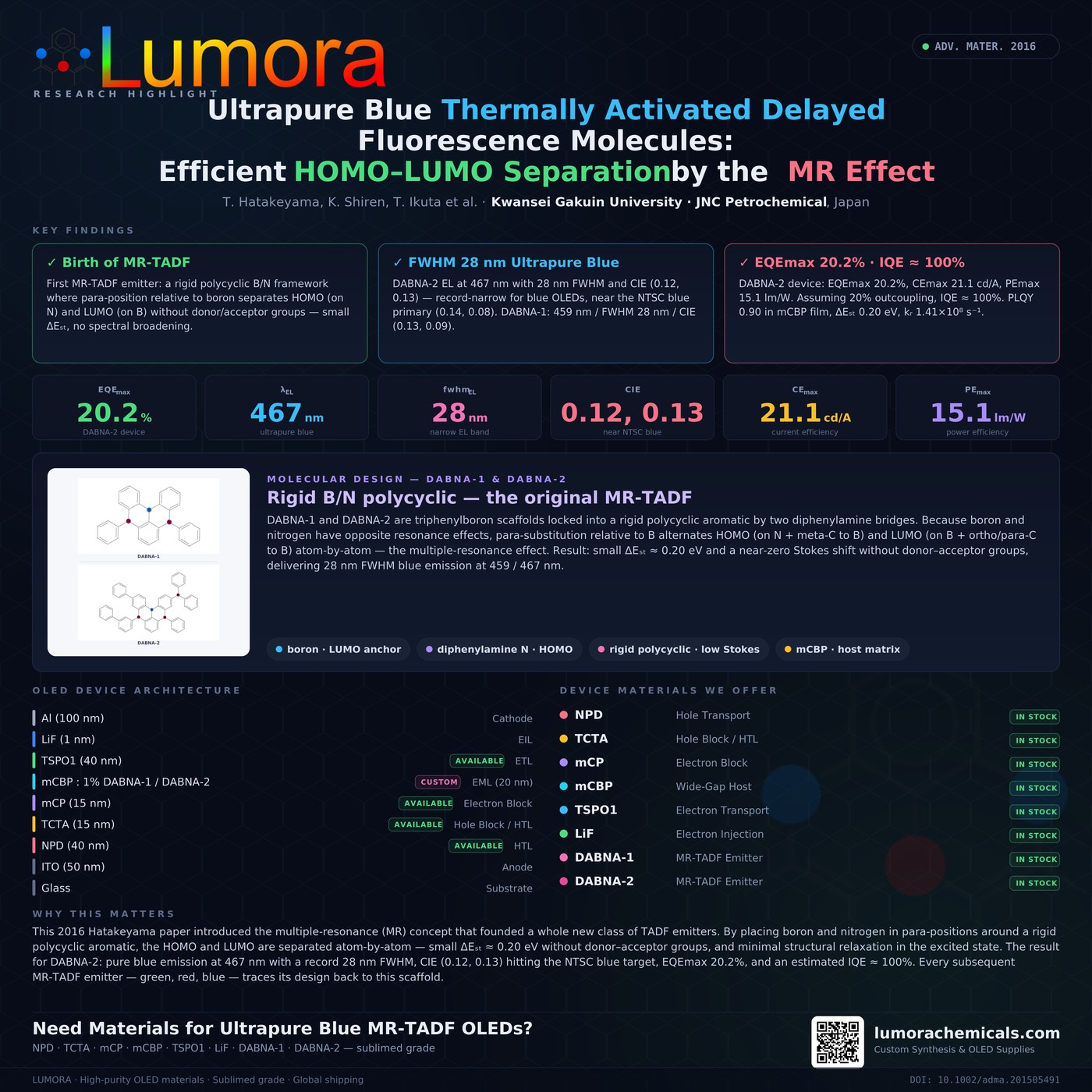
Spotlight on a Landmark Paper That Changed Blue OLED Emitter Design
Hatakeyama et al., Advanced Materials, 2016, "Ultrapure Blue TADF Molecules: Efficient HOMO-LUMO Separation by the Multiple Resonance Effect"
At LUMORA, we spotlight the scientific breakthroughs that shape the OLED materials landscape. This 2016 landmark paper by Prof. Takuji Hatakeyama (Kwansei Gakuin University), in collaboration with JNC Petrochemical Corporation, introduced a revolutionary emitter design concept that continues to define the direction of next-generation blue OLED development worldwide.
The Problem: Efficiency vs Colour Purity in Blue OLEDs
Conventional TADF emitters use a donor-acceptor (D-A) design that separates HOMO and LUMO to minimise the singlet-triplet gap (DELTA-EST), enabling near-100% IQE. However, this strategy causes excited-state structural relaxation, broadening EL spectra to 70-100 nm FWHM. For displays requiring NTSC/BT.2020-compliant blue emission, this forces lossy color filters or optical microcavities, severely limiting device efficiency.
The Breakthrough: Multiple Resonance (MR) Effect
Hatakeyama et al. engineered a rigid polycyclic boron-nitrogen framework where B and N atoms exert opposite resonance effects, spatially alternating HOMO (on N, meta-B) and LUMO (on B, ortho/para-B) without any D-A groups. This eliminates excited-state relaxation, yielding simultaneously small ∆EST and ultra-narrow emission, a combination previously considered impossible.
Key Device & Photophysical Results
- Emission / FWHM: 459 nm / 467 nm with only 28 nm FWHM, on par with commercial Samsung OLED displays
- PLQY: 0.88-0.90 in mCBP films; ∆EST = 0.14-0.20 eV
- OLED EQE: 13.5% (DABNA-1) and record 20.2% (DABNA-2); IQE ~100%
- CIE: (0.13, 0.09) / (0.12, 0.13), NTSC-compliant; no color filter required
- Scalability: Synthesis demonstrated at 6 g batch scale from commercial starting materials
Why MR-TADF is the Future of OLED Displays
Since this 2016 publication, the MR-TADF concept has spawned an entirely new branch of OLED emitter chemistry. Derivatives and expanded frameworks built on the DABNA scaffold covering narrowband green, red, and deep-blue emitters have now achieved EQEs exceeding 30% and are being actively evaluated by major OLED panel manufacturers globally. The BT.2020 ultra-high-definition standard demands even purer primary colors, making narrowband MR-TADF emitters commercially indispensable for next-generation smartphone, TV, and AR/VR display applications
Why This Matters for OLED Material Supply
This work defined the full MR-TADF device stack: emitters (DABNA-1/2), bipolar hosts (mCBP, mCP), hole transport layers (NPD, TCTA), and electron transport layer (TSPO1). Since 2016, DABNA-derived MR-TADF emitters have achieved EQEs exceeding 30% and are now entering commercial OLED panel evaluation for BT.2020-compliant displays. LUMORA CHEMICALS supplies high-purity MR-TADF emitters, host materials, and charge transport compounds to enable research teams and manufacturers worldwide to build on breakthroughs like this.
Reference: Hatakeyama, T. et al. Adv. Mater. 2016, 28, 2777-2781. DOI: 10.1002/adma.201505491
Target Molecules: IUPAC Names & Identifiers
Compound
IUPAC Systematic Name
Formula / MW
CAS No.
DABNA-1
5,9-Diphenyl-5,9-dihydro-5,9-diaza-13b-boranaphtho[3,2,1-de]anthracene
C₃₀H₂₁BN₂MW: 420.31 g/mol
1689552-89-3
DABNA-2
9-([1,1'-Biphenyl]-3-yl)-N,N,5,11-tetraphenyl-5,9-dihydro-5,9-diaza-13b-boranaphtho[3,2,1-de]anthracen-3-amine
C₅₄H₃₈BN₃MW: 739.71 g/mol
1689553-04-5
Spotlight on a Landmark Paper That Changed Blue OLED Emitter Design
Hatakeyama et al., #Advanced_Materials, 2016
"Ultrapure Blue TADF Molecules: Efficient HOMO-LUMO Separation by the Multiple Resonance Effect"
At Lumora, we spotlight the scientific breakthroughs that shape the #OLED materials landscape. This 2016 landmark paper by Prof. Takuji Hatakeyama (Kwansei Gakuin University), in collaboration with JNC Petrochemical Corporation, introduced a revolutionary emitter design concept that continues to define next-generation blue OLED development worldwide.
The Problem: Efficiency vs Colour Purity in Blue OLEDs
Conventional TADF emitters use a donor-acceptor (D-A) design that separates HOMO and LUMO to minimise the singlet-triplet gap (ΔEST), enabling near-100% IQE. However, this causes excited-state structural relaxation, broadening EL spectra to 70-100 nm FWHM. For displays requiring NTSC/BT.2020-compliant blue emission, this forces lossy color filters or optical microcavities, limiting device efficiency.
The Breakthrough: Multiple Resonance (MR) Effect
Hatakeyama et al. engineered a rigid polycyclic boron-nitrogen framework where B and N exert opposite resonance effects, spatially alternating HOMO (on N, meta-B) and LUMO (on B, ortho/para-B) without D-A groups. This eliminates excited-state relaxation, yielding small ΔEST and ultra-narrow emission, a combination previously considered impossible.
Key Device & Photophysical Results
Why MR-TADF is the Future of OLED Displays
Since this 2016 publication, the #MR-TADF concept has spawned a new branch of OLED emitter chemistry. Derivatives based on the DABNA scaffold covering narrowband green, red, and deep-blue emitters have achieved EQEs exceeding 30% and are being evaluated by major OLED panel manufacturers. The BT.2020 ultra-high-definition standard demands purer primary colours, making narrowband MR-TADF emitters commercially indispensable for next-generation smartphone, TV, and AR/VR displays.
Why This Matters for OLED Material Supply
This work defined the MR-TADF device stack: emitters (DABNA-1/2), bipolar hosts (mCBP, mCP), hole transport layers (NPD, TCTA), and electron transport layer (TSPO1). Since 2016, DABNA-derived MR-TADF emitters have achieved EQEs exceeding 30% and are now entering commercial OLED panel evaluation.
Lumora supplies all these high-purity MR-TADF emitters, host materials, and charge transport compounds to enable research teams and manufacturers worldwide to build on breakthroughs like this.
R&D and pilot quantities
We supply the key materials from this study in high-purity sublimed grades, from grams to kilograms, shipped worldwide.
Visit LUMORA →Kilogram to production, and custom MR-TADF
For large-scale supply, new emitter synthesis, and CRDMO support, work with LAMKO directly. Scope your project in the LUMI workspace, or send a partnership request.
Open LUMI workspace →Partner with us