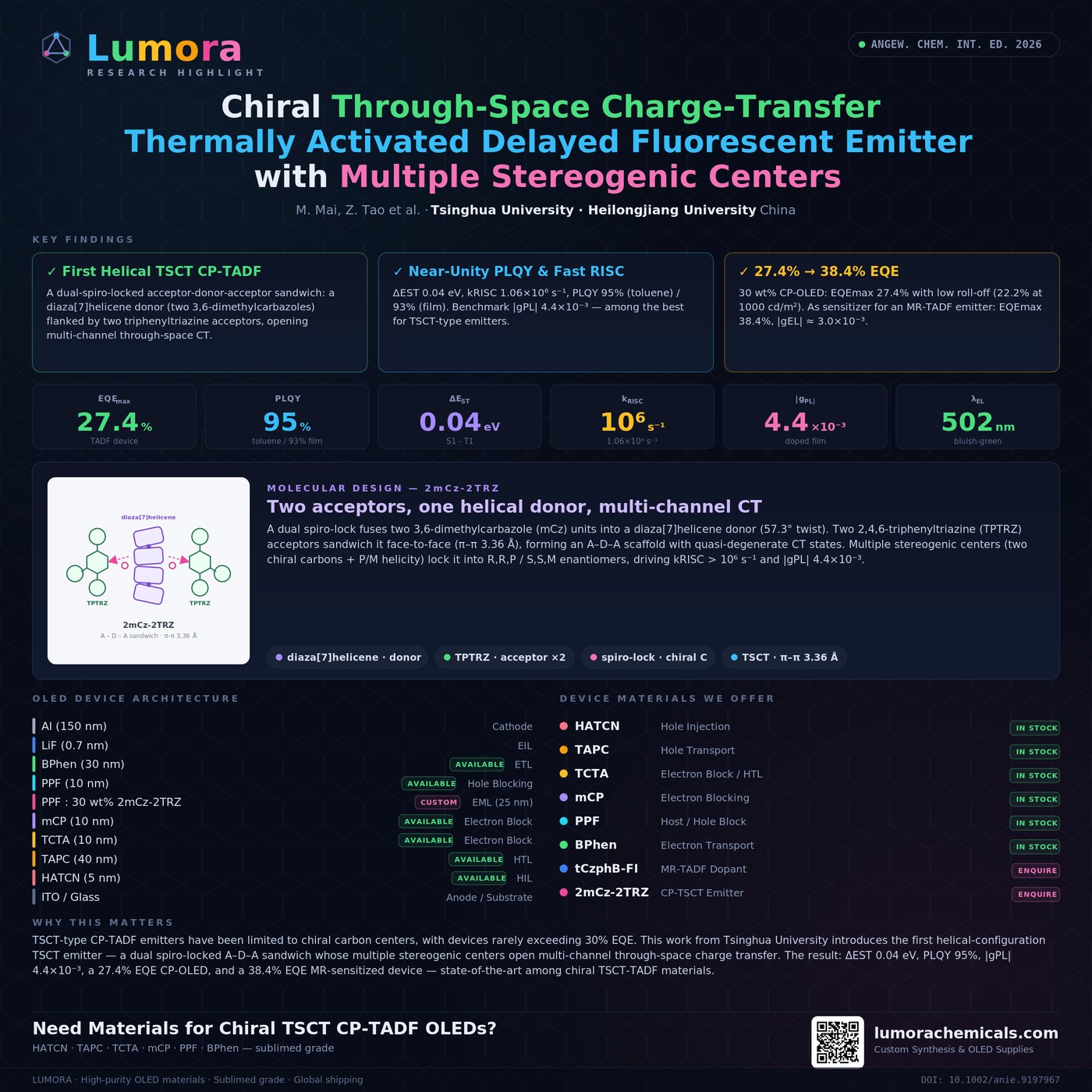
Why are high-performance circularly polarized TSCT-TADF OLEDs still difficult to realize?
The core problem is that through-space charge-transfer (TSCT) TADF emitters can naturally provide very small singlet-triplet energy gaps via spatial HOMO/LUMO separation, but converting them into circularly polarized OLED materials still requires a delicate balance among high photoluminescence quantum yield, fast RISC, strong dissymmetry factors, and stable molecular chirality.
New work published in Angewandte Chemie by Mai, Tao, Zhou, Qu, Zhang, Li, Xiang, Cheng, Han, Duan, and co-workers shows that this balance can be improved by integrating a helical donor into a dual spiro-locked TSCT scaffold, rather than relying only on conventional chiral carbon centers or through-bond D-A TADF motifs.
What they did
The authors designed a new chiral TSCT-TADF emitter, 2mCz-2TRZ, built from a diaza[7]helicene-like donor and two 2,4,6-triphenyl-1,3,5-triazine acceptors arranged in a face-to-face acceptor/donor/acceptor architecture. This sandwiched structure fixes the donor and acceptor units close enough for TSCT while also creating multiple stereogenic centers.
They combine:
1.Dual spiro-locking, which restricts donor-acceptor rotation, preserves short face-to-face D/A distances, and stabilizes intramolecular TSCT interactions instead of allowing uncontrolled conformational motion.
2.Helical chirality and multiple stereogenic centers, which give the molecule strong chiroptical activity and allow the separated (R,R)- and (S,S)-enantiomers to generate mirror-image CPL and CP-EL signals.
3.Multi-channel TSCT energy-state design, in which quasi-equivalent acceptors generate near-degenerate excited states, enhance spin-orbit coupling pathways, and support fast RISC while retaining high PLQY.
The molecule is then tested in two device roles: first as a direct CP-TSCT-TADF emitter, and then as a chiral sensitizer for an achiral green MR-TADF emitter, tCzphB-FI, thereby combining efficient triplet harvesting, a narrower emission, and circularly polarized electroluminescence.
What they achieved
- 2mCz-2TRZ shows a very small experimental ΔEST of 0.04 eV, high PLQYs of 95% in solution and 93% in doped film, fast kRISC values of 1.06 × 10⁶ and 1.03 × 10⁶ s⁻¹, and excellent thermal stability with Td = 502 °C.
- As a direct TADF emitter, the optimized 30 wt% OLED reaches a maximum EQE of 27.4% and still maintains 22.2% EQE at 1000 cd m⁻², with bluish-green EL centered at 502 nm.
- The separated enantiomers show strong circularly polarized luminescence in doped films, with gPL values of +4.45/−4.36 × 10⁻³, and the corresponding CP-OLEDs show gEL values of +3.24/−3.11 × 10⁻³ at the EL peak.
- In TSF devices using 2mCz-2TRZ as the chiral sensitizer and tCzphB-FI as the MR emitter, the EQEmax increases to 38.4% and 37.5% for the (R,R)- and (S,S)-based devices, respectively, while maintaining low roll-off, 537 nm emission, 31 nm FWHM, and gEL values around ±3.0 × 10⁻³.
Altogether, the work demonstrates the first helical-configuration-integrated TSCT-type CP-TADF emitter with multiple stereogenic centers, and shows that chiral TSCT-TADF molecules can function not only as emitters but also as high-efficiency chiral sensitizers for MR-TADF OLEDs.
What's worth taking from this
The central message is that CP-TSCT-TADF design should not be limited to simply attaching chiral groups to conventional TADF structures. By jointly controlling the three-dimensional donor-acceptor geometry, chirality, and near-degenerate excited states, TSCT emitters can simultaneously improve RISC, PLQY, CPL/CP-EL activity, and OLED efficiency.
By moving from a single chiral-center design to a dual spiro-locked helical A-D-A framework, the authors demonstrate that you can:
- Use through-space HOMO/LUMO separation to obtain a very small ΔEST without losing the orbital interaction needed for radiative decay.
- Strengthen circularly polarized emission by embedding helicity and multiple stereogenic centers directly into the emissive framework.
- Use a chiral TADF sensitizer to transfer both exciton energy and chiroptical character to an achiral MR-TADF final emitter through CP-FRET, enabling higher EQE and narrower EL than the direct TSCT emitter device.
For next-generation CP-OLEDs, this paper reinforces the shift from simple chiral modification toward full three-dimensional excited-state engineering, in which molecular geometry, TSCT interactions, energy-level degeneracy, RISC dynamics, and sensitized emission are designed as a single, integrated system.
📄 DOI: 10.1002/anie.9197967
🔗 Paper: https://doi.org/10.1002/anie.9197967
Why are high-performance circularly polarized TSCT-TADF OLEDs still difficult to realize?The core problem is that TSCT-TADF emitters can naturally provide very small singlet-triplet energy gaps via spatial HOMO/LUMO separation, but converting them into circularly polarized OLED materials still requires a delicate balance among high photoluminescence quantum yield, fast RISC, strong dissymmetry factors, and stable molecular chirality.
New work in Angewandte Chemie by Mai, Tao, Zhou, Qu, Zhang, Li, Xiang, Cheng, Han, Duan, and co-workers shows this balance can be improved by integrating a helical donor into a dual spiro-locked TSCT scaffold, rather than relying only on conventional chiral carbon centers or through-bond D-A TADF motifs.
What they did
The authors designed a chiral TSCT-TADF emitter, 2mCz-2TRZ, built from a diazahelicene-like donor and two 2,4,6-triphenyl-1,3,5-triazine acceptors in a face-to-face A/D/A architecture. This fixes donor and acceptor proximity for TSCT while creating multiple stereogenic centers.
They combine:
Dual spiro-locking to restrict D-A rotation, preserve short distances, and stabilize TSCT.
Helical chirality + multiple stereogenic centers to enable strong CPL and mirror-image CP-EL.
Multi-channel TSCT states to enhance spin-orbit coupling and fast RISC while retaining high PLQY.
The molecule is tested both as a direct emitter and as a chiral sensitizer for an achiral MR-TADF emitter (tCzphB-FI).
What they achieved> ΔEST of 0.04 eV, PLQY up to 95%, kRISC ~10⁶ s⁻¹, Td = 502 °C.> Direct OLED EQEmax 27.4% (22.2% at 1000 cd m⁻², 502 nm).> Strong CPL with gPL ±4.4 × 10⁻³ and CP-OLED gEL ±3.2 × 10⁻³.> In TSF devices: EQEmax up to 38.4%, 537 nm emission, 31 nm FWHM, gEL ~±3.0 × 10⁻³.
Altogether, this is the first helical-configuration-integrated TSCT-type CP-TADF emitter with multiple stereogenic centers, and shows TSCT materials can act as both emitters and efficient chiral sensitizers for MR-TADF OLEDs.
What's worth taking from thisThe key message is that CP-TSCT-TADF design should move beyond simple chiral modification toward full three-dimensional excited-state engineering.
By moving to a dual spiro-locked helical A-D-A framework, you can:
Use TSCT to achieve very small ΔEST without losing radiative decay.
Strengthen circularly polarized emission via embedded helicity.
Transfer both energy and chirality to MR-TADF emitters via CP-FRET for higher EQE and narrower EL.
📄 DOI: 10.1002/anie.9197967
R&D and pilot quantities
We supply the key materials from this study in high-purity sublimed grades, from grams to kilograms, shipped worldwide.
Visit LUMORA →Kilogram to production, and custom MR-TADF
For large-scale supply, new emitter synthesis, and CRDMO support, work with LAMKO directly. Scope your project in the LUMI workspace, or send a partnership request.
Open LUMI workspace →Partner with us