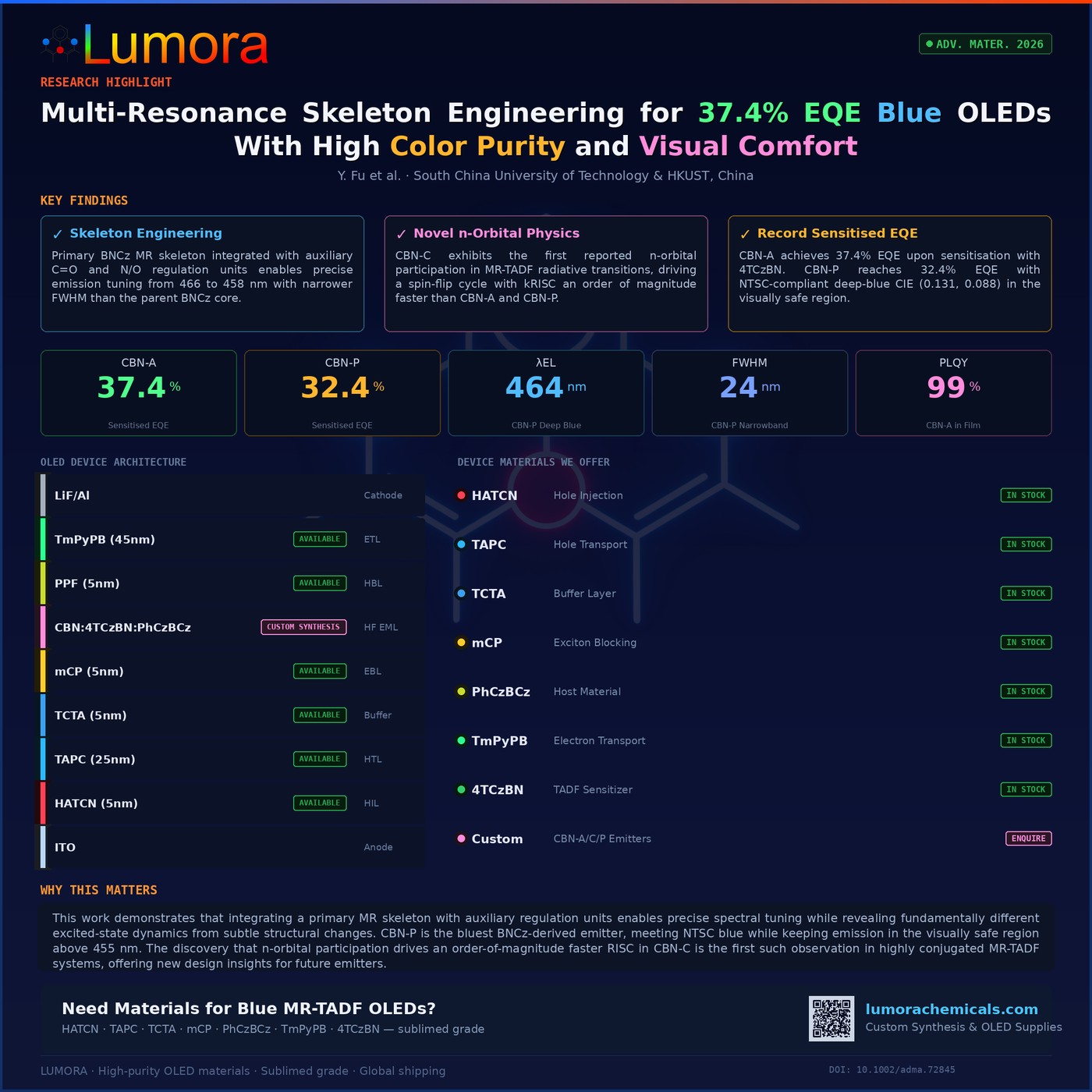
Why do highly efficient blue MRTADF OLEDs with both narrow emission and good visual comfort remain so hard to realize?
The core problem is that classic multi-resonance design focuses on rigidifying the emitter and narrowing the spectrum but often ignores how the MR skeleton itself controls dipole orientation, high-energy emission components, and device-level visual comfort under real display operating conditions.
New work published in Advanced Materials by He, Liang, Tang, and co-workers shows that multi-resonance skeleton engineering is a powerful lever to simultaneously optimize color purity, visual comfort, and device efficiency in blue OLEDs not by tweaking substituents, but by re-architecting the MR core itself.
What they did
The authors introduce a family of skeleton-engineered MR-TADF emitters in which the B-N multi-resonance framework is reshaped to decouple narrowband emission from harsh, high-energy components and poor dipole alignment.
They combine:
Carefully tuned MR cores that confine frontier orbitals and suppress vibronic sidebands, giving ultrasmall Stokes shifts and narrow FWHM in the blue/deepblue region.
Asymmetric perturbations to the MR backbone that allow precise color tuning across blue while preserving high photoluminescence quantum yields and small ΔE_ST for efficient TADF.
Molecular designs that promote favorable horizontal transition dipole orientation in thin films, boosting outcoupling without relying on complex optical microcavity tricks.
These emitters are then integrated into optimized host and charge-transport architectures to fully exploit their narrowband spectra and improved orientation under realistic OLED bias conditions.
What they achieved
- Blue OLEDs with high external quantum efficiency while maintaining the ultranarrow emission profiles characteristic of MRTADF.
- Emission peaks in the blue/deepblue range with small FWHM, compatible with widegamut display standards and high color purity.
- Emission spectra engineered for visual comfort, reducing excessive highenergy components that can be problematic for long viewing times, without sacrificing efficiency.
Altogether, the work shows that MR skeleton engineering can deliver blue pixels that are efficient, spectrally sharp, and more eyefriendly at displayrelevant luminance.
What's worth taking from this
The central message is that the multi-resonance skeleton is not a fixed scaffold to decorate it is an active design dimension that simultaneously governs bandwidth, color coordinates, dipole orientation, and human-centric emission quality.
By moving from peripheral substitution to backbonelevel MR engineering, the authors demonstrate that you can:
Retain hallmark MRTADF narrowband emission while improving film orientation and outcoupling.
Access finely tunable blue/deepblue emission windows with high PLQY and efficient triplet harvesting.
Design blue emitters that target not only efficiency and color purity, but also longterm visual comfort for real devices.
For next-generation blue OLEDs, this paper reinforces the shift from "componentlevel" tweaks to skeleton-level MR-TADF design as a route to practical, human-centric displays.
📄 DOI: 10.1002/adma.72845
🔗 Paper: https://advanced.onlinelibrary.wiley.com/doi/10.1002/adma.72845
R&D and pilot quantities
We supply the key materials from this study in high-purity sublimed grades, from grams to kilograms, shipped worldwide.
Visit LUMORA →Kilogram to production, and custom MR-TADF
For large-scale supply, new emitter synthesis, and CRDMO support, work with LAMKO directly. Scope your project in the LUMI workspace, or send a partnership request.
Open LUMI workspace →Partner with us