Why is it hard to make long-wavelength MR-TADF emitters that are both red-shifted and ultra-narrowband?
The core problem is that MR-TADF molecules can exhibit narrow emission due to rigid orbital localization, but red-shifting the emission by π-extension or stronger charge-transfer character often increases vibrational relaxation and broadens the spectrum.
New work published in 'Angewandte Chemie International Edition' by Liu, Zhang, Duan, and co-workers shows that antiaromatic perturbation can break this trade-off. By embedding four-membered antiaromatic rings into a DABNA-type BN-MR skeleton, the authors achieve a large bathochromic shift while narrowing the emission band.
What they did
The authors designed CBD-DABNA, a four-membered-ring-fused MR-TADF emitter derived from DABNA-1.
They combine:
Antiaromatic four-membered ring fusion to extend π-conjugation and shift emission from blue to pure green.
Aromaticity localization to suppress vibronic coupling, reorganization energy, and shoulder emission.
A rigid BN-MR framework with high PLQY and strong horizontal dipole orientation for efficient OLED operation.
CBD-DABNA was synthesized in four steps and verified by NMR, HRMS, single-crystal X-ray analysis, DFT/TD-DFT, aromaticity analysis, Franck-Condon simulation, photophysical measurements, and OLED testing.
What they achieved
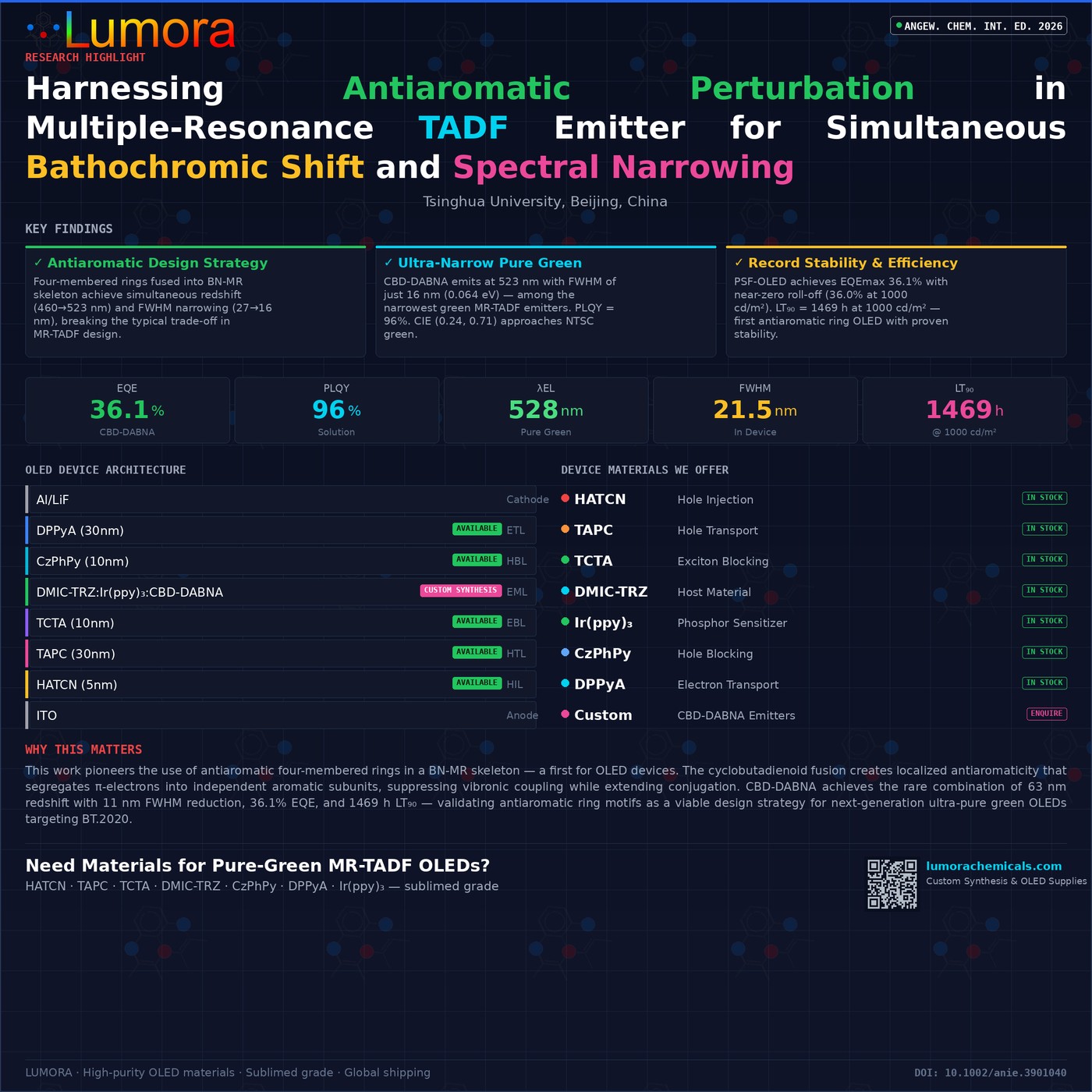
- Compared with DABNA-1, CBD-DABNA shows a large redshift emission from 460 to 523 nm, while the FWHM decreases from 27 to 16 nm.
- The emitter shows PLQY = 96%, ΔEST = 0.20 eV, τp/τd = 6.0 ns/24.84 µs, kr = 1.12 × 10⁸ s⁻¹, and kRISC = 5.28 × 10⁴ s⁻¹.
- In a doped film, CBD-DABNA keeps PLQY over 90% and shows a high horizontal dipole ratio of 91.5%, supporting efficient outcoupling.
- The optimized phosphor-sensitized OLED uses DMIC-TRZ as host, Ir(ppy)₃ as sensitizer, and CBD-DABNA as terminal emitter to accelerate FRET-based triplet utilization.
- The final device emits at 528 nm with FWHM = 21.5 nm and CIE = (0.26, 0.70), reaches EQE_max = 36.1%, and maintains 36.0%, 31.4%, and 25.9% EQE at 1000, 10,000, and 100,000 cd m⁻².
- The device also shows LT90 = 1469 h at 1000 cd m⁻², demonstrating that the antiaromatic four-membered ring can operate stably under electrical excitation.
Altogether, the work shows that localized antiaromaticity can shift an MR skeleton to longer wavelengths, increase its rigidity, reduce its vibronic broadening, and make it more suitable for high-performance OLEDs.
What's worth taking from this
The central message is that antiaromaticity is not only a destabilizing feature. When precisely embedded into an MR-TADF framework, it becomes a molecular design tool for controlling color, linewidth, shoulder intensity, and device stability.
By moving from peripheral substitution to antiaromatic backbone perturbation, the authors demonstrate that you can:
· Achieve a large bathochromic shift without the usual FWHM broadening.
· Suppress vibronic coupling through aromaticity localization and reduced reorganization energy.
· Combine ultra-narrow pure-green emission with high EQE, low roll-off, and long operational lifetime.
For next-generation wide-color-gamut OLEDs, this paper reinforces the need to engineer the MR skeleton through aromaticity, antiaromaticity, orbital localization, and vibrational control.
📄 DOI: 10.1002/anie.3901040
🔗 Paper: https://doi.org/10.1002/anie.3901040
R&D and pilot quantities
We supply the key materials from this study in high-purity sublimed grades, from grams to kilograms, shipped worldwide.
Visit LUMORA →Kilogram to production, and custom MR-TADF
For large-scale supply, new emitter synthesis, and CRDMO support, work with LAMKO directly. Scope your project in the LUMI workspace, or send a partnership request.
Open LUMI workspace →Partner with us