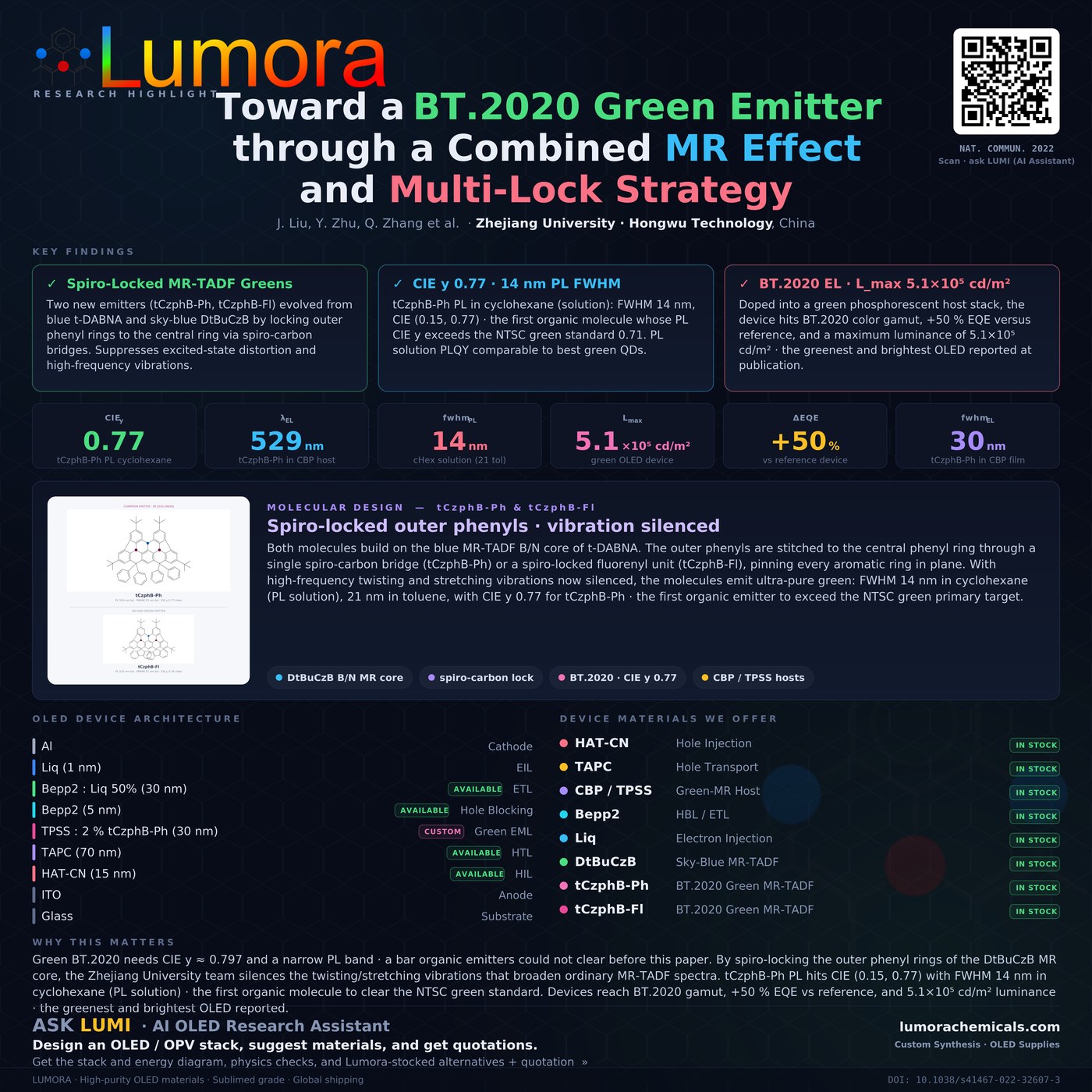
BT.2020 Green MR-TADF Emitters via Multiple Resonance and Multi-Lock Molecular Design
Liu, Zhu, Tsuboi, Deng, Lou, Wang, Liu, and Zhang, Nature Communications, 2022 "Toward a BT.2020 green emitter through a combined multiple resonance effect and multi-lock strategy"
At LUMORA CHEMICALS, we track the material innovations that move OLED performance closer to commercial display standards. This 2022 Nature Communications paper by Junyuan Liu, Yunhui Zhu, and colleagues presents an important advance in green MR-TADF emitter design by addressing a long-standing challenge: achieving BT.2020-level green color purity without sacrificing efficiency, emission narrowness, or brightness. Instead of using the common red-shifting strategy based on electron-withdrawing groups, the authors introduced a multi-lock structural design that rigidifies the molecule, suppresses vibrational motion, and preserves the narrowband emission required for premium display applications.
The Problem: Pure Green OLED Emission Is Hard to Achieve Organically
To meet the BT.2020 green standard, emitters must combine the correct wavelength window with an extremely narrow full width at half maximum (FWHM). Many organic green emitters can be shifted to longer wavelengths, but that often broadens the spectrum because stronger intramolecular charge transfer and excited-state relaxation increase vibrational loss. Earlier green MR-TADF designs improved CIEy values but often incurred a penalty in spectral width, limiting true color saturation. The challenge, therefore, was to achieve both strong green emission and exceptional color purity in a single organic molecular platform.
The Breakthrough: Multi-Lock Spiro-Carbon Rigidification of MR-TADF Molecules
The authors developed two new green MR-TADF emitters, tCzphB-Ph and tCzphB-Fl, derived from the blue MR emitter t-DABNA and the sky-blue emitter DtBuCzB. Their key strategy was to lock the outer phenyl rings to the central phenyl ring via spiro carbon bridges, thereby creating a more planar and rigid molecular framework while maintaining the multiple-resonance boron-nitrogen electronic structure. This multi-lock design suppresses both irreversible geometry relaxation and reversible high-frequency vibration in the excited state, dramatically reducing Huang-Rhys factors and preserving ultra-narrow emission. As a result, the molecules reached FWHM values of only 14 nm in cyclohexane and achieved CIE y values of 0.77 and 0.76, placing them among the purest green molecular emitters reported and comparable to top-performing green quantum dots.
Key Photophysical & Device Results
- Pure green PL in cyclohexane: Both tCzphB-Ph and tCzphB-Fl achieved an ultra-narrow 14 nm FWHM; CIE coordinates reached (0.15, 0.77) and (0.19, 0.76), respectively.
- Doped-film optical quality: In TPSS host at 2 wt%, tCzphB-Ph and tCzphB-Fl showed PLQY values of 0.98 and 0.93 with FWHM of 23 and 25 nm, respectively.
- TADF properties: Both emitters had very small ΔEST of 0.04 eV, prompt lifetimes around 7 ns, and delayed lifetimes of 372 and 412 μs.
- Bottom-emitting OLED color purity: The tCzphB-Ph device emitted at 527 nm with 24 nm FWHM and CIE (0.21, 0.75), reported as the purest green bottom-emitting OLED at the time.
- Conventional TADF OLED efficiency: EQEmax reached 29.3% for tCzphB-Ph and 26.2% for tCzphB-Fl, although roll-off remained severe at high brightness.
- PSTADF OLED performance: With Ir(ppy)3 as sensitizer, the tCzphB-Ph PSTADF device achieved EQEmax 31.3% and still maintained 30.6% EQE at 10,000 cd/m².
- Extreme brightness: The best PSTADF device reached 5.1 × 10⁵ cd/m², described in the paper as the greenest and brightest OLED yet reported.
- Operational stability trend: The tCzphB-Fl device showed stronger locking-bond stability and longer lifetime than tCzphB-Ph due to higher bond dissociation energy.
Why This Matters for OLED Material Supply
This paper is highly relevant for OLED materials development because it demonstrates that structural rigidification, not just donor/acceptor tuning, can unlock BT.2020-grade green emission in purely organic molecules. It also shows the commercial importance of host selection: replacing CBP with the low-polar, sphere-like TPSS host reduced solid-state solvation and preserved narrow emission. In addition, the phosphor-sensitized TADF (PSF) architecture based on BCz-o-TRZ host, Ir(ppy)3 sensitizer, and tCzphB terminal dopants delivered an especially attractive combination of color purity, brightness, and roll-off control. For materials suppliers, these highlight the growing demand for not only next-generation MR-TADF emitters but also compatible low-polar hosts, sensitizers, and high-stability transport layers that preserve optical purity in real device stacks.
Reference: Liu, J.; Zhu, Y.; Tsuboi, T.; Deng, C.; Lou, W.; Wang, D.; Liu, T.; Zhang, Q. Nat. Commun. 2022, 13, 4876. DOI: 10.1038/s41467-022-32607-3
Target Molecules: IUPAC Names & Identifiers
tCzphB-Ph
2,5,11,14-tetra-tert-butyl-7,7,9,9-tetraphenyl-7,9-dihydro-3a2,8a2-diaza-15b-boradiacenaphtho[1,2,3,4-defg:1',2',3',4',5'-pqrst]pentaphene
tCzphB-Fl
2',5',11',14'-tetra-tert-butyl-3a2',8a2'-diaza-15b'-boradispiro[fluorene-9,7'-diacenaphtho[1,2,3,4-defg:1',2',3',4',5'-pqrst]pentaphene-9',9''-fluorene]-1'(15c'),2',3a',3b',3b1'(6a'),5',7a',7a1'(15b1'),8a',9a',10',12',12b',13',15'-pentadecaene
R&D and pilot quantities
We supply the key materials from this study in high-purity sublimed grades, from grams to kilograms, shipped worldwide.
Visit LUMORA →Kilogram to production, and custom MR-TADF
For large-scale supply, new emitter synthesis, and CRDMO support, work with LAMKO directly. Scope your project in the LUMI workspace, or send a partnership request.
Open LUMI workspace →Partner with us