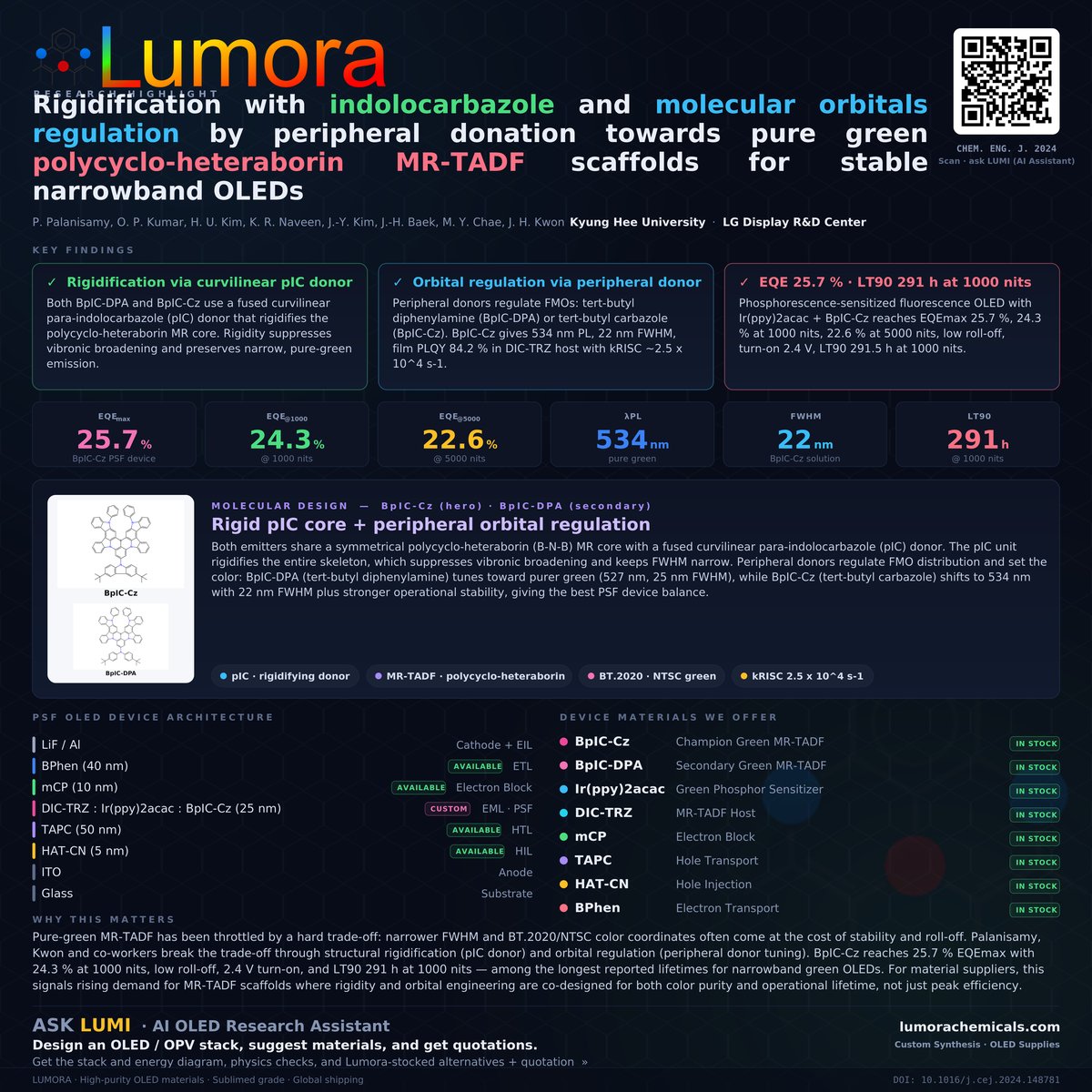
🔬 Rigid Indolocarbazole-Based Pure-Green MR-TADF Emitters for Stable Narrowband OLEDs
Palanisamy, Kumar, Kim, Naveen, Kim, Baek, Chae & Kwon · Kyung Hee University + LG Display R&D · Chem. Eng. J. 2024
At LUMORA we track green MR-TADF materials closely because commercial relevance depends on more than peak efficiency. Narrow bandwidth, color-coordinate accuracy, roll-off control, and lifetime all matter at once. This 2024 Chemical Engineering Journal paper from the Kwon lab addresses the full package through a design built on two ideas: rigidifying the emitter core with fused curvilinear indolocarbazole and regulating the frontier molecular orbitals with peripheral donors.
🚧 The Problem
Many green MR-TADF emitters reach high EQE but broaden in emission, drift from BT.2020 / NTSC green, or suffer from limited stability. Earlier systems delivered efficiency but FWHM often above 29-50 nm or coordinates outside strict industrial green. The authors aimed for a rigid, better-orbital-regulated boron scaffold that stays narrow, remains pure green, and survives real device operation.
💡 The Breakthrough
Two highly symmetrical MR-TADF emitters, BpIC-DPA and BpIC-Cz, are built around a fused curvilinear para-indolocarbazole (pIC) donor that rigidifies the polycyclo-heteraborin skeleton. FMOs are then regulated through peripheral donors: tert-butyl diphenylamine (BpIC-DPA) or tert-butyl carbazole (BpIC-Cz). Result: rigid non-planar structures with atomically separated HOMO / LUMO, narrowband pure-green emission, and high film PLQY.
📊 Key Device Results
🟢 Solution PL: BpIC-DPA 527 nm / 25 nm FWHM; BpIC-Cz 534 nm / 22 nm FWHM
🟢 Film PLQY in DIC-TRZ host: 87.9 % (DPA), 84.2 % (Cz); kRISC ~2.5 × 10⁴ s⁻¹
🟢 Conventional TADF OLEDs: EQEmax 16.8 % (DPA), 17.5 % (Cz), with roll-off
🟢 PSF OLED with Ir(ppy)2acac: BpIC-DPA 22.0 % EQEmax
🟢 Best PSF, BpIC-Cz: EQEmax 25.7 %, 24.3 % @ 1000 nits, 22.6 % @ 5000 nits
🟢 Turn-on 2.4 V; LT90 291.5 h @ 1000 nits (Cz) vs 156.1 h (DPA), among the longest for narrowband green
🧭 Why This Matters
Green MR-TADF performance can be improved through structural rigidity, not just excited-state tuning. The best material is not always the one with the narrowest intrinsic spectrum, but the one that keeps color purity while holding roll-off control and long lifetime in a real device. For material suppliers, BpIC-Cz-type design links rigidity, orbital control, and operational stability in one scalable direction for high-color-purity displays.
Reference: Palanisamy, P.; Kumar, O. P.; Kim, H. U.; Naveen, K. R.; Kim, J.-Y.; Baek, J.-H.; Chae, M. Y.; Kwon, J. H. Chem. Eng. J. 2024, 481, 148781. DOI: 10.1016/j.cej.2024.148781
R&D and pilot quantities
We supply the key materials from this study in high-purity sublimed grades, from grams to kilograms, shipped worldwide.
Visit LUMORA →Kilogram to production, and custom MR-TADF
For large-scale supply, new emitter synthesis, and CRDMO support, work with LAMKO directly. Scope your project in the LUMI workspace, or send a partnership request.
Open LUMI workspace →Partner with us