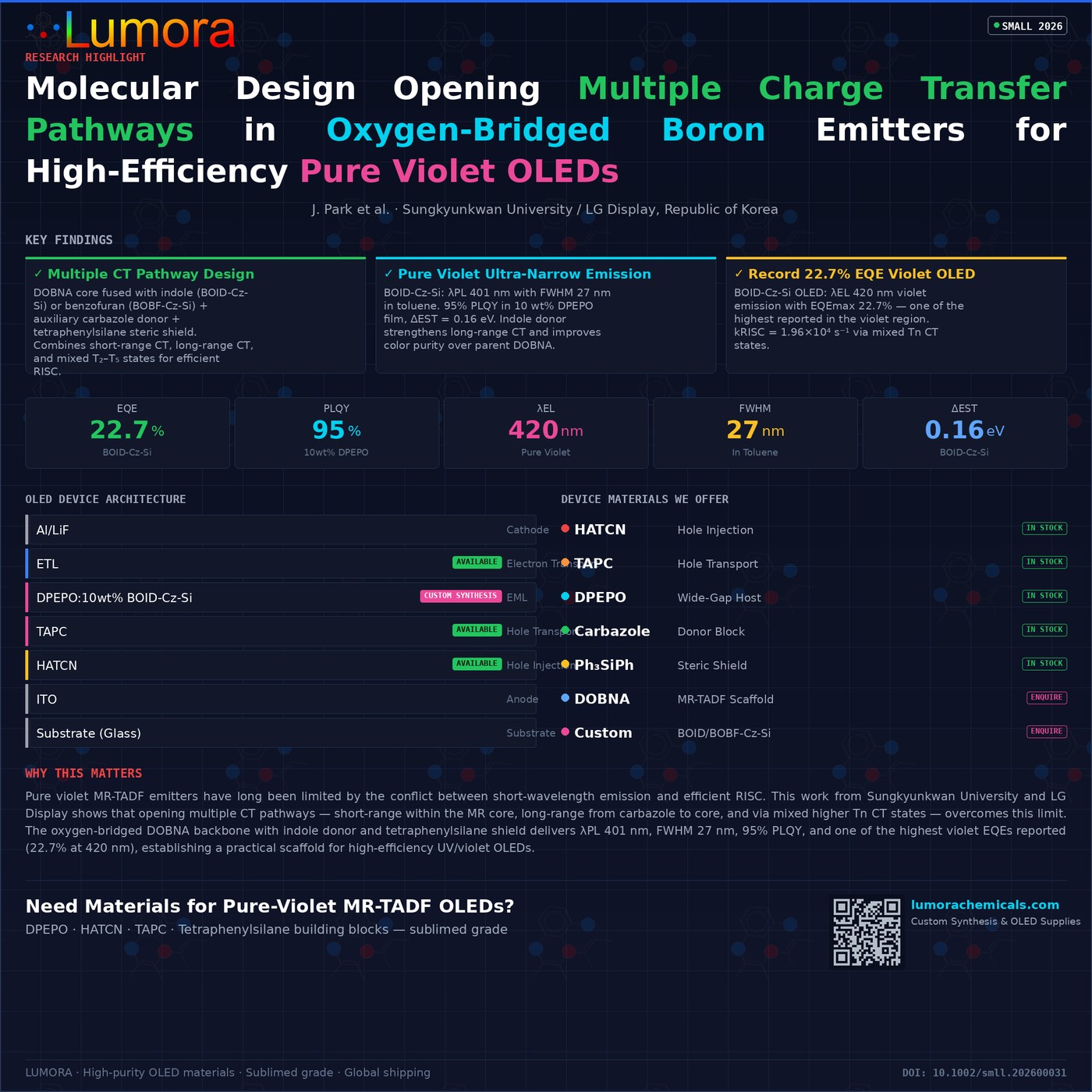
Why does achieving efficient, narrowband emission in the pure-violet region remain so difficult for organic light-emitting diodes?
The core problem is that most multi-resonance (MR)-TADF emitters are built on boron-nitrogen frameworks that inherently emit above 450 nm, because nitrogen donors raise the HOMO and shrink the optical gap. Replacing N with O (as in DOBNA) blue-shifts emission into the violet region but typically suppresses TADF behaviour due to a large singlet-triplet gap, leading to either low color purity or low EQE. Reaching deep violet wavelengths while preserving narrow emission, high PLQY, and efficient reverse intersystem crossing (RISC) at the same time has remained an open challenge. Professor Lee, and co-workers from Sungkyunkwan University and LG Display shows that this barrier can be overcome by deliberately opening multiple charge transfer (CT) pathways within an oxygen-bridged boron framework, yielding two new pure-violet MR-TADF emitters: BOID-Cz-Si and BOBF-Cz-Si.
What they did
The authors designed two oxygen-bridged boron emitters built on the DOBNA scaffold and engineered them to operate through multiple coexisting CT channels rather than relying on a single one.
They combine:
1. A DOBNA-based oxygen-bridged boron core that hosts the short-range CT typical of MR-TADF emitters and locks the violet emission wavelength.
2. An electron-rich indole unit (in BOID-Cz-Si) or benzofuran unit (in BOBF-Cz-Si) fused into the polycyclic aromatic backbone, which extends π-conjugation, increases molecular rigidity, and modulates HOMO/LUMO distributions to introduce additional long-range CT character.
3. An auxiliary carbazole donor attached at the para-position to the boron atom, which delocalizes the HOMO and creates a second long-range CT pathway between the donor and the MR core.
4. A bulky tetraphenylsilyl (Ph₃Si-Ph) group placed adjacent to the carbazole, acting as a steric shield that increases intermolecular distance and suppresses aggregation, excimer formation, and concentration quenching.
The combined design enables short-range CT within the MR core, long-range CT from the carbazole donor to the boron acceptor, and a series of mixed-character higher-lying triplet states (T₂-T₅) that provide efficient RISC channels through spin-vibronic coupling, in accordance with El-Sayed's rule. The molecules were synthesized via nucleophilic substitution, one-pot lithiation-borylation, and Suzuki coupling, and characterized by NMR, HRMS, DFT/TD-DFT, photophysics, electrochemistry, thermal analysis, and OLED device fabrication.
What they achieved
- In dilute toluene solution, BOID-Cz-Si and BOBF-Cz-Si exhibit pure-violet emission with peaks at 401 and 397 nm, ultra-narrow FWHM values of 27 and 25 nm, and small Stokes shifts of 11 and 14 nm, respectively, indicating strong molecular rigidity and minimal excited-state relaxation.
- Singlet-triplet energy gaps (ΔE_ST) were measured as 0.16 eV for BOID-Cz-Si and 0.20 eV for BOBF-Cz-Si, both small enough to support TADF behaviour, with BOID-Cz-Si showing the more efficient singlet-triplet conversion.
- In a 10 wt.% DPEPO doped film, BOID-Cz-Si reached a PLQY of 95% under nitrogen, with τ_p = 3.1 ns and τ_d = 89 µs, k_r = 8.71 × 10⁷ s⁻¹ and k_RISC = 1.96 × 10⁴ s⁻¹, while BOBF-Cz-Si reached 86% PLQY with slower kinetics, confirming that the indole donor provides a more efficient multi-CT excited-state landscape.
- Decomposition temperatures (T_d) of 461 °C (BOID-Cz-Si) and 454 °C (BOBF-Cz-Si) indicate excellent thermal robustness suitable for vacuum-deposited OLED fabrication.
- The BOID-Cz-Si-based OLED with DPEPO host emitted at 420 nm in the violet region with a maximum EQE of 22.7%, which is one of the highest efficiencies reported for violet OLEDs to date.
Altogether, the work demonstrates that an oxygen-bridged boron core engineered with electron-rich fused donors, an auxiliary carbazole, and a steric shield can simultaneously deliver violet emission, narrow FWHM, high PLQY, and efficient RISC, overcoming the long-standing trade-off between short-wavelength emission and high device efficiency.
What's worth taking from this
The central message is that for short-wavelength MR-TADF emitters, it is not enough to rely on a single CT pathway. Opening multiple CT channels, short-range within the MR core, long-range donor-to-core, and via mixed higher Tn states, provides additional SOC routes that accelerate RISC without sacrificing color purity.
By combining DOBNA-type oxygen-bridged frameworks with rational donor and steric engineering, the authors demonstrate that you can:
· Achieve pure-violet narrowband emission (λ_PL ≈ 400 nm, FWHM ≈ 25-27 nm) on a single MR scaffold.
· Maintain high PLQY (up to 95%) and small ΔE_ST despite operating in the violet region.
· Reach high-efficiency violet electroluminescence (EQE 22.7% at 420 nm) using a conventional DPEPO-host OLED stack.
· Suppress concentration quenching through bulky tetraphenylsilane shielding rather than complex peripheral engineering.
For next-generation UV/violet OLEDs, sensing, photoresist exposure, and high-color-gamut display applications, this paper reinforces multi-pathway CT engineering on oxygen-bridged boron cores as a practical route to efficient, narrowband, pure-violet MR-TADF emitters.
📄 DOI: 10.1002/smll.202600031
🔗 Paper: https://doi.org/10.1002/smll.202600031
R&D and pilot quantities
We supply the key materials from this study in high-purity sublimed grades, from grams to kilograms, shipped worldwide.
Visit LUMORA →Kilogram to production, and custom MR-TADF
For large-scale supply, new emitter synthesis, and CRDMO support, work with LAMKO directly. Scope your project in the LUMI workspace, or send a partnership request.
Open LUMI workspace →Partner with us