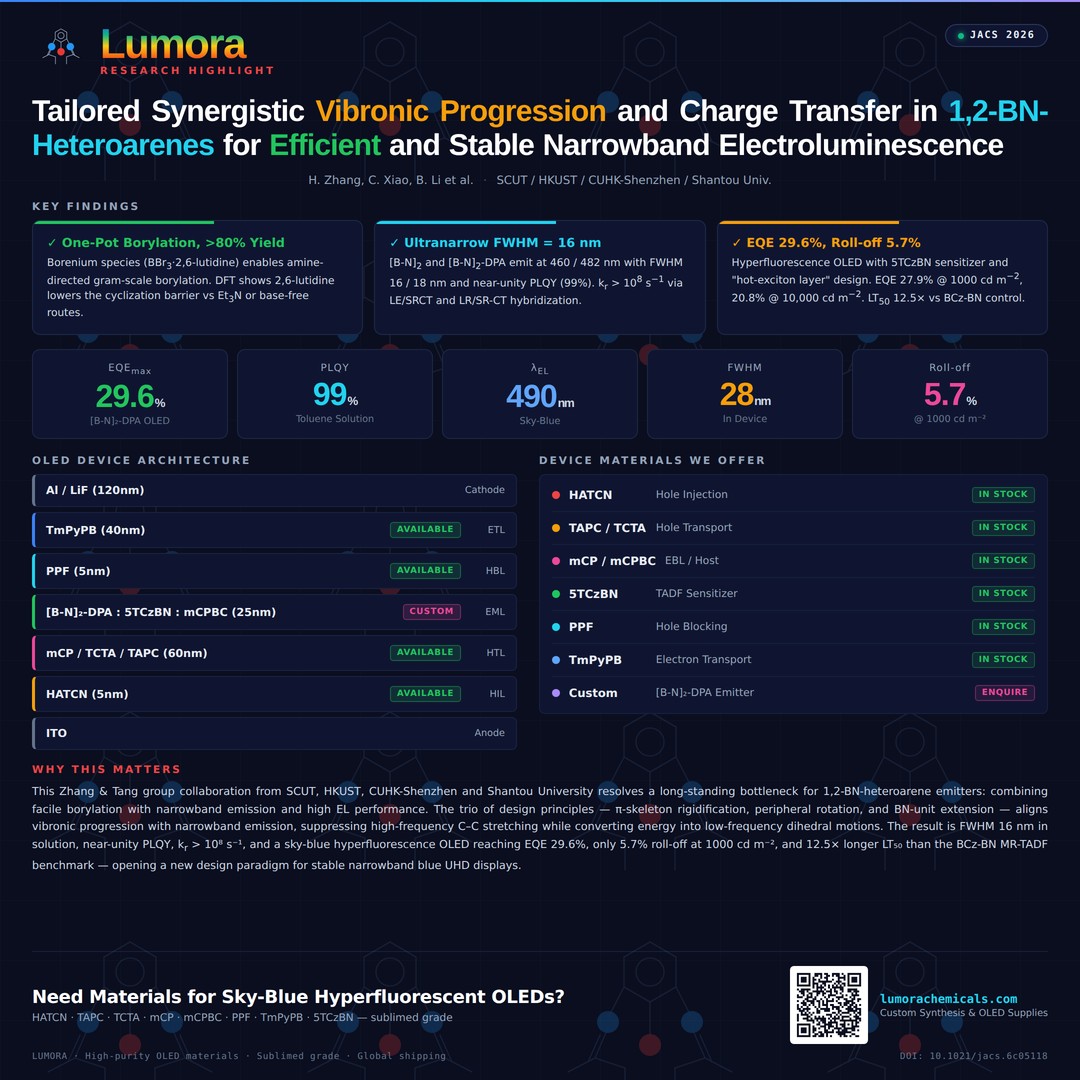
Why are efficient, stable narrowband OLEDs based on 1,2-BN heteroarenes still difficult to realize?
The core problem is that 1,2-BN-heteroarenes are synthetically accessible and structurally diverse, but their OLED use has long been limited by broad emission, weak color purity, and insufficient triplet-exciton management compared with established 1,4-BN multi-resonance emitters.
New work published in the Journal of the American Chemical Society by Zhang, Xiao, Li, Tang, and co-workers shows that 1,2-BN-heteroarenes can be converted into efficient and stable narrowband electroluminescent emitters by tailoring vibronic progression and charge-transfer character together, rather than treating molecular rigidity and device exciton dynamics as separate issues.
What they did
The authors introduce a new family of 1,2-BN-heteroarene narrowband emitters, including [B-N], [B-N]-DPA, [B-N]₂, and [B-N]₂-DPA, in which the BN-PAH skeleton is redesigned to suppress high-frequency vibronic coupling while allowing tunable locally excited, long-range charge-transfer, and short-range charge-transfer characters.
They combine:
1. Planar locking of the π-skeleton, which reduces excited-state structural relaxation and converts a formerly broad 1,2-BN scaffold into a much more rigid, narrowband-emissive framework.
2. Peripheral rotation through DPA-type groups, which introduces controlled local flexibility and redistributes reorganization energy from high-frequency bond-stretching modes toward lower-frequency dihedral motions.
3. BN-unit extension, which enhances nonbonding character and weakens aromaticity in the benzene rings, thereby suppressing shoulder peaks and high-frequency vibronic progression while keeping high oscillator strength.
These emitters are then integrated into optimized OLED structures using a "hot-exciton layer" design, so that the narrowband terminal emitters are not only spectrally sharp but also supported by faster exciton dynamics and reduced triplet-exciton accumulation.
What they achieved
- [B-N]₂ and [B-N]₂-DPA show ultranarrow PL emissions at 460 and 482 nm with FWHMs of 16 and 18 nm, respectively, near-unity PLQYs, and fast radiative decay rates above 10⁸ s⁻¹.
- The [B-N]₂-DPA-based OLED reaches a maximum EQE of 29.6% with narrowband EL, while maintaining a very low efficiency roll-off of 5.7% at 1000 cd m⁻² and an EQE of 20.8% even at 10,000 cd m⁻².
- The hot-exciton-layer device shows improved stability, with an LT50 of 26.2 h at an initial luminance of 5000 cd m⁻², corresponding to a 12.5-fold lifetime extension compared with the control 1,4-BN-heteroarene BCz-BN device.
Altogether, the work demonstrates the first high-performance narrowband OLEDs based solely on 1,2-BN-heteroarene emitters, while also showing that color purity, efficiency, and operational stability can be improved together when molecular vibronic design and device exciton management are co-optimized.
What's worth taking from this
The central message is that 1,2-BN-heteroarenes should not be viewed only as easier-to-synthesize analogues of 1,4-BN emitters. With the right geometric and electronic structure engineering, they become a distinct, narrowband emitter platform with their own design rules.
By moving from simple structural modification to synergistic vibronic and charge-transfer control, the authors demonstrate that you can:
- Narrow emission by suppressing high-frequency bond-stretching vibrations, not only by making the whole molecule rigid.
- Use LE, LRCT, and SRCT interplay to tune color while retaining high PLQY and fast radiative decay.
- Improve OLED roll-off and lifetime by pairing the terminal emitter with a device architecture that consumes triplet excitons more efficiently.
For next-generation narrowband OLEDs, this paper reinforces the shift from conventional MR-core imitation toward broader scaffold-level design, in which molecular vibrations, charge-transfer character, and device exciton dynamics are engineered as a connected system.
📄 DOI: 10.1021/jacs.6c05118
🔗 Paper: https://pubs.acs.org/doi/10.1021/jacs.6c05118
Why are efficient, stable narrowband OLEDs based on 1,2-BN heteroarenes still difficult to realize?
The core problem is that although 1,2-BN-heteroarenes are synthetically accessible and structurally diverse, their OLED application has long been limited by broad emission, weak color purity, and poor triplet-exciton management compared with 1,4-BN multi-resonance emitters.
New work published in JACS by Zhang, Xiao, Li, Tang, and co-workers shows that 1,2-BN-heteroarenes can be transformed into efficient, stable narrowband emitters by co-optimizing vibronic progression and charge-transfer character, rather than treating molecular rigidity and device physics separately.
What they did
The authors introduce a family of emitters ([B-N], [B-N]-DPA, [B-N]₂, [B-N]₂-DPA) where the BN-PAH skeleton is redesigned to suppress high-frequency vibronic coupling while enabling tunable LE, LRCT, and SRCT characteristics.
They combine:
Planar locking of the π-skeleton to reduce excited-state relaxation and narrow emission.
Peripheral rotation (DPA groups) to redistribute reorganization energy into low-frequency modes.
BN-unit extension to weaken aromaticity and suppress vibronic shoulders while maintaining oscillator strength.
These emitters are integrated into OLEDs using a hot-exciton-layer design, improving exciton dynamics and reducing triplet accumulation.
What they achieved
- [B-N]₂ and [B-N]₂-DPA show ultranarrow PL at 460 and 482 nm with FWHMs of 16 and 18 nm and near-unity PLQY.
- [B-N]₂-DPA OLED reaches EQE of 29.6% with low roll-off (5.7% at 1000 cd m⁻², 20.8% at 10,000 cd m⁻²).
- Device lifetime improves significantly (LT50 = 26.2 h at 5000 cd m⁻²), a 12.5× enhancement over a 1,4-BN reference.
What's worth taking from this
1,2-BN-heteroarenes should not be viewed as simplified 1,4-BN analogues. With proper design, they form a distinct narrowband emitter platform.
This work shows that you can:
Narrow emission by suppressing high-frequency vibrations, not just rigidifying the molecule.
Tune color via LE/LRCT/SRCT interplay while retaining high PLQY and fast decay.
Improve roll-off and stability through coordinated molecular and device design.
Overall, it highlights a shift toward integrated control of molecular vibrations, electronic structure, and exciton dynamics in next-generation OLEDs.
📄 DOI: 10.1021/jacs.6c05118
🔗 https://pubs.acs.org/doi/10.1021/jacs.6c05118
R&D and pilot quantities
We supply the key materials from this study in high-purity sublimed grades, from grams to kilograms, shipped worldwide.
Visit LUMORA →Kilogram to production, and custom MR-TADF
For large-scale supply, new emitter synthesis, and CRDMO support, work with LAMKO directly. Scope your project in the LUMI workspace, or send a partnership request.
Open LUMI workspace →Partner with us