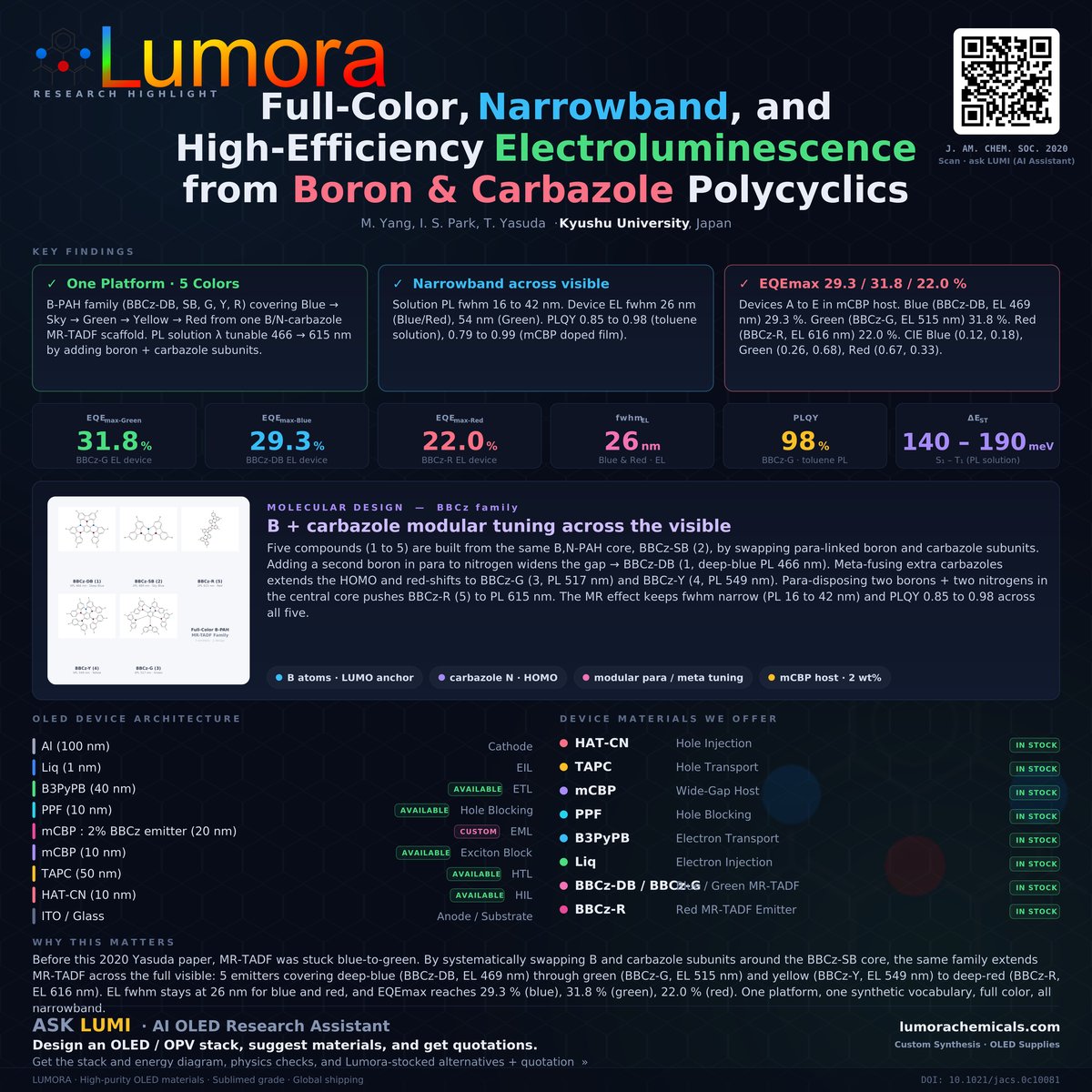
For the first time, a single family of MR-TADF emitters delivers full-color narrowband electroluminescence, from deep-blue to deep-red
Yang, Park, and Yasuda, J. Am. Chem. Soc. 2020, 142, 19468-19472, "Full-Color, Narrowband, and High-Efficiency Electroluminescence from Boron and Carbazole Embedded Polycyclic Heteroaromatics"
At LUMORA CHEMICALS, we spotlight the scientific breakthroughs that shape the OLED materials landscape. This landmark 2020 JACS communication by Minlang Yang, In Seob Park, and Prof. Takuma Yasuda (Kyushu University, INAMORI Frontier Research Center) introduces the first full-color MR-TADF emitter family, extending narrowband TADF emission from the blue-green region all the way to deep red for the very first time and establishing a modular molecular design platform capable of covering the entire visible spectrum with record OLED performance.
The Challenge: Extending MR-TADF Beyond Blue-Green
Prior to this work, MR-TADF emitters were fundamentally constrained to the blue-to-green spectral window. The multiple resonance (MR) effect, driven by the opposite resonance of boron and nitrogen atoms, inherently produces wide HOMO-LUMO gaps, making it extremely difficult to red-shift emission into yellow, orange, and red regions while retaining TADF characteristics and narrowband emission. Conventional red-shifting strategies (extending conjugation or increasing D-A character) typically broaden the emission spectrum and compromise the very color purity that defines MR-TADF. The absence of a viable red MR-TADF emitter was the critical gap preventing this material class from serving as a universal platform for full-color display applications.
The Breakthrough: Modular Boron-Carbazole B, N-PAH Design
Yang et al. introduced a versatile new class of boron- and carbazole-embedded polycyclic aromatic hydrocarbons (B, N-PAHs) by combining electron-accepting tricoordinate boron centers with electron-donating carbazole (BCz) subunits within a rigid fused PAH skeleton. Starting from a DABNA-analogue core, emission color was systematically modulated by varying the position and number of boron and nitrogen atoms in the pi-core:
Para B-N-N arrangement: reduces donor/acceptor strength > blue-shifted emission (compounds 1, 2)
Para B-N-B and N-N-N arrangements: enhance donor/acceptor strength > progressively red-shifted emission (compounds 3, 4, 5)
This strategy achieved systematic color-tuning of narrowband MR-TADF emission from deep-blue (466 nm) through sky-blue (489 nm), green (517 nm), yellow (549 nm), to deep-red (615 nm) all synthesized in two to three steps from commercially available materials with excellent thermal stability (Td = 409-533°C).
Target Molecules: IUPAC Names & Identifiers
Key Device & Photophysical Results
- PL FWHM: 16-42 nm across all five colors, MR-characteristic narrowband emission maintained from blue to red
- PLQY: Phi = 85-98% in toluene; 79-99% in mCBP doped films
- Radiative rate kr: Exceeds 10⁸ s⁻¹ for compounds 1, 2, and 5, highest among all reported TADF emitters
- OLED EQE (Blue, Device A): 29.3% max EL at 469 nm, FWHM 27 nm, CIE (0.12, 0.18)
- OLED EQE (Green, Device C): 31.8% max EL at 515 nm, FWHM 54 nm, CIE (0.26, 0.68)
- OLED EQE (Red, Device E): 22.0% max EL at 616 nm, FWHM 26 nm, CIE (0.67, 0.33)
Why This Matters for OLED Material Supply
This paper establishes the BBCz B, N-PAH series as the first MR-TADF platform delivering BT.2020-compatible primary colors blue (0.12, 0.18), green (0.26, 0.68), and red (0.67, 0.33), all with narrowband emission and EQEs above 22%. The device stack (ITO / HAT-CN / TAPC / mCBP / BBCz:mCBP / PPF / B3PyPB / Liq / Al) introduces a complete set of ancillary materials: HAT-CN (hole injection), TAPC (hole transport), PPF (exciton blocker), and B3PyPB (electron transport). LUMORA CHEMICALS supplies the complete BBCz-series emitters, along with all supporting device-stack materials, to accelerate your research and manufacturing.
Reference: Yang, M.; Park, I. S.; Yasuda, T. J. Am. Chem. Soc. 2020, 142, 19468-19472. DOI: 10.1021/jacs.0c10081
Compound
IUPAC / Systematic Name
Formula / MW
Color / λem (nm)
1 (BBCz-DB)
3,9-Bis(3,6-di-tert-butylcarbazol-9-yl)-5,9-dihydro-5,9-diaza-13b-boranaphtho[3,2,1-de]anthracene
C₅₀H₅₈B₂N₄MW: ~756 g/mol
Deep Blue / 466 nm
2 (BBCz-SB)
9-(3,6-Di-tert-butylcarbazol-9-yl)-5,9-dihydro-5,9-diaza-13b-boranaphtho[3,2,1-de]anthracene
C₃₆H₃₃BN₂MW: ~548 g/mol
Sky Blue / 489 nm
3 (BBCz-G)
Extended triaza-monoboron B, N-PAH with three 3,6-di-tBu-carbazole units at para and meta positions
C66H72BN3MW: ~944 g/mol
Green / 517 nm
4 (BBCz-Y)
Extended tetraaza-diboron B, N-PAH with four BCz units; V-shaped crystal conformation
C₇₂H₈₂BN₃MW: ~1032 g/mol
Yellow / 549 nm
5 (BBCz-R)
Large 17-ring-fused bis-boron tetracarbazole B, N-PAH with helical-twist cove regions
C₈₈H₉₆B₂N₄MW: ~1260 g/mol
Deep Red / 615 nm
R&D and pilot quantities
We supply the key materials from this study in high-purity sublimed grades, from grams to kilograms, shipped worldwide.
Visit LUMORA →Kilogram to production, and custom MR-TADF
For large-scale supply, new emitter synthesis, and CRDMO support, work with LAMKO directly. Scope your project in the LUMI workspace, or send a partnership request.
Open LUMI workspace →Partner with us