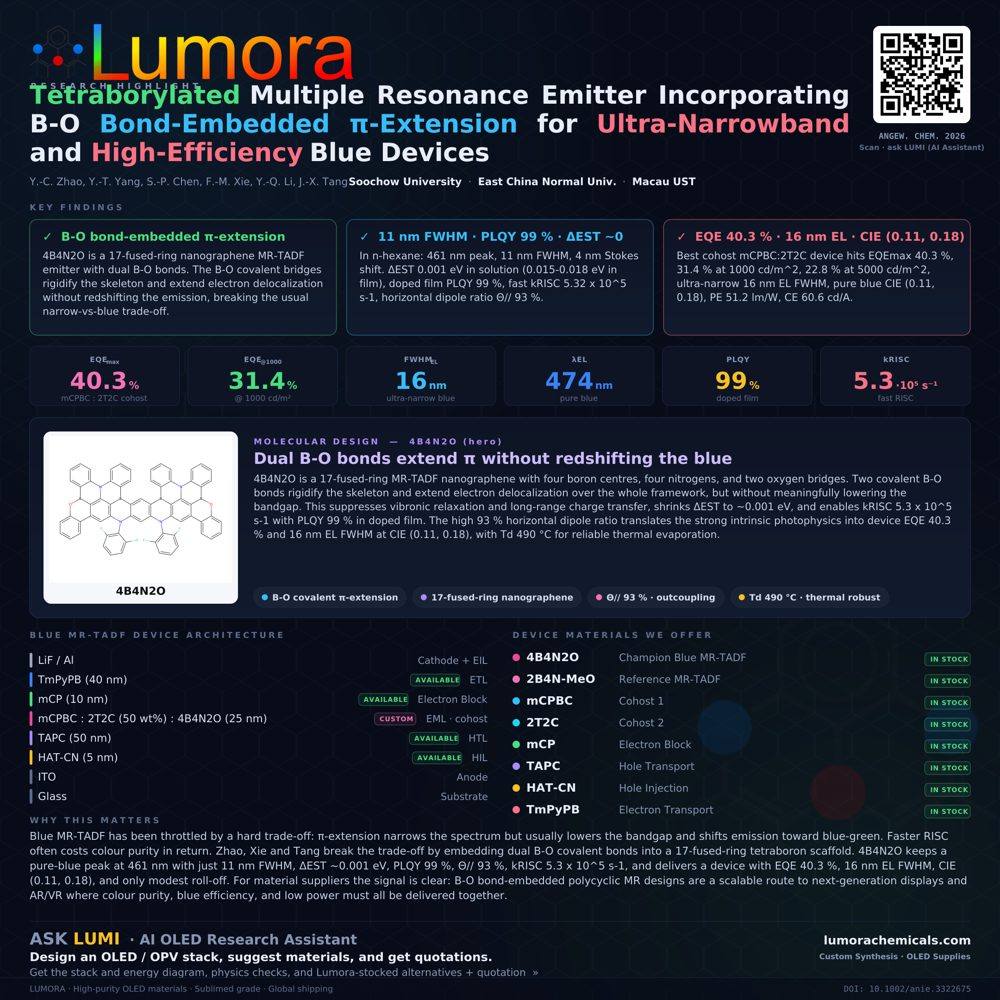
Zhao, Yang, Chen, Xie, Li, and Tang, Angewandte Chemie International Edition, 2026 — "Tetraborylated Multiple Resonance Emitter Incorporating B–O Bond-Embedded π-Extension for Ultra-Narrowband and High-Efficiency Blue Devices"
At LUMORA CHEMICALS, we closely track blue MR-TADF development because the commercial challenge is no longer just achieving a narrow spectrum or a high EQE independently, but reaching both together while keeping roll-off low at practical brightness. This 2026 Angewandte Chemie paper from Yi-Cheng Zhao and co-workers is especially important because it shows a molecular design strategy that addresses all three simultaneously. By embedding dual B–O covalent bonds into a tetraboron nanographene framework, the authors created a blue MR-TADF emitter that is not only exceptionally narrowband but also highly efficient and remarkably stable against roll-off.
The Problem: Narrower Blue MR-TADF Emitters Often Sacrifice Either Color or Exciton Dynamics
For blue MR-TADF emitters, conventional π-extension can narrow the emission spectrum, but it usually lowers the bandgap and redshifts the emission toward blue-green or green. Other approaches can accelerate reverse intersystem crossing, but often at the cost of broader spectra or weakened color purity. This means that many blue emitters still struggle to combine sub-20 nm bandwidth, high PLQY, fast kRISC, and strong device efficiency at high luminance. The authors set out to solve that trade-off directly through a B–O bond-embedded tetraborylated design.
The Breakthrough: Dual B–O Bond π-Extension Without the Usual Redshift Penalty
The team designed 4B4N2O, a 17-fused-ring tetraboron MR-TADF molecule derived from a reference 2B4N-MeO framework. The dual B–O covalent bonds rigidify the skeleton, suppress long-range charge transfer, and extend electron delocalization over the whole fused framework without meaningfully widening the emission. This reduces vibronic relaxation, shrinks ΔEST to nearly zero, and supports fast RISC while maintaining pure blue output. As a result, the molecule gives both an ultra-narrow spectrum and unusually strong device performance, overcoming a central limitation of earlier blue MR emitters.
Target Molecule: structural highlight
Key Results
- Ultra-narrow solution emission: 4B4N2O emitted in n-hexane at 461 nm with just 11 nm FWHM, and in toluene at 468 nm with 13 nm FWHM and only a 4 nm Stokes shift.
- Near-zero singlet–triplet gap: The molecule showed ΔEST = 0.001 eV in solution and around 0.015–0.018 eV in doped films, enabling highly efficient TADF behavior.
- Fast and efficient excited-state dynamics: The doped film delivered near-unity PLQY of 99%, a high radiative rate, and a fast kRISC of 5.32 × 10⁵ s−1, faster than the 2B4N-MeO reference.
- Thermal robustness: 4B4N2O showed a decomposition temperature of 490 °C, indicating strong thermal stability for vacuum-deposited OLED fabrication.
- Excellent host-based device performance: The best single-host devices already reached 36.5% EQE with mCPBC and 32.9% EQE with 2T2C, both with ultra-narrow blue EL.
- Best cohost OLED: Using an mCPBC:50 wt% 2T2C cohost, the optimized device achieved 40.3% EQEmax, 31.4% EQE at 1000 cd m−2, 22.8% EQE at 5000 cd m−2, and only 16 nm EL FWHM.
- Pure-blue coordinates and efficiency: The optimized OLED emitted at 474 nm with CIE (0.11, 0.18), PEmax of 51.2 lm W−1, and CEmax of 60.6 cd A−1.
- Orientation advantage: A very high horizontal dipole ratio of 93% helped translate the strong intrinsic photophysics into top-tier device efficiency.
Why This Matters for OLED Material Supply
This paper is important because it shows a realistic path to high-color-purity blue OLEDs without relying on energy-wasting optical filtering or sacrificing high-brightness performance. The B–O bond-embedded tetraboron concept expands the MR-TADF design toolbox by demonstrating that π-extension can be used to narrow spectra and accelerate RISC at the same time, rather than forcing a trade-off between them. For OLED materials suppliers, that makes this type of scaffold highly attractive for next-generation display and AR/VR applications, where blue efficiency, color purity, and low power consumption must all be delivered together.
Key Compounds & IUPAC Names
4B4N2O
17-fused-ring tetraboron MR-TADF emitter with dual B–O bond-embedded π-extension
R&D and pilot quantities
We supply the key materials from this study in high-purity sublimed grades, from grams to kilograms, shipped worldwide.
Visit LUMORA →Kilogram to production, and custom synthesis
For large-scale supply, new emitter synthesis, and CRDMO support, work with LAMKO directly. Scope your project in the LUMI workspace, or send a partnership request.
Open LUMI workspace →Partner with us